

Backup and storage admin jobs in the AI era
Part of a 14-post series on IT jobs in the AI era. Start with the overview: IT job market 2022 to 2026: openings fell, jobs held.
In the six months to October 2026, UK employers posted 13 permanent job ads for a backup engineer and 33 for a storage engineer. Two years earlier the counts were 28 and 66 [IT Jobs Watch, 2026]. I spent fifteen years in storage and backup, in presales and product management at HP and HPE, Dell, Lenovo, NetApp and Catalogic, so these are the people I sold to and worked next to. The restore work has not gone away, because ransomware keeps it busy. What changed is who employs the people doing it, what their job is called and what the ad asks for. AI is the newest of the forces behind that change, and so far it is the smallest.
The admin layer shrank and the design layer grew
US statistics have no separate line for backup or storage administrators; they are counted inside the broader admin occupations. Those occupations split between 2022 and 2025.
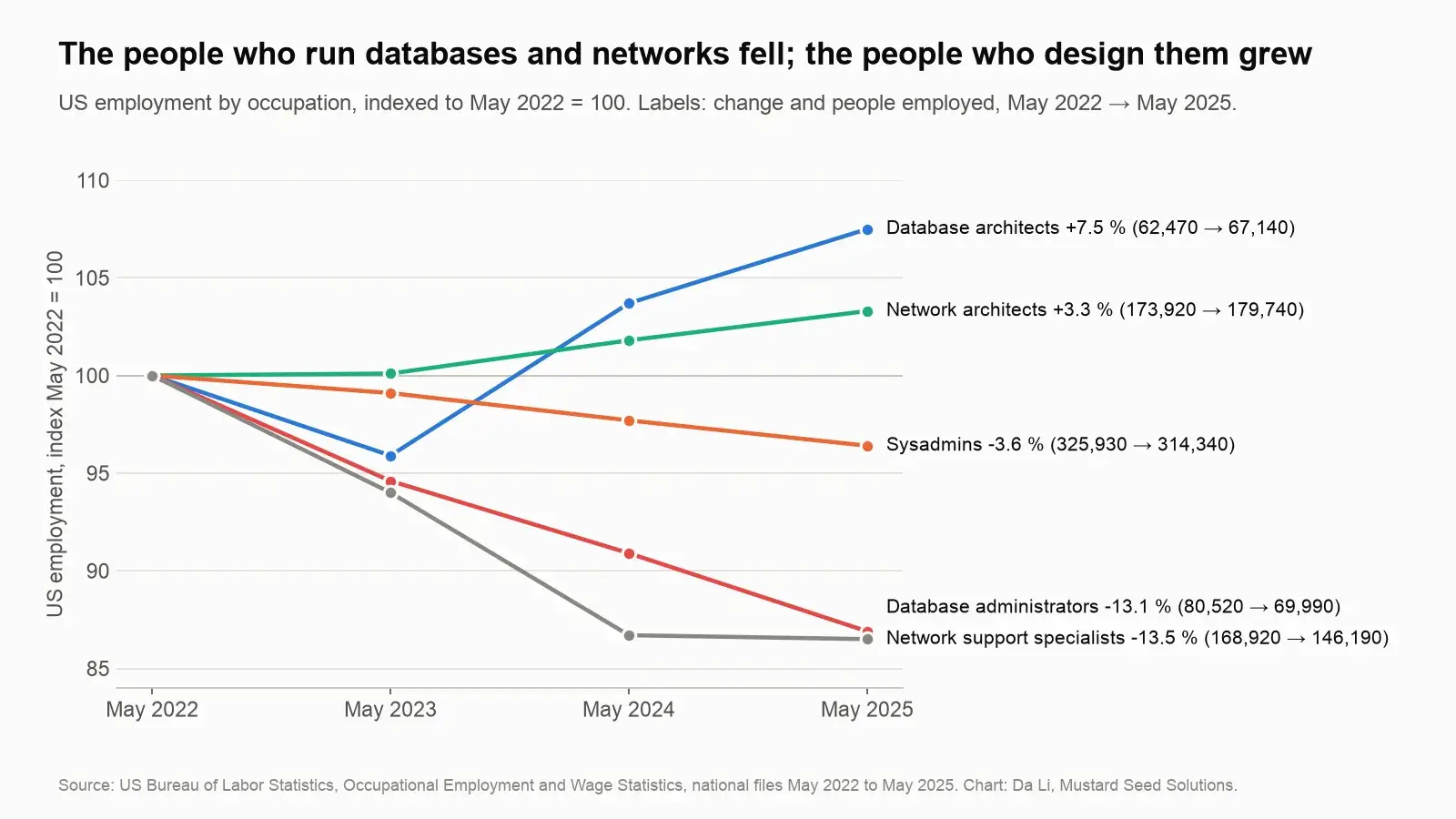 US employment by occupation, indexed to May 2022 = 100. Source: BLS Occupational Employment and Wage Statistics, national files May 2022 to May 2025.
Database administrators fell from 80,520 to 69,990, down 13.1 %. Network support specialists fell 13.5 % and systems administrators 3.6 %. Database architects grew 7.5 % and network architects 3.3 % [BLS OEWS, 2025]. Pay tells the same story. The median database administrator earned $99,890 in 2022 and $104,620 in 2025, a 4.7 % raise against 10.1 % inflation, so a real cut of 4.8 % [BLS OEWS, 2025]. Fewer people run the systems, and the ones who stay have not been paid more for it.
Fewer ads say "backup", and most of them come from outsourcers
In UK ads, backup and storage titles lost half their volume while platform titles more than doubled.
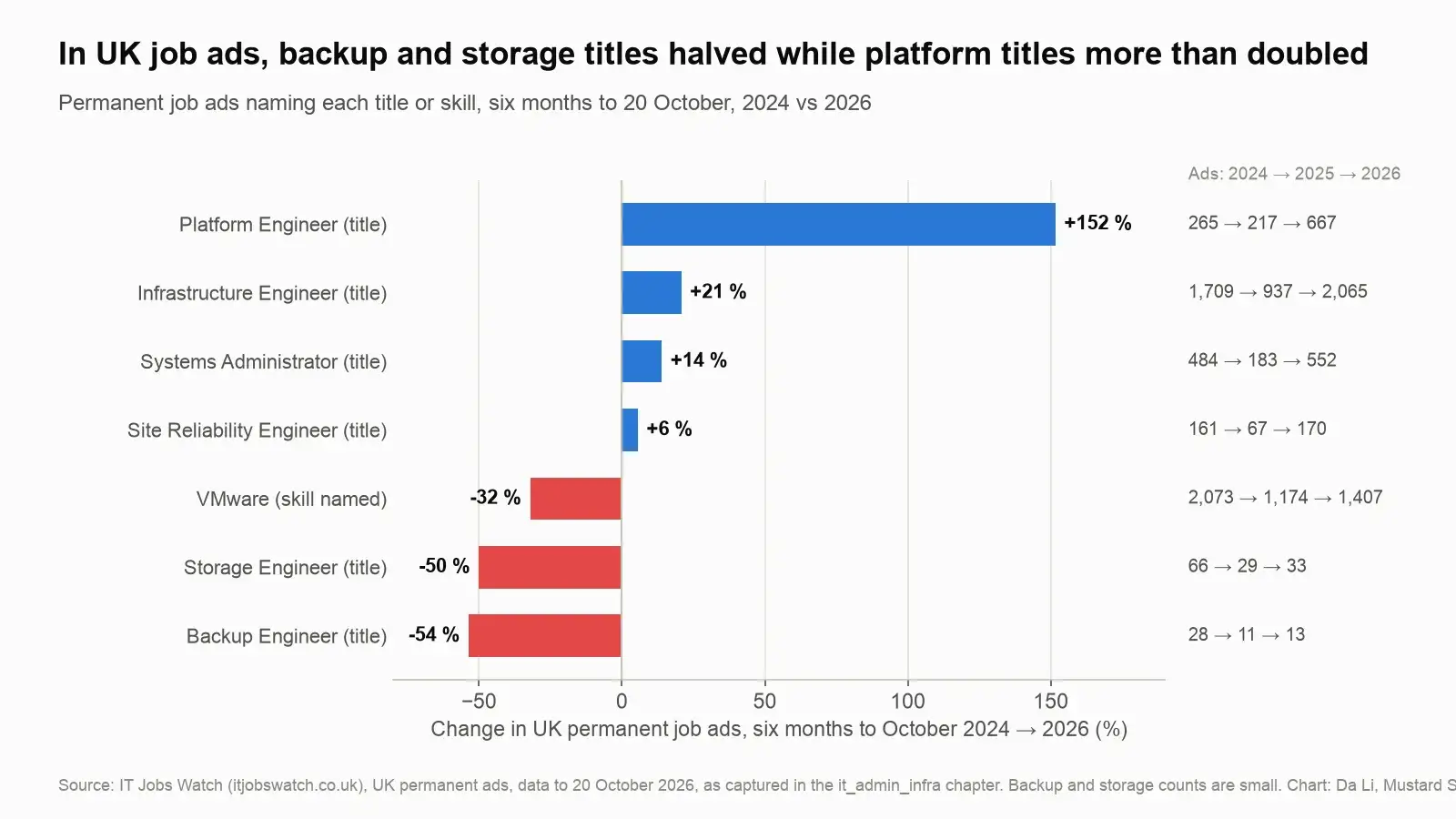 Change in UK permanent job ads, six months to October 2024 vs 2026. Source: IT Jobs Watch.
"Platform Engineer" ads went from 265 to 667 and "Infrastructure Engineer" from 1,709 to 2,065, while ads naming VMware fell by a third [IT Jobs Watch, 2026]. The plain "Backup Administrator" title had one UK ad in six months, and none in the same window of 2024 or 2025 [IT Jobs Watch, 2026].
Tech companies hardly advertise these jobs at all. On the Greenhouse, Lever and Ashby boards in our corpus, I found no backup or storage titles among 9,720 job pages from late 2022 and early 2023, and four among 42,994 pages from 2026. "DevOps engineer" titles fell from 10.9 to 2.5 per 1,000 pages over the same period while "platform engineer" rose from 2.6 to 3.8 [company job pages, 2026]. One vendor shows the renaming in its own job titles. Pure Storage advertised "Modern Data Protection Specialist" in late 2022 and early 2023. In 2026 its matching title was "Consulting Field Solutions Architect, Cyber Resilience" [company job pages, 2026].
The jobs went to the people who run other people's infrastructure. LinkedIn searches for data backup roles across Europe in late August and September 2026 returned 29 distinct backup and storage titles. Twenty-three were posted by IT services firms, outsourcers or recruiters such as Cognizant, CGI, DXC, Fujitsu, Inetum, Sopra Steria and Wipro. Only six came from companies running the systems for themselves, among them Visa, OpenText and Arla Foods. Nine of the 29 titles still said "administrator" [own LinkedIn sample, 2026]. In my experience that matches where the work moved: enterprises kept a storage architect and handed the daily backup jobs and the tape rotation to a service contract.
Poland is a good example. Wipro hired a backup administrator in Gdańsk, Arla Foods two VMware and Veeam backup specialists in the same city, and Sopra Steria a Linux and storage administrator in Katowice [own LinkedIn sample, 2026]. Rates there kept up less well. Hays Poland's most frequently expected B2B rate for a storage engineer with five or more years of experience rose from 140 to 160 PLN an hour net between its 2022 and 2025 contracting reports, about 14 %, while prices in Poland rose 18.7 % [Hays Poland, 2025; Eurostat HICP, 2025].
VMware and ransomware moved these jobs more than AI did
Broadcom closed its VMware deal on 22 November 2023 and stopped selling perpetual licences on 11 December [Techzine, 2024]. In the UK, ads naming VMware fell from 2,073 to 1,407 between the six months to October 2024 and the same window of 2026 [IT Jobs Watch, 2026]. In a January 2026 survey of 302 large North American firms, 86 % were reducing their VMware footprint and 4 % had left it entirely [CloudBolt, 2026]. Every one of those exits is a migration project, and in backup the migration includes re-protecting every workload on the new platform. That work keeps people busy for a year or two but does not create a permanent seat.
Ransomware pulled the other way. In Veeam's 2025 survey of 1,300 organisations, 69 % had been attacked in the previous year. Only 10 % recovered more than 90 % of their data, and 57 % recovered less than half [Veeam, 2025]. That is the strongest argument a backup person has in a budget meeting. The people themselves are restless, though. In Veeam's 2024 survey, 47 % of data protection staff planned to look for a job with another employer, and the top reason was a lack of new skills to learn [Virtualization Review, 2024].
What the ads ask for, and what the vendors sell
Infrastructure job pages now name storage hardware less and recovery, availability and audit more.
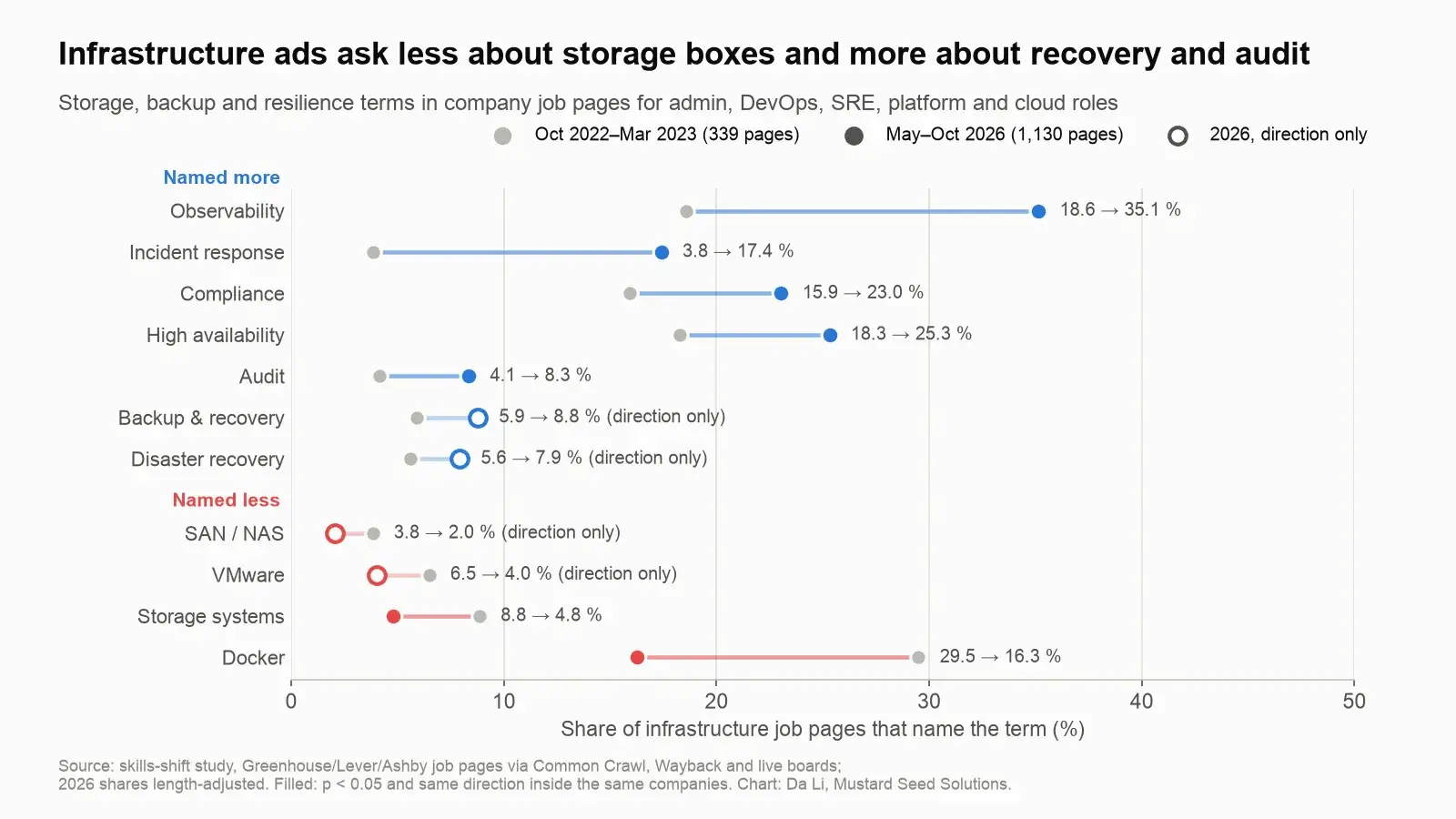 Share of infrastructure job pages naming each term, October 2022 to March 2023 vs May to October 2026. Source: ai-era-it-jobs study of Greenhouse, Lever and Ashby job pages.
"Storage systems" fell from 8.8 % to 4.8 % of pages. High availability rose from 18.3 % to 25.3 %, compliance from 15.9 % to 23.0 % and audit from 4.1 % to 8.3 %. Backup and recovery went from 5.9 % to 8.8 %, a rise too small to be certain of [ai-era-it-jobs study, 2026]. The specialist ads are more traditional still. The 13 UK backup engineer ads most often named NetBackup, security clearance, PowerShell, SAN, Veeam and NetApp. No AI skill appears among the ten skills they named most often [IT Jobs Watch, 2026].
The vendors have moved faster than the job ads. Cohesity put a language model on top of backup data in February 2024 [Cohesity, 2024]. Rubrik launched Agent Rewind in August 2025 to undo actions taken by AI agents [Rubrik, 2025]. In 2026 Commvault added tools to prepare backup data for AI, monitor agents and recover agent configurations [Blocks & Files, 2026]. Most of these features protect AI agents and the data they touch, and the job ads have not caught up with them. The analysts are careful too. Gartner expects AI agents inside 60 % of IT operations tools by 2028, but only 15 % of agents fully autonomous within seven years [Gartner, 2025]. Admins report the same caution: in Action1's 2026 survey, 16 % had automated patching against the 67 % who expected to by now [Action1, 2026]. More change also means more to roll back. DORA's 2024 research found that each 25 % increase in AI adoption went with a 7.2 % drop in delivery stability [DORA, 2024], and every unstable change is a possible restore.
What this means if you are a backup or storage admin
- Move your title toward recovery and resilience. "Backup administrator" is close to gone from UK ads, while job pages naming high availability, compliance and audit grew. If you run restores, call yourself a data protection or resilience engineer and show the recovery times you achieved.
- Choose your employer type deliberately. Most backup and storage seats in Europe now sit at outsourcers and service providers. Use those firms for breadth across NetBackup, Veeam, NetApp and cloud object storage, then move to an end user as the architect who owns the recovery plan.
- Get ahead of the vendors' AI features. Learn how your backup product protects and rolls back agent-made changes, because the first time an agent deletes the wrong volume, the person who can restore it in an hour becomes the most valuable admin on the team.
Sources
- US Bureau of Labor Statistics, Occupational Employment and Wage Statistics, national files May 2022 to May 2025 (SOC 15-1231, 15-1241, 15-1242, 15-1243, 15-1244), employment and median pay. https://www.bls.gov/oes/special-requests/oesm25nat.zip
- US Bureau of Labor Statistics, CPI-U via FRED, May 2022 to May 2025 (10.1 % inflation, as computed in the ai-era-it-jobs report). https://fred.stlouisfed.org/series/CPIAUCSL
- IT Jobs Watch, UK permanent job ads, six months to 20 October 2024, 2025 and 2026: Backup Engineer, Storage Engineer, Backup Administrator, VMware, Systems Administrator, Site Reliability Engineer, Infrastructure Engineer, Platform Engineer. https://www.itjobswatch.co.uk/jobs/uk/backup%20engineer.do, https://www.itjobswatch.co.uk/jobs/uk/storage%20engineer.do, https://www.itjobswatch.co.uk/jobs/uk/backup%20administrator.do, https://www.itjobswatch.co.uk/jobs/uk/vmware.do, https://www.itjobswatch.co.uk/jobs/uk/platform%20engineer.do
- Company job pages on Greenhouse, Lever and Ashby boards, October 2022 to March 2023 (Common Crawl, Wayback Machine) and May to October 2026 (live boards), the ai-era-it-jobs study; title counts.
- Own sample of European job postings from LinkedIn, search "data backup", August and September 2026; title list and poster type.
- Hays Poland, "Raport płacowy IT Contracting" 2022 and 2025, on-premises operations table, hourly net B2B rates. https://image.email.hays.com/lib/fe4515707564057c751477/m/5/9a1d7d71-193d-430d-bbf2-335285e3ea4a.pdf and https://image.email.hays.com/lib/fe4515707564057c751477/m/1/b7044312-4e84-48a2-933a-f154c78a1685.pdf
- Eurostat, harmonised index of consumer prices for Poland (CP0000PLM086NEST via FRED), January 2022 to January 2025. https://fred.stlouisfed.org/series/CP0000PLM086NEST
- Techzine, "Broadcom ends VMware partner program" (acquisition close 22 November 2023, perpetual licences ended 11 December 2023). https://www.techzine.eu/news/infrastructure/133131/broadcom-ends-vmware-partner-program
- CloudBolt, "New CloudBolt research: 86% of companies actively reducing their VMware footprint", 17 February 2026. https://www.cloudbolt.io/company/news/new-cloudbolt-research-86-of-companies-actively-reducing-their-vmware-footprint/
- Veeam, "Veeam report finds close to 70% of organizations still under cyber-attack despite improved defenses" (2025 Ransomware Trends report, 1,300 organisations), 23 April 2025. https://www.veeam.com/company/press-release/veeam-report-finds-close-to-70-percent-of-organizations-still-under-cyber-attack-despite-improved-defenses.html
- Virtualization Review on Veeam's 2024 Data Protection Trends report, 22 January 2024. https://virtualizationreview.com/articles/2024/01/22/data-protection-report.aspx
- Skills-shift study: infrastructure job pages, October 2022 to March 2023 vs May to October 2026, AI terms removed before counting.
- Cohesity, "Cohesity Gaia pioneers AI-powered insights from on-premises backup data", 18 March 2025 (Gaia first launched February 2024). https://www.businesswire.com/news/home/20250318819798/en/
- Rubrik, "Rubrik unveils Agent Rewind for when AI agents go awry", 12 August 2025. https://www.rubrik.com/company/newsroom/press-releases/25/rubrik-unveils-agent-rewind-for-when-ai-agents-go-awry
- Blocks & Files, Commvault AI tools for data preparation, agent oversight and resilience (14 April 2026) and agent configuration recovery (2 October 2026). https://www.blocksandfiles.com/ai-ml/2026/04/14/commvault-announces-trio-of-ai-tools-for-data-prep-agent-oversight-resilience/5217385 and https://www.blocksandfiles.com/ai-ml/2026/10/02/commvault-looking-after-claude-agent-configs/5300884
- Gartner, "Gartner IT Infrastructure, Operations & Cloud Strategies Conference 2025 London: Day 1 Highlights", 17 November 2025. https://www.gartner.com/en/newsroom/press-releases/2025-11-17-gartner-it-infrastructure-operations-and-cloud-strategies-conference-2025-london-day-1-highlights
- Action1, "Action1 Survey Finds AI Adoption Falls Far Short of Sysadmin Expectations" (2026 AI Impact on Sysadmins), 30 July 2026. https://www.action1.com/company-news/action1-survey-finds-ai-adoption-falls-far-short-of-sysadmin-expectations/
- DORA (Google Cloud), Accelerate State of DevOps Report 2024, October 2024. https://dora.dev/research/2024/dora-report/2024-dora-accelerate-state-of-devops-report.pdf