

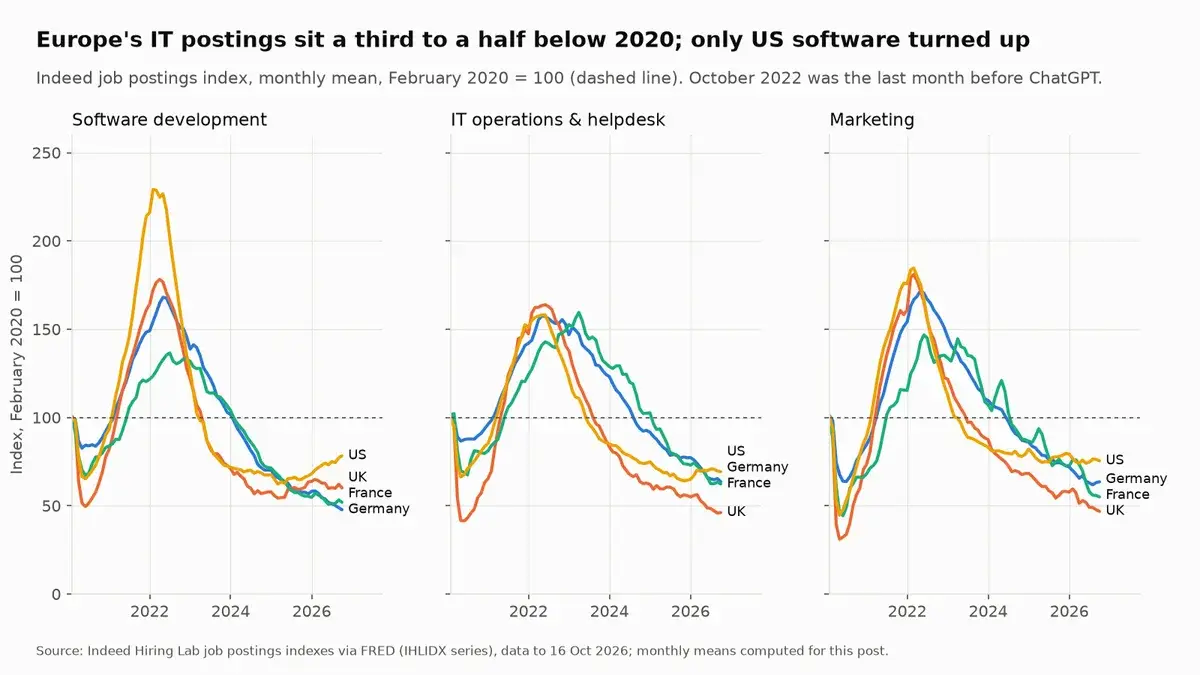
The IT job market 2022→2026: openings collapsed, jobs mostly didn't
This is the first of 14 posts on IT jobs in the AI era, built from job ads, employment statistics and salary data for 2022 to 2026. A new one follows every two days.
German software developer job postings stand at 49 % of their February 2020 level, and UK IT operations and helpdesk postings at 46 %. If you read only the job boards, IT work in Europe looks like it is disappearing. The employment data says otherwise. In the US, where the statistics count people in jobs, 12 of the 17 IT and go-to-market occupations I track employed more people in May 2025 than in May 2022. Software developers alone went from 1.53 million to 1.69 million. This first post of the series explains why both numbers hold, and what that means for anyone looking for IT work in 2026.
Openings: Europe is still falling, the US has turned
Indeed publishes a daily index of job postings by occupation, set to 100 in February 2020. In October 2022, the month before ChatGPT launched, German software postings stood at 151 and US software postings at 161. By September 2026 the German index was at 49, the UK at 62, France at 53 and the US at 77 [Indeed Hiring Lab via FRED, 2026]. IT operations and helpdesk fell harder: the UK went from 153 to 46. Marketing in Germany went from 158 to 63, in the UK from 136 to 48. Across software, IT operations, marketing and sales in Germany, the UK and France, postings now sit between 46 % and 91 % of their pre-pandemic level.
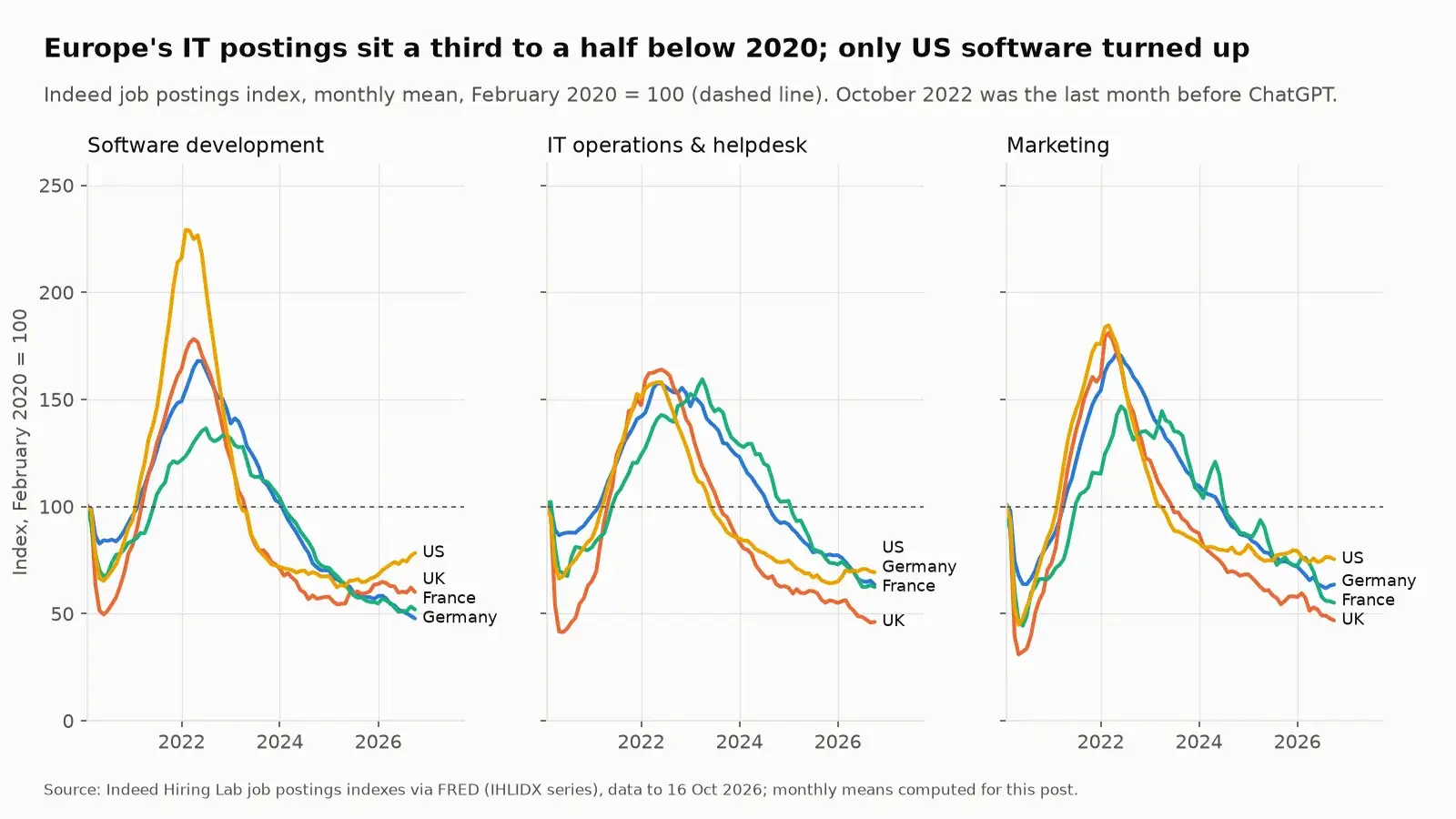 Indeed job postings index, monthly mean, February 2020 = 100. Source: Indeed Hiring Lab via FRED, data to 16 October 2026.
Official vacancy statistics show the same fall. Eurostat's job vacancy rate for information and communication fell from 5.7 % to 2.5 % in Germany, from 2.8 % to 1.4 % in Poland and from 3.9 % to 2.2 % across the EU between late 2022 and late 2025 [Eurostat, 2026]. In the US, information-sector job openings fell from 215,000 in October 2022 to 123,000 in August 2026 [BLS JOLTS, 2026].
Be careful about blaming all of this on AI. Most of the 2023 fall was the end of pandemic over-hiring and the interest-rate cycle. The US software index peaked at 229 in February 2022 and was already down to 161 by October 2022, before ChatGPT existed. It reached 75 a year later, before any tool could do a junior developer's work [Indeed Hiring Lab via FRED, 2026].
After 2024 the two sides of the Atlantic split. The US software index bottomed at 61 in May 2025 and rose 19 % in the twelve months to September 2026. Germany's fell 16 % over the same twelve months and hit a new low in October 2026 [Indeed Hiring Lab via FRED, 2026]. Employers in both countries had the same tools in the same quarter and moved in opposite directions, which tells me Europe is going through the same adjustment later.
Jobs: most people kept their seats
Postings measure intent to hire. Employment measures people in jobs. The US Bureau of Labor Statistics counts employment by occupation every May, and its numbers tell a calmer story [BLS OEWS, 2025].
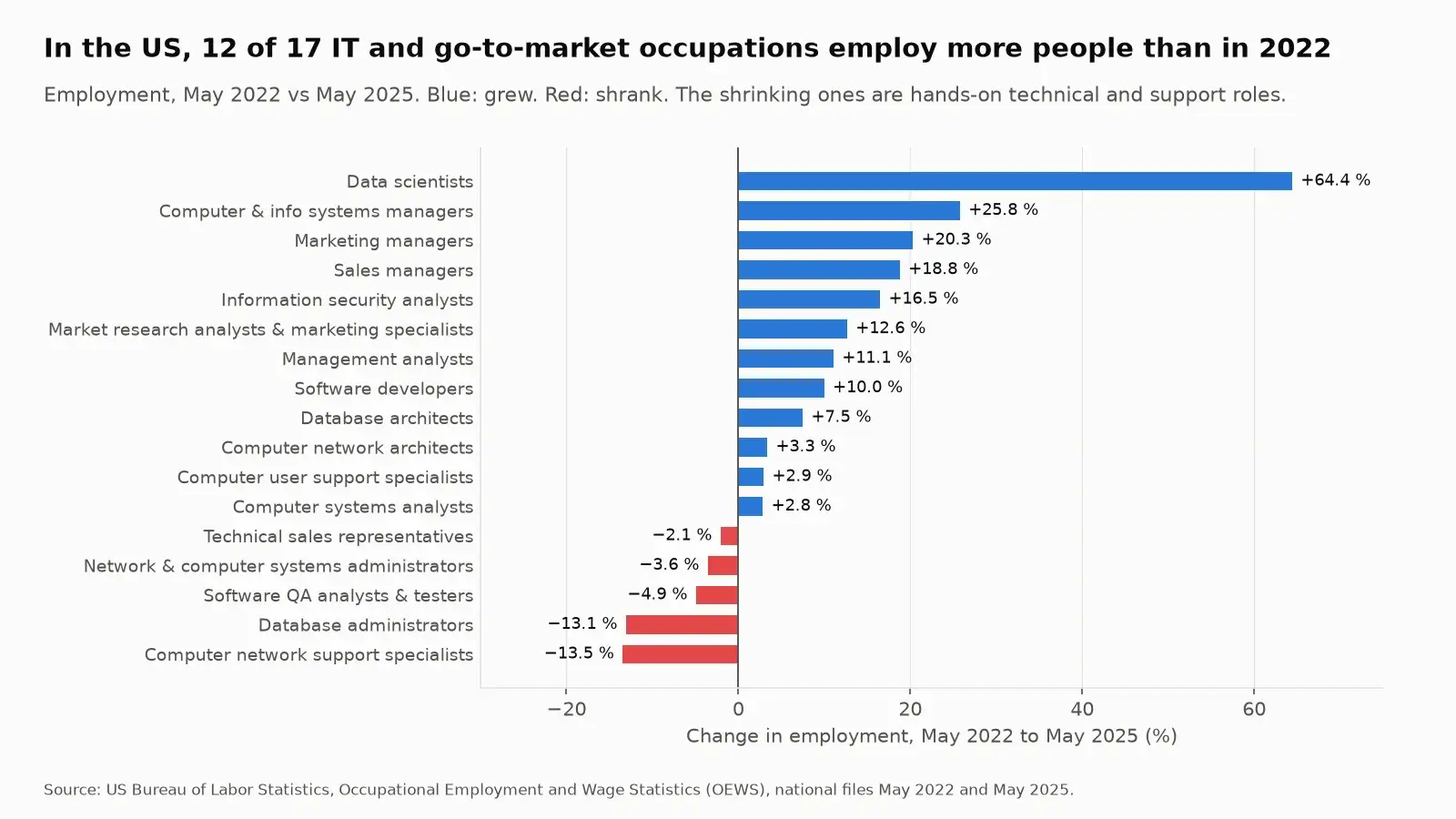 Change in US employment, May 2022 to May 2025, 17 IT and go-to-market occupations. Source: BLS Occupational Employment and Wage Statistics.
Twelve of the 17 occupations grew. Software developers rose 10 %. Computer and information systems managers went from 533,220 to 670,570, up 26 %. Information security analysts grew 16.5 % and data scientists 64 %. The five that shrank share a profile. Computer network support specialists fell 13.5 %, database administrators 13.1 %, software testers 4.9 %, systems administrators 3.6 % and technical sales reps 2.1 %. These are the hands-on layers, where a large share of the work is reading, checking and routine fixing, while the layers that decide and manage grew.
Europe has no comparable count by occupation in the data I could collect, so we know more about American database administrators than about German ones. The nearest European measure is Eurostat's count of ICT specialists, and it rose. The EU had 9.37 million in 2022 and 10.45 million in 2025. Germany went from 2.07 million to 2.32 million. Poland grew fastest, from 644,600 to 778,800, up 21 % [Eurostat, 2026]. And the share of German firms recruiting ICT specialists rose from 11.0 % in 2022 to 12.0 % in 2024 while German public postings collapsed [Eurostat, 2025]. German firms kept hiring and advertised less of it.
Why both are true: a frozen market
The US information-sector hires rate fell from 3.4 % of employment in October 2022 to 1.6 % in August 2026. Quits barely moved, from 1.0 % to 1.1 % [BLS JOLTS, 2026]. Low hiring and low quitting describe a market where nobody moves: people who have a job keep it, fewer seats come free, fewer ads go up, and each ad that does go up gets more applicants.
Anyone who has run a team through a hiring freeze knows the pattern. You stop backfilling and keep the people you have. The ads disappear months before the org chart changes, and when it finally does change, it usually changes through attrition.
The cost of a frozen market lands on everyone trying to get in: graduates, career changers, people coming back from a layoff, people relocating. That is the subject of the next post in this series, and the numbers there are worse in Europe than in the US.
Where AI shows up: in the ad, not yet in the headcount
AI changed the job advertisement much faster than it changed employment. In the monthly "Who is hiring?" threads on Hacker News, a start-up-heavy but long-running sample, the share of posts naming any AI term or tool went from 20.7 % in late 2022 to 61.2 % in 2026 [Hacker News via Algolia, 2026].
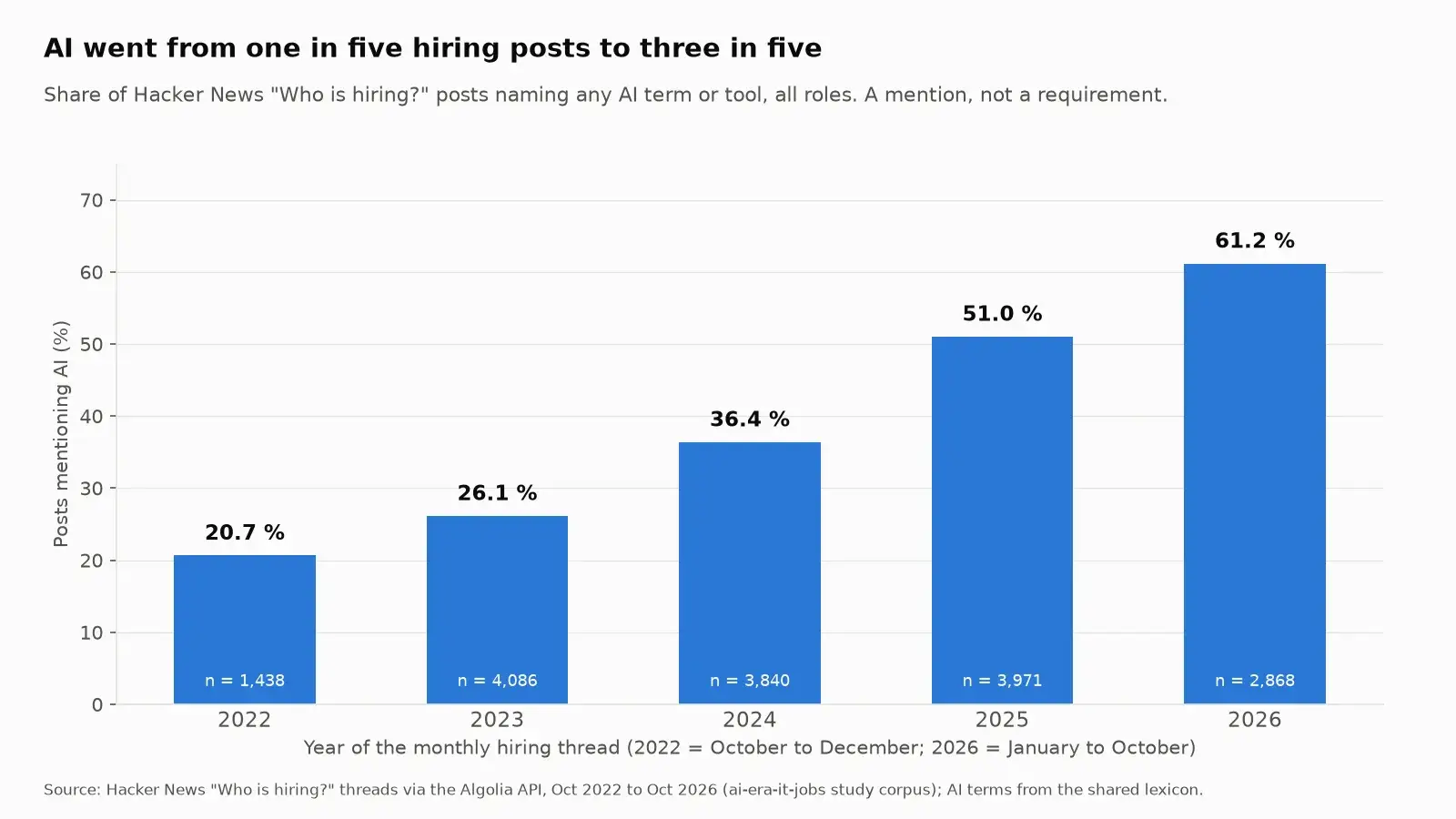 Share of Hacker News "Who is hiring?" posts mentioning AI, by year. Source: Hacker News via the Algolia API, October 2022 to October 2026.
A mention can be company boilerplate, so I also counted only the requirements section of company job pages: the part under "What you'll need". There, AI went from between 1 % and 9 % of postings in late 2022 and early 2023 to between 29 % and 57 % in 2026, depending on the role family [company job pages, Greenhouse/Lever/Ashby, 2026]. Across the whole market the levels are lower: 4.2 % of all US postings mentioned AI in December 2025 [Indeed Hiring Lab, 2026], and 9.4 % of UK postings in June 2026 [Indeed Hiring Lab UK, 2026].
Layoff announcements moved too. Employers cited AI for 4.5 % of announced US job cuts in 2025 and for 21 % from January to September 2026 [Challenger, Gray & Christmas, 2026]. These are the reasons employers give, which may differ from the real cause, but the stated share more than quadrupled in a year.
My reading: so far AI has changed who gets hired and what the job ad asks for much more than it has changed how many people are employed. If the employment effect comes, the first place to see it is the BLS May 2026 count, published in spring 2027. I will check these numbers against it.
What this means if you are looking for an IT job in Europe
- Check a target company's headcount trend before its job ads. A company that grew its LinkedIn headcount over the last twelve months but posts few roles is hiring through referrals. Put those companies on your list first and find the person who would be your manager.
- If you work in network support, database administration, testing or systems administration, plan a move up a layer. Those are the US occupations that lost people. Take on the part of the work that decides, such as architecture, security, platform ownership or managing a vendor, before your employer redraws the role.
- Put one measured AI result on your CV. Between 29 % and 57 % of requirement sections now name AI, and a line such as "cut ticket triage from 20 minutes to 5 with an assistant I configured" answers that ask better than a list of tools.
Sources
- Indeed Hiring Lab, job postings indexes by occupation and country (IHLIDXDETPSOFTDEVE, IHLIDXGBTPSOFTDEVE, IHLIDXFRTPSOFTDEVE, IHLIDXUSTPSOFTDEVE and the ITOPHE, MARK and SALE series), via FRED, data to 16 October 2026. https://fred.stlouisfed.org/series/IHLIDXDETPSOFTDEVE
- Eurostat, job vacancy statistics by NACE Rev. 2, section J (jvs_q_nace2), Q4 2022 and Q4 2025. https://ec.europa.eu/eurostat/databrowser/view/jvs_q_nace2/
- Eurostat, ICT specialists in employment (isoc_sks_itspt), 2022 and 2025. https://ec.europa.eu/eurostat/databrowser/view/isoc_sks_itspt/
- Eurostat, enterprises that recruited ICT specialists (isoc_ske_itrcrn2), 2022 and 2024. https://ec.europa.eu/eurostat/databrowser/view/isoc_ske_itrcrn2/
- US Bureau of Labor Statistics, Occupational Employment and Wage Statistics, national files May 2022 and May 2025. https://www.bls.gov/oes/special-requests/oesm25nat.zip
- US Bureau of Labor Statistics, Job Openings and Labor Turnover Survey, information sector (JTS510000000000000JOL, HIR, QUR), October 2022 to August 2026. https://www.bls.gov/jlt/
- Hacker News "Ask HN: Who is hiring?" threads, October 2022 to October 2026, all top-level posts, via the Algolia API. https://hn.algolia.com/api
- Company job pages on Greenhouse, Lever and Ashby boards, October 2022 to March 2023 (Common Crawl, Wayback Machine) and May to October 2026 (live boards); the ai-era-it-jobs study, requirements-section coding in the ai-era-it-jobs report, Table 6.1.
- Indeed Hiring Lab, "January labor market update: jobs mentioning AI are growing amid broader hiring weakness", 22 January 2026. https://hiringlab.indeed.com/2026/01/22/january-labor-market-update-jobs-mentioning-ai-are-growing-amid-broader-hiring-weakness/
- Indeed Hiring Lab UK, "Indeed's 2026 mid-year UK jobs & hiring trends report", 3 August 2026. https://hiringlab.indeed.com/uk/blog/2026/08/03/mid-year-uk-jobs-hiring-trends-report/
- Challenger, Gray & Christmas, monthly job cuts reports, 2025 and January to September 2026. https://www.challengergray.com/blog/category/job-cuts-report/