

Newsletter
Subscribe our newsletter
Get new infrastructure guides, comparison reports, and migration notes in your inbox.
OpenShift Virtualization vs VMware
Updated October 2026
OpenShift Virtualization vs VMware: OpenShift Virtualization suits teams that already run, or are moving to, Kubernetes and want VMs and containers managed through one API. VMware suits traditional VM estates that need the most mature vSAN, NSX and GUI-driven operations. In the VM Platform Ledger, OpenShift Virtualization has the higher Ledger Index (72.0 against 63.9), and VMware leads on capability (93.1 against 83.0).
Scores side by side
Capability and Ledger Index are out of 100. Credibility, commercial risk and lock-in are out of 25, AI is out of 20. For commercial risk and lock-in, lower is better.
| Platform | Ledger Index | Capability | Credibility | Commercial risk | Lock-in | AI |
|---|---|---|---|---|---|---|
| Red Hat OpenShift Virtualization | 72.0 | 83.0 | 18.0 | 11.0 | 11.0 | 14.5 |
| VMware vSphere / VCF | 63.9 | 93.1 | 14.5 | 23 | 15.5 | 15.5 |
Source: VM Platform Ledger 2026. Scorecards: OpenShift Virtualization, VMware.
Behind the capability totals, the Ledger scores ten domains from 0 to 5. OpenShift Virtualization scores 5 for Kubernetes against 4.5 for VMware, and 4.5 for migration-in against 3. VMware scores higher on networking (5 against 4), data protection and disaster recovery (5 against 4), GPU (5 against 3.5), storage (4.5 against 4) and compute (5 against 4.5). OpenShift Virtualization also carries much lower commercial risk, 11.0 against 23.
OpenShift Virtualization (OCP-V)
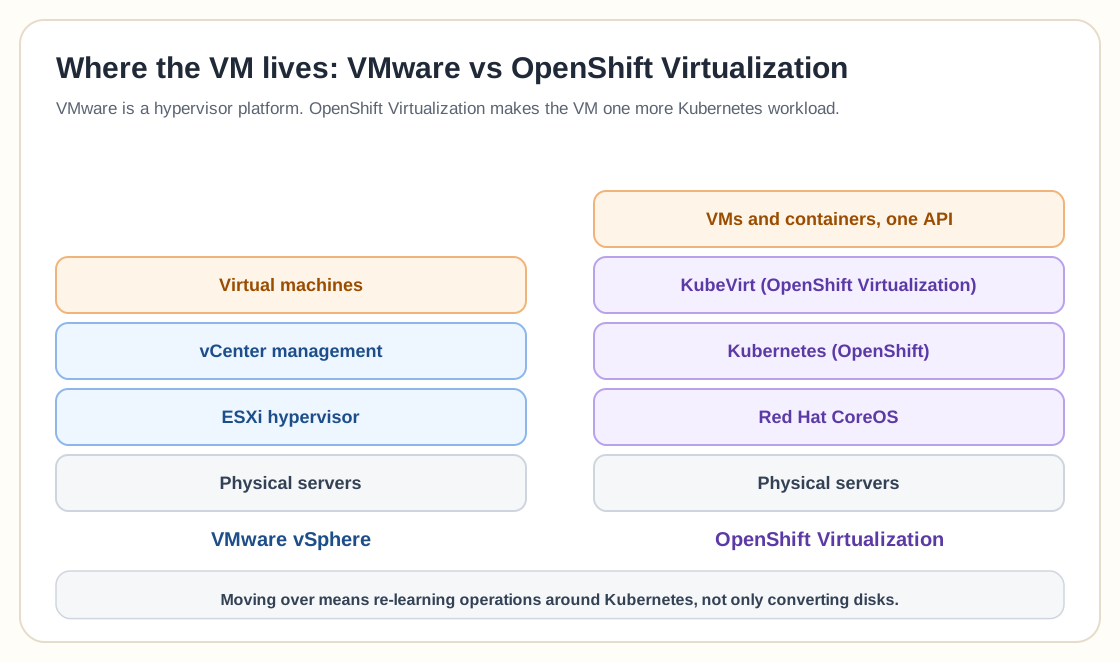
OpenShift Virtualization extends Kubernetes to run and manage virtual machines alongside containers, so one platform orchestrates both across hybrid infrastructure.
VMware vSphere / ESXi
VMware's hypervisor platform remains the capability reference for traditional virtualization, although its licensing and openness have changed under Broadcom.
Feature Comparison
Learn more about OpenShift Virtualization and VMware vSphere official documentation.
Integrates virtualization within Kubernetes (via KubeVirt) and puts workload orchestration ahead of separate hypervisor silos.
Hypervisor-first approach, with virtualization as a distinct management layer and a mature ecosystem of integrations.
Runs VMs as pods inside Kubernetes clusters on bare metal; uses YAML manifests, pipelines and GitOps workflows.
Managed via vCenter; GUI-driven configuration; supports vMotion, HA, DRS, vSAN and NSX.
CI/CD-native with Ansible, Tekton and GitOps pipelines; one automation model for VMs and containers.
REST APIs, Terraform and Ansible across the stack. Kubernetes is available through vSphere Kubernetes Service in VCF 9, but the VM remains the main object.
Red Hat's Migration Toolkit for Virtualization moves VMs from vSphere, with warm migration for powered-on VMs and a phased approach by workload.
Stable for existing workloads; leaving usually needs external tooling, and Broadcom removed the public VDDK download in August 2026.
Growing set of CSI and CNI vendors; integrates with Advanced Cluster Management, Ansible and OpenShift AI.
Very large partner ecosystem across backup, monitoring, storage and networking, and the biggest skills pool.
Subscription per bare-metal node for the VM-only edition, or per core pair for the full container platform. Red Hat raised list prices about 10% in 2024, per the Ledger.
Subscription only, per core, minimum 16 cores per CPU, sold as VVF or VCF bundles. No public price list.
Requires Kubernetes proficiency on top of virtualization skills; YAML- and CLI-driven; higher initial complexity but strong automation.
GUI-driven and admin-friendly; ideal for teams with traditional virtualization expertise.
Licensing: what you actually buy (as of October 2026)
Red Hat sells OpenShift Virtualization Engine as a VM-only edition. One subscription covers one physical bare-metal server regardless of sockets or cores, and it allows unlimited VMs on subscribed hosts. It cannot run containerized application workloads, and Red Hat Enterprise Linux guest entitlements are bought separately. Support is Standard (8x5) or Premium (24x7). If you also want to run containers, the full OpenShift Container Platform is licensed per core pair or per node.
VMware is subscription only and sold per core as vSphere Foundation or Cloud Foundation, with at least 16 cores licensed per CPU, according to Broadcom's June 2026 program documents. A refreshed vSphere Standard has been reported for smaller customers, but we could not find a published edition or price. For an exit plan, factor in the Ledger's lock-in note: VMDK is widely readable, but VMFS and vSAN are not.
Red Hat is running a limited migration promotion that waives the first year of the OpenShift Virtualization subscription on qualifying 3-year agreements that include a Virtualization Migration Assessment, for deals signed by 31 December 2026. Hardware, migration work and training are not covered.
Migrating from VMware to OpenShift Virtualization
Red Hat's Migration Toolkit for Virtualization (MTV) is the supported path. It supports warm migration of powered-on vSphere VMs, and it requires Changed Block Tracking on each VM and disk. A VM can hold up to 28 CBT snapshots, and too many can make a warm migration fail. For Windows guests, the VSS service must be running so that snapshot quiescing works.
Plan the target platform first: bare-metal nodes, storage that provides ReadWriteMany access if you want live migration inside the cluster, and enough Kubernetes skill to operate it. Start with development and test workloads, then move production by application group. The VMware migration report compares the main exit paths and VMware migration tools in detail covers the tooling. To see how OpenShift ranks for your workload mix, try the Hypervisor Advisor.
When each fits
Choose OpenShift Virtualization if:
- You already run OpenShift, or are modernizing toward containers.
- You want one Kubernetes-native platform and API for VMs and containers.
- You have, or can hire, Kubernetes and GitOps skills.
- You want to reduce dependence on a single proprietary hypervisor vendor.
Choose VMware if:
- You need the most mature storage, networking and DR features (vSAN, NSX, vMotion).
- Your operations team is built around vCenter and GUI-driven change.
- You depend on vGPU live migration or integrations that OpenShift does not yet match.
- You can accept Broadcom's subscription-only licensing and renewal risk.
Frequently Asked Questions
Is OpenShift Virtualization a direct replacement for VMware?
For many workloads, yes, but not for all. The Ledger notes that OpenShift Virtualization has closed most of the VMware parity list, while vGPU live migration and incremental backup still lag. VMware is ahead on networking, storage and disaster recovery depth.
What is OpenShift Virtualization?
It is Red Hat's feature for running virtual machines on OpenShift using KubeVirt. VMs run as Kubernetes workloads next to containers. Red Hat also sells OpenShift Virtualization Engine, a VM-only edition licensed per bare-metal node.
How does OpenShift Virtualization pricing compare with VMware?
The models differ. VMware is subscription only, per core, with 16 cores minimum per CPU. OpenShift Virtualization Engine is a subscription per bare-metal node with unlimited VMs, no container workloads and RHEL guest entitlements bought separately. Neither vendor publishes a full public price list.
How difficult is VMware migration to OpenShift Virtualization?
It needs planning and upskilling. Red Hat's Migration Toolkit for Virtualization supports warm migration of powered-on vSphere VMs if Changed Block Tracking is enabled. Most teams start with test or development workloads.
Does OpenShift Virtualization support live migration?
Yes, between nodes in a cluster, using KubeVirt. In-cluster live migration needs shared storage with ReadWriteMany access mode. Red Hat's live migration between clusters is a technology preview in Migration Toolkit 2.10.
Can you run OpenShift on VMware?
Yes. Standard OpenShift can run as VMs on vSphere, which is a different model from OpenShift Virtualization running VMs inside a Kubernetes cluster on bare metal. Many organizations run OpenShift on VMware today as a stepping stone.
Does OpenShift Virtualization need bare metal?
The VM-only OpenShift Virtualization Engine is sold for bare-metal nodes with OpenShift installed directly on the hardware, with no third-party hypervisor underneath.
Is there a Red Hat offer for VMware customers?
As of October 2026 Red Hat waives the first year of the OpenShift Virtualization subscription on qualifying 3-year agreements that include a Virtualization Migration Assessment, for deals signed by 31 December 2026. Check the full terms with Red Hat.
Related Comparisons
- Proxmox vs VMware: the open source route, with prices and feature equivalents
- VMware vs Hyper-V: licensing, features and Ledger scores
- Oracle Linux Virtualization Manager vs VMware: licence models and fit
- OpenShift vs Rancher: a comparison of two enterprise Kubernetes management platforms
- VMware Licensing in 2026: what is driving teams to look at alternatives