

Newsletter
Subscribe our newsletter
Get new infrastructure guides, comparison reports, and migration notes in your inbox.
VMware vs Hyper-V (2026): Feature, Licensing & Performance Comparison
A comparison of VMware vs Hyper-V, two leading enterprise virtualization platforms, covering features, performance, licensing costs and when to choose each, with a feature matrix and an FAQ.
Feature matrix: VMware vSphere vs Microsoft Hyper-V
| Feature | VMware vSphere | Microsoft Hyper-V |
|---|---|---|
| Memory Overcommitment | ✅ | ❌ |
| Live Migration | ✅ | ✅ |
| Free Version Available | ❌ | ✅ |
| Built-in Storage Virtualization | ✅ | ✅ |
| Multi-Cloud Support | ✅ | ❌ |
| Native Linux VM Support | ✅ | ✅ |
| GPU Passthrough | ✅ | ✅ |
| Micro-Segmentation (Network) | ✅ | ❌ |
| PowerShell Automation | ❌ | ✅ |
| Fault Tolerance (Active-Active) | ✅ | ❌ |
| Shielded VMs / TPM Attestation | ❌ | ✅ |
| Per-Core Subscription Pricing | ✅ | ✅ |
Main features: VMware vs Hyper-V
VMware and Hyper-V are both Type 1 (bare-metal) hypervisors built for high-performance virtualization.
VMware vSphere features
- Distributed Resource Scheduler (DRS) and vMotion for load balancing without interruption
- High Availability (HA) and Fault Tolerance up to 128 vCPUs per VM
- Multi-cloud support for AWS, Azure, and Google Cloud
- Advanced SDN via VMware NSX and vSAN for software-defined storage
- vSphere Replication with RPO as low as one minute
Hyper-V features
- Native integration with Windows Server and Microsoft Azure
- Live Migration and Storage Migration with minimal downtime
- Failover Clustering and Shielded VMs for enhanced security
- Storage Spaces Direct and SMB Direct for efficient data access
- Dynamic Memory allocation and built-in PowerShell automation
Performance and scalability
VMware typically leads in workload efficiency with up to 768 vCPUs and 24 TB RAM per VM. Hyper-V on Windows Server 2025 scales to 2,048 vCPUs and 240 TB of memory per VM. VMware's DRS and vMotion offer more granular balancing, while Hyper-V has improved Live Migration speed for Azure Stack HCI.
Licensing and cost comparison
VMware Licensing (2026)
- Subscription-only, per-core model (minimum 16 cores/CPU)
- VVF and VCF bundles
- Annual renewals with 20% late penalty
- $120 to $350 per core/year
Hyper-V Licensing
- Included with Windows Server Standard and Datacenter
- Per-core licensing, minimum 8 cores per CPU
- Unlimited VM rights with Datacenter Edition
- Optional Azure Stack HCI subscription
Over 3 to 5 years, Hyper-V generally has a 40 to 70% lower TCO than VMware for organizations running 10+ VMs per host.
Thinking of switching?
Read our guide to migrating from VMware to other platforms, including Proxmox and Hyper-V.
Related guides
More comparisons and migration resources for checking your virtualization plans.
Proxmox vs Raw KVM
Compare management simplicity, feature depth, and operational overhead.
Oracle Linux vs VMware
Evaluate enterprise alternatives when VMware licensing costs rise.
VMware Migration Report
Migration patterns, risks, and platform decision framework.
What Happens When VMware License Expires?
Understand operational impact before renewal and migration decisions.
Hyper-V vs Proxmox
Considering an open-source alternative instead of Microsoft's hypervisor?
The Unexpected Nuances of Making the Leap
What actually changes day-to-day when you switch from VMware to Hyper-V.
When to choose VMware vs Hyper-V
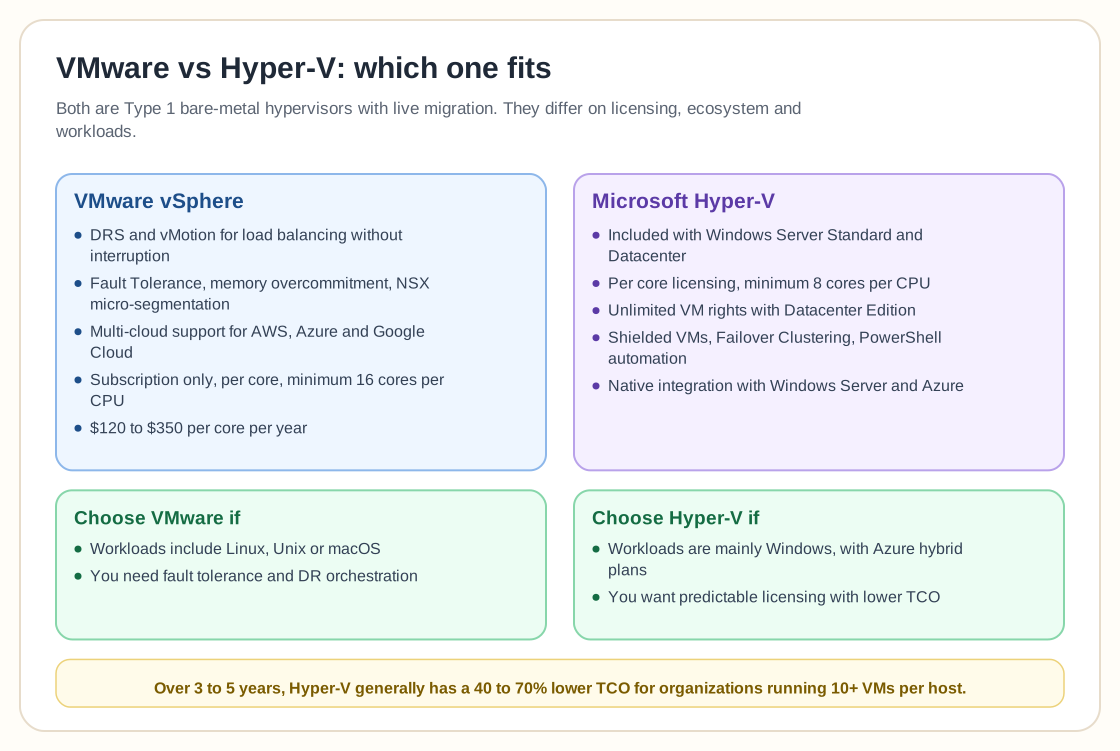
Choose VMware if:
- You need multi-cloud support across AWS, Azure, and Google Cloud
- Your workloads include Linux, Unix, or macOS
- You require advanced automation, fault tolerance, and DR orchestration
- Your organization prioritizes enterprise-grade support
Choose Hyper-V if:
- You're invested in Windows Server and Azure hybrid cloud
- You need predictable licensing with lower TCO
- Your workloads are primarily Windows-based
- You want simple management with PowerShell and Admin Center