

Newsletter
Subscribe our newsletter
Get new infrastructure guides, comparison reports, and migration notes in your inbox.
Oracle Linux vs VMware: A Practical Look for Modern Virtualization Teams
Shifting licensing models have many organizations reviewing their infrastructure strategy, and the question of oracle linux vs vmware keeps coming up. This page compares Oracle Linux's KVM-based virtualization with VMware on features, cost, scale, learning curve and migration effort.
Key points
- Oracle Linux provides a virtualization stack built on KVM and integrated management tools.
- VMware has a mature, feature-rich hypervisor ecosystem that many large enterprises use.
- The cost of the two keeps drifting further apart, so many teams are reconsidering which platform to run.
- Operational complexity, feature gaps, and ecosystem requirements weigh heavily on the long-term choice.
Feature & platform comparison
Oracle Linux
- Based on a Red Hat compatible distribution.
- Includes KVM-based virtualization with Oracle Linux Virtualization Manager.
- No-cost OS support tier available, with paid options for enterprise SLA.
- Strong fit for environments already invested in Oracle's database or cloud stack.
- More engineering effort required for teams accustomed to VMware's integrated approach.
VMware
- Industry-standard hypervisor with a very mature ecosystem.
- Advanced features such as vSAN, vMotion, DRS, NSX, and lifecycle automation.
- Deep tooling integrations across backup, monitoring, networking, and cloud.
- Strong reliability and performance for large-scale virtualization environments.
- Recent pricing changes have cost-sensitive deployments looking at other options.
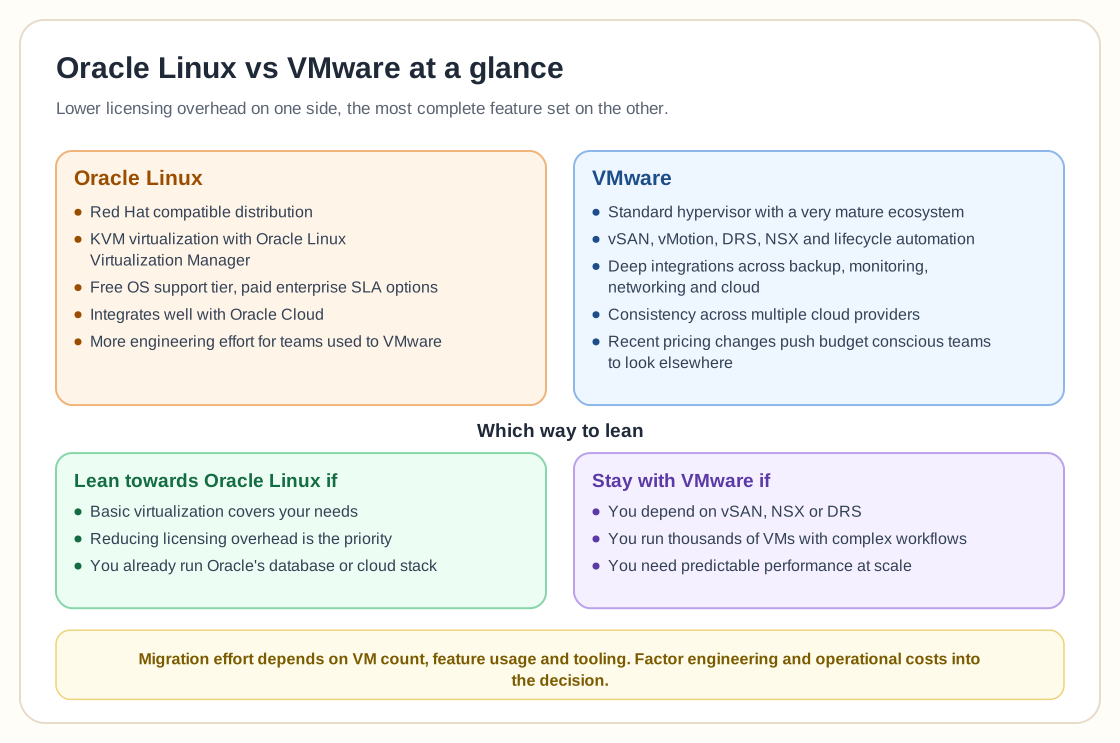
Benefits of each platform
When comparing oracle linux vs vmware, organizations weigh price and the operational impact on their teams. Each platform has strengths that suit different infrastructure strategies.
- Cost flexibility: Oracle Linux appeals to teams that want to reduce licensing overhead, particularly when OS support is the primary requirement.
- Feature completeness: VMware still has the most complete virtualization feature set, which makes it a good fit for environments that depend on advanced automation or software-defined networking.
- Scalability: Both platforms scale, but VMware's long-standing enterprise adoption gives it an advantage in environments with thousands of VMs and complex workflows.
- Learning curve: Oracle Linux takes real adjustment for teams that have only ever worked in VMware ecosystems.
- Cloud alignment: Oracle Linux integrates well with Oracle Cloud, while VMware offers consistency across multiple cloud providers.
Common questions
Is Oracle Linux a full replacement for VMware?
Not entirely. Oracle Linux can replace VMware for organizations needing basic virtualization without depending on VMware's advanced feature stack. Feature-heavy VMware shops will see gaps.
Does Oracle Linux reduce licensing costs?
It often does, especially for teams using the OS without premium support. However, a full migration may introduce engineering and operational costs that should be factored in.
How does performance compare?
Performance can be strong on both platforms, but VMware's maturity and driver ecosystem provide more predictable results at scale.
Is it hard to migrate off VMware?
Migration complexity depends on your VM count, feature usage, and operational tooling. Environments dependent on vSAN, NSX, or DRS will require extensive redesign.
Who should consider Oracle Linux?
Organizations seeking lower-cost virtualization with a traditional Linux-based stack or those already aligned with Oracle's ecosystem.