

Newsletter
Subscribe our newsletter
Get new infrastructure guides, comparison reports, and migration notes in your inbox.
OpenShift vs Rancher: Red Hat vs SUSE Kubernetes
OpenShift vs Rancher comes down to one integrated Kubernetes platform against one management layer for many clusters. This comparison of Red Hat OpenShift and SUSE Rancher Prime covers platform architecture, multi-cluster management, security, AI, pricing, and ecosystem strategy.
Red Hat OpenShift
An enterprise Kubernetes distribution that works as a full Platform-as-a-Service, with integrated CI/CD, DevSecOps, and hybrid cloud management.
SUSE Rancher Prime
A multi-cluster Kubernetes management platform with centralized governance for any Kubernetes distribution across cloud, on-prem, and edge environments.
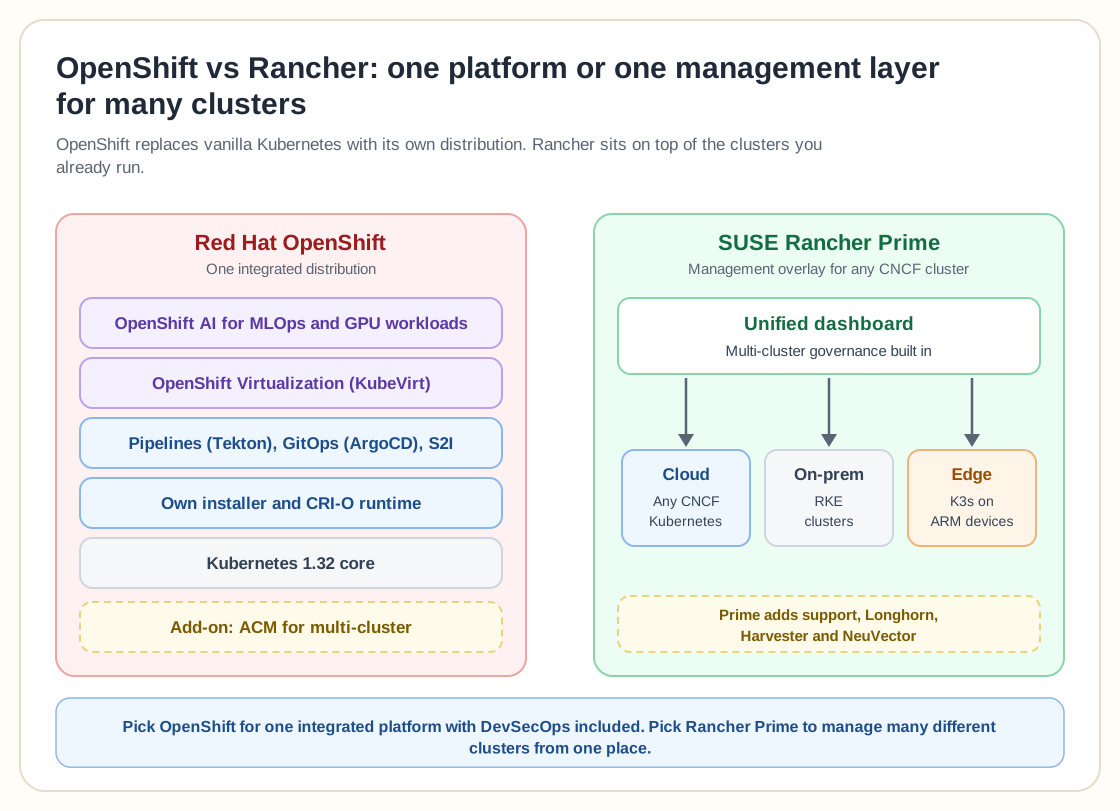
Feature comparison
Learn more about Red Hat OpenShift and SUSE Rancher official documentation.
Fully integrated Kubernetes distribution (based on Kubernetes 1.32, CRI-O runtime). Lifecycle management is consistent, and DevOps tooling is built in.
A management overlay for any CNCF-compliant Kubernetes cluster. It adds flexibility and centralized control and leaves upstream Kubernetes in place.
Uses Red Hat Advanced Cluster Management (ACM) add-on for multi-cluster governance, policy control, and visibility.
Multi-cluster management is built in, with a unified dashboard for hybrid and edge deployments.
Includes OpenShift Pipelines (Tekton), GitOps (ArgoCD), and Source-to-Image (S2I) to automate build and deployment workflows.
Integrates external CI/CD tools like Jenkins and GitLab. Offers DevX Validated Designs for custom DevOps pipelines.
OpenShift Virtualization (KubeVirt) manages VMs and containers together, which suits VMware migration scenarios.
Harvester (SUSE Virtualization) is a hyperconverged infrastructure platform that combines virtualization and distributed storage.
Includes OpenShift AI (formerly OpenShift Data Science) for MLOps, AI model training, and GPU-based workloads.
Supports AI workloads on existing clusters through SUSE AI integrations and certified infrastructure partners.
Platform Plus includes Red Hat Advanced Cluster Security (RHACS), Trusted Artifact Signer, and compliance scanning.
Integrates with NeuVector for runtime zero-trust security, network firewalling, and continuous compliance scanning.
Supports edge data centers with consistent enterprise-grade features via Device Edge and ACM.
K3s provides lightweight Kubernetes for ARM/edge devices under 100MB footprint with 512MB RAM minimum.
Strong ecosystem with AWS (ROSA), Azure (ARO), IBM Cloud, Oracle Cloud, and hundreds of OperatorHub-certified integrations.
SUSE One Partner Program with certified storage vendors (NetApp, Dell, Oracle) and integrations for SAP and financial services.
Subscription-based (~CHF 43 to 155/vCPU/month). Includes Red Hat support and enterprise SLAs.
Fully open source. Rancher Prime subscriptions (~$4,742/year) add enterprise support, Longhorn, Harvester, and NeuVector.
Decision guidance
Choose OpenShift if you need:
- End-to-end enterprise platform with integrated DevSecOps.
- Strong AI/ML and virtualization support for VMware migration.
- Certified ecosystem and global Red Hat support.
Choose Rancher Prime if you need:
- Centralized management across diverse Kubernetes clusters.
- Lightweight edge deployments and open-source flexibility.
- Vendor neutrality with lower operational costs.
Frequently asked questions
Is SUSE Rancher a Kubernetes distribution or management tool?
Rancher is primarily a multi-cluster management platform. It can manage any CNCF-certified Kubernetes distribution and provision clusters using RKE or K3s.
Does OpenShift replace vanilla Kubernetes?
Yes. OpenShift is a complete Kubernetes distribution with its own installer, CRI-O runtime, and Red Hat-managed ecosystem.
Which platform is better for hybrid or multi-cloud?
Rancher offers broader flexibility across mixed Kubernetes environments, while OpenShift provides a more integrated enterprise hybrid cloud experience with ACM.
How do OpenShift and Rancher differ in cost structure?
OpenShift follows a vCPU-based subscription model with included Red Hat support. Rancher is free to start with paid enterprise support available via Rancher Prime.