"Passion" left the job ad. "Ownership" moved in.
Part of a 14-post series on IT jobs in the AI era. Start with the overview: IT job market 2022 to 2026: openings fell, jobs held.
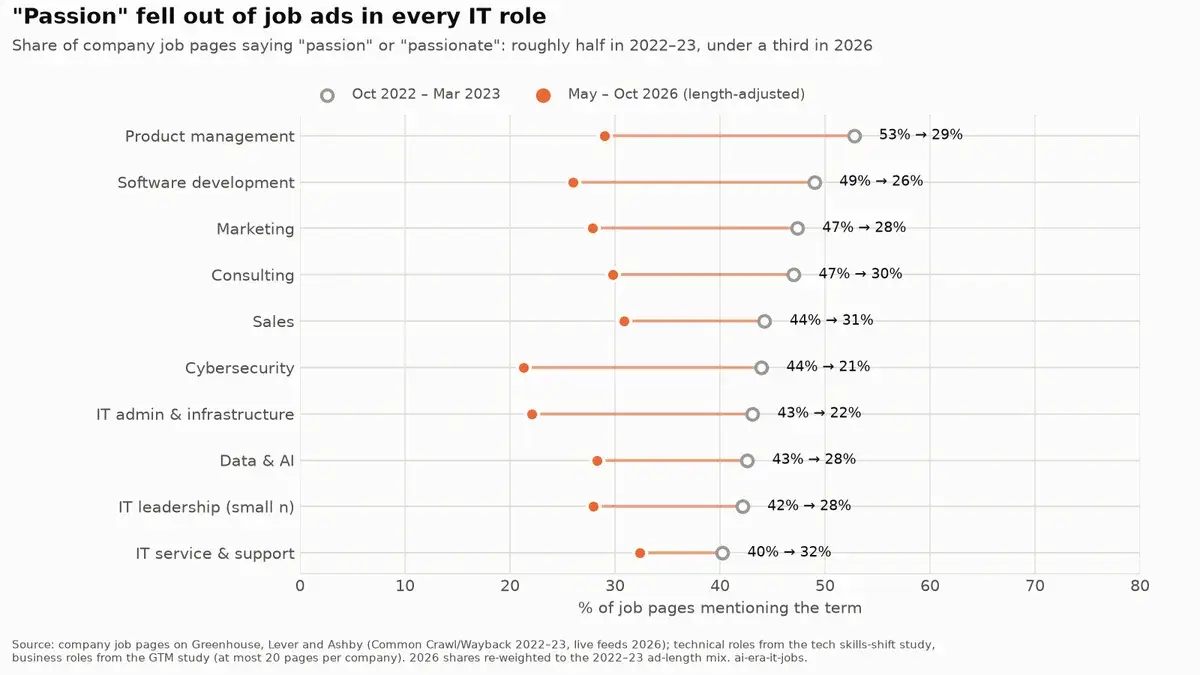
In winter 2022-23, 49% of software developer job pages asked for "passion" or a "passionate" candidate. In the pages open this autumn, 26% do [ai-era-it-jobs, 2026]. The same drop shows up in every one of the ten IT role families I measured, from cybersecurity (44% to 21%) to marketing (47% to 28%). The word that grew in its place is "ownership": 26% to 43% in developer ads, 29% to 50% in marketing, 45% to 65% in product management. The ads now describe what the hire will answer for, where they used to describe how the hire should feel about the work.
Enthusiasm out
The data comes from two studies in this project that read company job pages on Greenhouse, Lever and Ashby. The 2022-23 pages were recovered from Common Crawl and the Wayback Machine; the 2026 pages are live postings. The technical study covers software development, infrastructure, security and data; the business study covers sales, marketing, product, consulting, IT service and IT leadership. Together they compare about 6,700 pages from October 2022 to March 2023 with about 17,700 from May to October 2026 [ai-era-it-jobs, 2026]. Ads in 2026 are longer, which on its own raises the chance of any word appearing, so the 2026 shares below are re-weighted to the length mix of 2022-23. Unadjusted, the rises would look larger and the falls smaller.
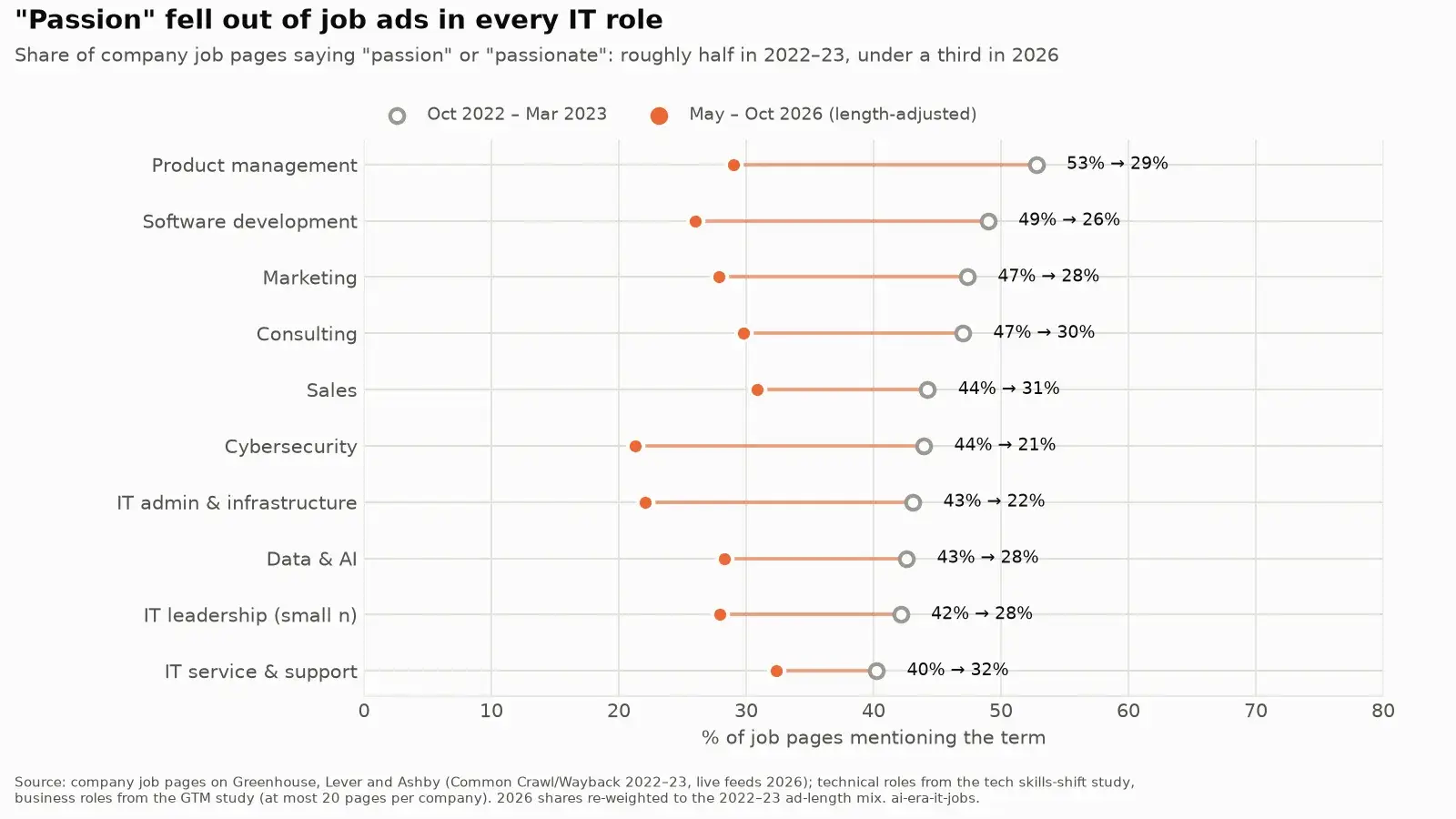 Share of job pages saying "passion" or "passionate", 2022-23 vs 2026 (length-adjusted). Source: ai-era-it-jobs study (tech and go-to-market job pages).
Across technical pages, "passion" fell from 46.9% to 25.3%; across business pages, from 46.0% to 30.0%. Product management fell furthest (53% to 29%), IT service and support least (40% to 32%). In technical ads the drop holds inside the same companies (19.2 points) and inside the requirements block alone, where "passion" fell from 22.2% to 10.3% of pages [ai-era-it-jobs, 2026].
I read this as the end of a hiring style. In 2022 a company competed for scarce engineers and sellers, and the ad was a pitch: join us if you love this. With fewer openings and more applicants per opening, the ad no longer needs to sell the job. It screens for the person who will deliver it.
Ownership in
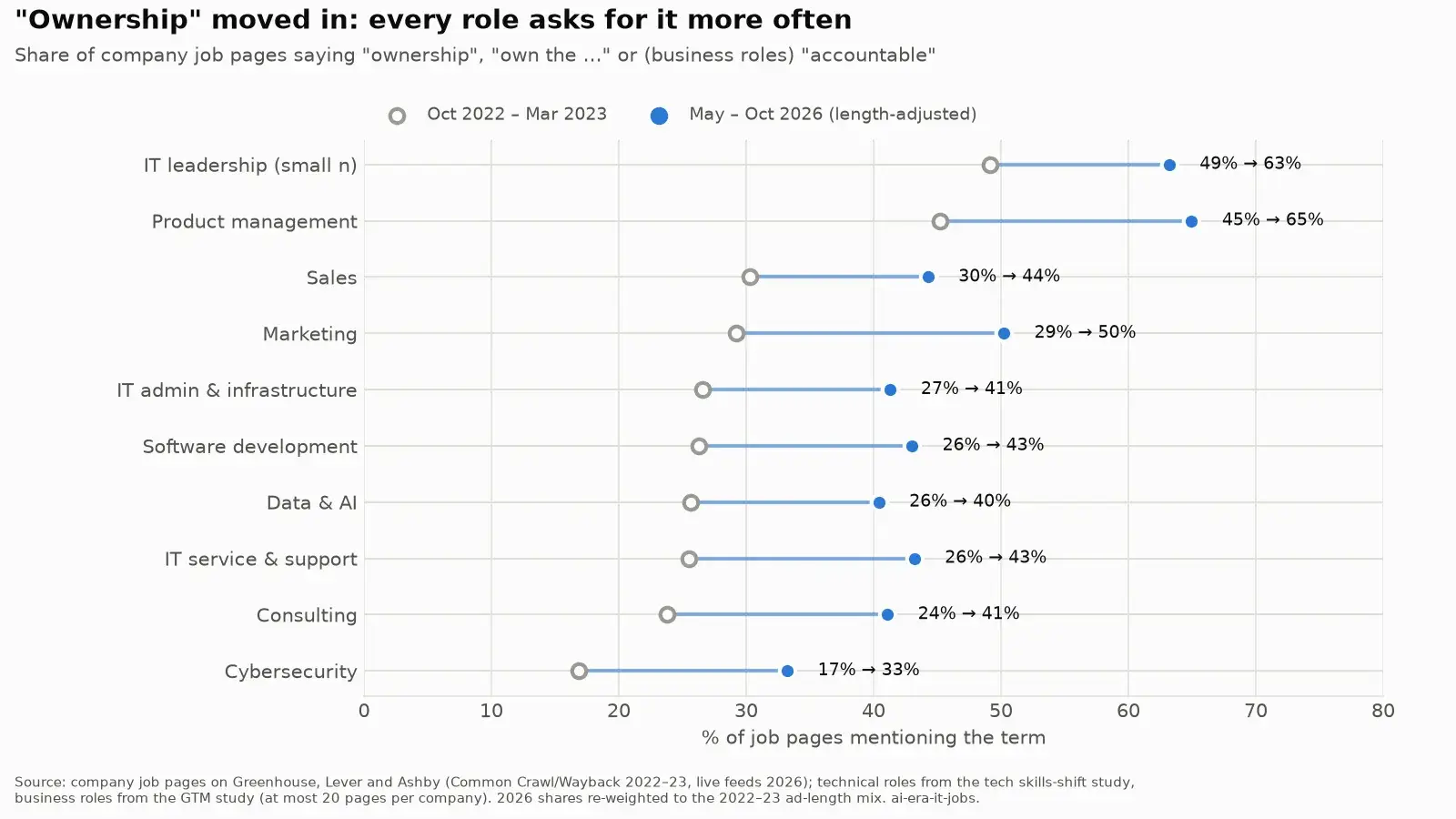 Share of job pages saying "ownership", "own the …", in business roles, "accountable", 2022-23 vs 2026 (length-adjusted). Source: ai-era-it-jobs study (tech and go-to-market job pages).
"Ownership" rose in every family. Across technical pages it went from 25.6% to 40.9%; across business pages, from 31.1% to 47.5% (56.2% before the length adjustment) [ai-era-it-jobs, 2026]. Security went from 17% to 33%, consulting from 24% to 41%, IT service from 26% to 43%. In IT leadership ads, already high, it went from 49% to 63% on a small sample of 57 and 116 pages.
Two checks matter here. First, the new word is rarely tied to AI: only 3% of the 2026 business pages that use "ownership" have every mention within 80 characters of an AI term [ai-era-it-jobs, 2026]. Second, it rises inside the same companies, by 15.7 points in technical pages and 12.7 points in business pages, so it is not a change in who was hiring. Its companion words rose too. "Judgment" went from 2.9% to 10.4% of technical pages.
Europe moved further than the US. In business pages, ownership rose 22.7 points in Europe-located ads and 16.2 points in US ones, both length-adjusted. In the 96 Poland-located postings in the 2026 data, half say it [ai-era-it-jobs, 2026]. LinkedIn's 2026 Skills on the Rise list for Europe names "end-to-end ownership" among the fastest-growing skills in Germany [LinkedIn, 2026]. That is profile data rather than ads, and it points the same way.
A builder with a record, and more years
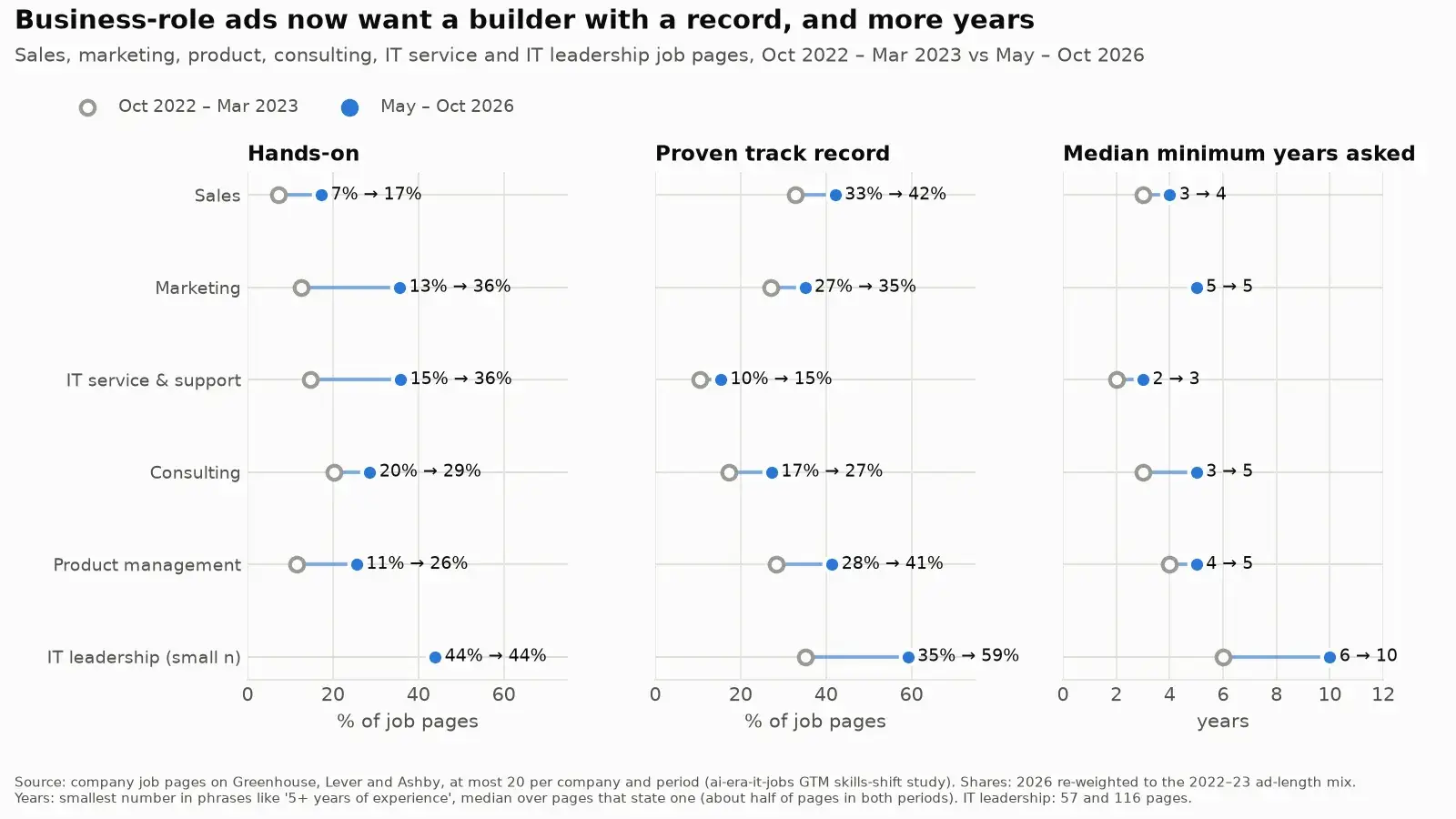 Business roles, 2022-23 vs 2026: "hands-on" and "proven track record" (length-adjusted) and the median minimum years of experience asked. Source: ai-era-it-jobs GTM ai-era-it-jobs study; years parsed with the tech study's rule.
The other two words that grew are "hands-on" and "proven track record". "Hands-on" went from 13% to 36% of marketing pages and from 15% to 36% of IT service pages. "Proven track record" rose from 28% to 38% across business pages and from 35% to 59% in IT leadership ads [ai-era-it-jobs, 2026]. Hands-on did not grow in leadership ads, where it was already at 44%.
The number of years asked went up with them. In ads that state a minimum, the median rose from 4 to 5 years in software development and infrastructure, from 3 to 5 in data roles and in consulting, from 3 to 4 in sales and from 2 to 3 in IT service. It held at 5 in marketing and security [ai-era-it-jobs, 2026]. Indeed sees the same tilt in the whole US market: senior postings were up 14.7% year on year in May 2026 while entry-level postings fell 7.5% [Indeed Hiring Lab, 2026].
Taken together, the 2026 ad describes a senior individual contributor who has done the job before and will do it without a manager walking them through it.
What the new words say about teams
The words match what large employers have said about their own structure. Amazon set a target of 15% more individual contributors per manager by March 2025 [GeekWire, 2024]. Google said in August 2025 that it had 35% fewer managers of small teams than a year before [NBC News, 2025]. Microsoft described its May 2025 layoffs as building a leaner management tier [TechRepublic, 2025]. When there are fewer managers per person, each hire has to run their own work, and "ownership" is the word for that.
Juniors pay for this shift. "Passion" was a word you could put in a junior's ad, and nobody writes "proven track record" for a first job. The entry-level squeeze I covered in earlier posts shows up here in the vocabulary.
I would not over-read single words. Soft-skill phrases sit partly in company culture copy, and the tech study flags this. Still, the change survives the strictest cut I have: "ownership" in technical requirements sections alone went from 7.5% to 14.1%, and in business requirements sections it rose 9.3 points [ai-era-it-jobs, 2026].
What this means if you are applying for an IT job in 2026
- Rewrite your CV bullets as things you owned end to end: the system you ran in production, the territory you carried, the campaign whose pipeline you answered for. Drop the "passionate about" line; fewer ads ask for it, and it now reads as filler.
- Put one number next to each claim. "Proven track record" is now in 38% of business ads and 59% of leadership ads; a result with a figure is the evidence they mean.
- If you are early in your career, show hands-on work outside a job title: a homelab, a shipped side project, a support queue you ran. The years asked went up, so evidence of doing the work has to stand in for the years you do not have yet.