

Junior IT jobs are disappearing, and Europe is losing them faster than the US
Part of a 14-post series on IT jobs in the AI era. Start with the overview: IT job market 2022 to 2026: openings fell, jobs held.
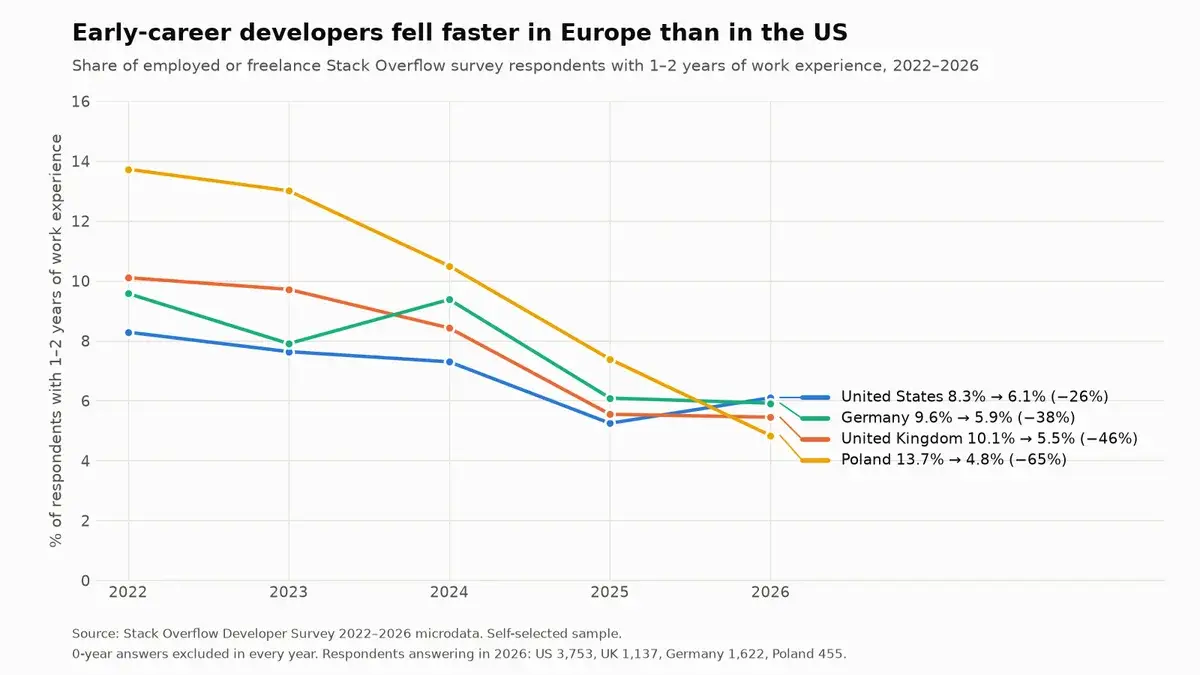
In 2022, 13.7% of the Polish developers who answered the Stack Overflow survey had one or two years of work experience. In 2026 the figure was 4.8%, down almost two thirds [Stack Overflow survey, 2022-2026]. The US fell from 8.3% to 6.1%, about a quarter. Germany fell 38% and the UK 46%. These are survey shares rather than hiring counts, but most other series I could find agree: the first rung of an IT career is breaking on both sides of the Atlantic, and faster in Europe. That surprised me. I expected Europe to move later and more slowly. It is later on demand, and at least as fast at the entry door.
The US evidence: hiring stopped at the bottom
The cleanest numbers are American, because the US has payroll data. Stanford's "Canaries in the Coal Mine" study, revised in August 2026 on ADP payroll records, finds that employment of 22-25-year-olds in the most AI-exposed occupations fell about 11% between November 2022 and June 2026, while the same age group in the least-exposed jobs grew about 10%. Measured against the path of their less-exposed peers, the young workers are 19% behind, up from 15% a year earlier. Experienced workers in the same jobs show no comparable gap, and the authors find the effect works through fewer hires, not more layoffs [Stanford Digital Economy Lab, 2026]. Software development and customer service are among the exposed occupations.
A Harvard study of résumé data shows the same thing inside firms: junior employment at companies that had hired a "GenAI integrator" fell 7.7% relative to other firms within six quarters, starting in the first quarter of 2023 [Hosseini & Lichtinger, 2025]. New graduates were 7% of Big Tech hires in 2024 [SignalFire, 2025], and about one in ten engineering hires at larger companies in 2025, against nearly three in ten in 2023 [The Pragmatic Engineer, 2026].
The squeeze started in 2023, before AI coding tools were good enough to do a junior's work. My reading is that the rate cycle closed the door and the tools then gave employers a reason to keep it shut. In a field experiment with customer-support agents, the AI assistant raised productivity most for novices, by 34% [Brynjolfsson, Li & Raymond, 2023]. Employers went on to hire fewer novices anyway.
Europe: the same squeeze, deeper
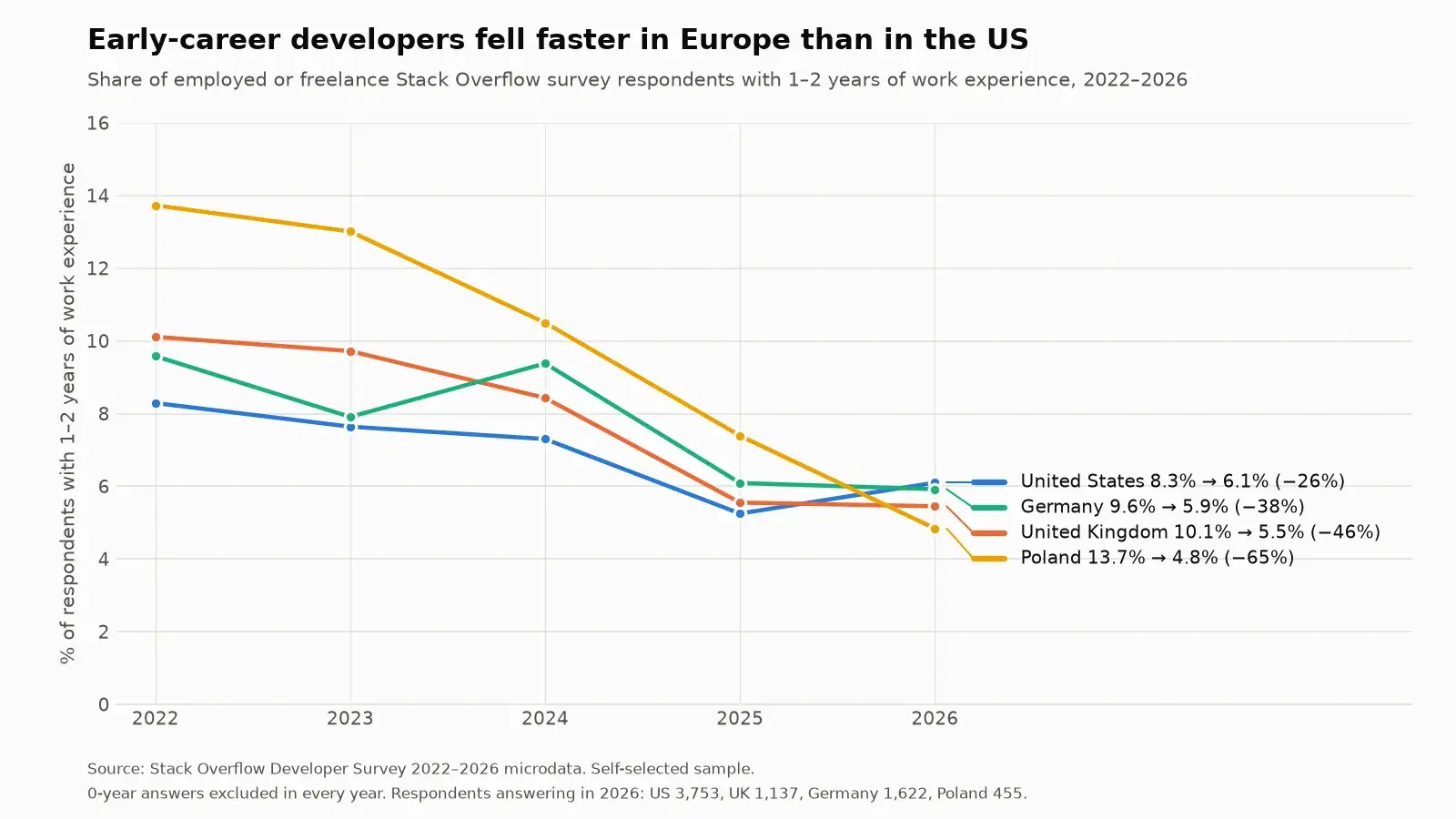 Early-career developers as a share of employed survey respondents, 2022-2026. Source: Stack Overflow Developer Survey microdata.
The survey chart is the only series I hold that measures all four markets the same way, and Europe falls further in every case. A self-selected survey can drift with who chooses to answer, so I checked it against job-board and job-page data, and most of it agrees.
Poland is the extreme. On No Fluff Jobs, junior roles were 15% of IT offers in 2022, 8% in 2023, 5.9% in 2024 and 5.3% in 2025 [No Fluff Jobs, 2026]. On Just Join IT they were 4.8% of offers in 2025 [Just Join IT, 2026]. Yet Poland grew its IT workforce faster than any other market in our data: ICT specialists rose 21%, from 644,600 to 778,800, between 2022 and 2025 [Eurostat, 2026]. The two facts fit: Western employers nearshore senior, remote, English-speaking capacity to Poland, and very few of them nearshore graduates.
Germany is the only one of five markets with enough company job pages to compare where entry-level titles fell: from 6.8% of pages in 2022-23 to 4.3% in 2026, while US pages held at 4.6% to 5.1% and UK pages at 3.6% to 4.0% [company job pages, 2022-2026]. The UK shows it in security: the share of core cyber postings open to people with under a year's experience went from 25% in 2022 to 22% in 2023 and 17% in 2024 [UK DSIT, 2026]. How far UK graduate hiring fell depends on the board: Adzuna counted 45.6% fewer graduate vacancies in July 2026 than a year earlier, Indeed only about 7% fewer [Adzuna via Consultancy.uk, 2026; Indeed Hiring Lab UK, 2026]. France looks like the exception, with entry titles rising from 5.4% to 9.5% of job pages, but 43 of the 60 entry titles in 2026 are internships, apprenticeships or alternance places [company job pages, 2026]. Its apparent strength is the work-study route.
The demand cycle makes this worse for Europe. The US software postings index hit its low in May 2025 and rose 19% in the year to September 2026. Germany's is at 49% of its February 2020 level, down 16% in twelve months and still making new lows [Indeed Hiring Lab via FRED, 2026]. American employers have started hiring again, mostly experienced people. German and French employers have not. When they do, I expect this year's graduates to compete with three classes before them that never got a first job.
The job ad now asks for a year more
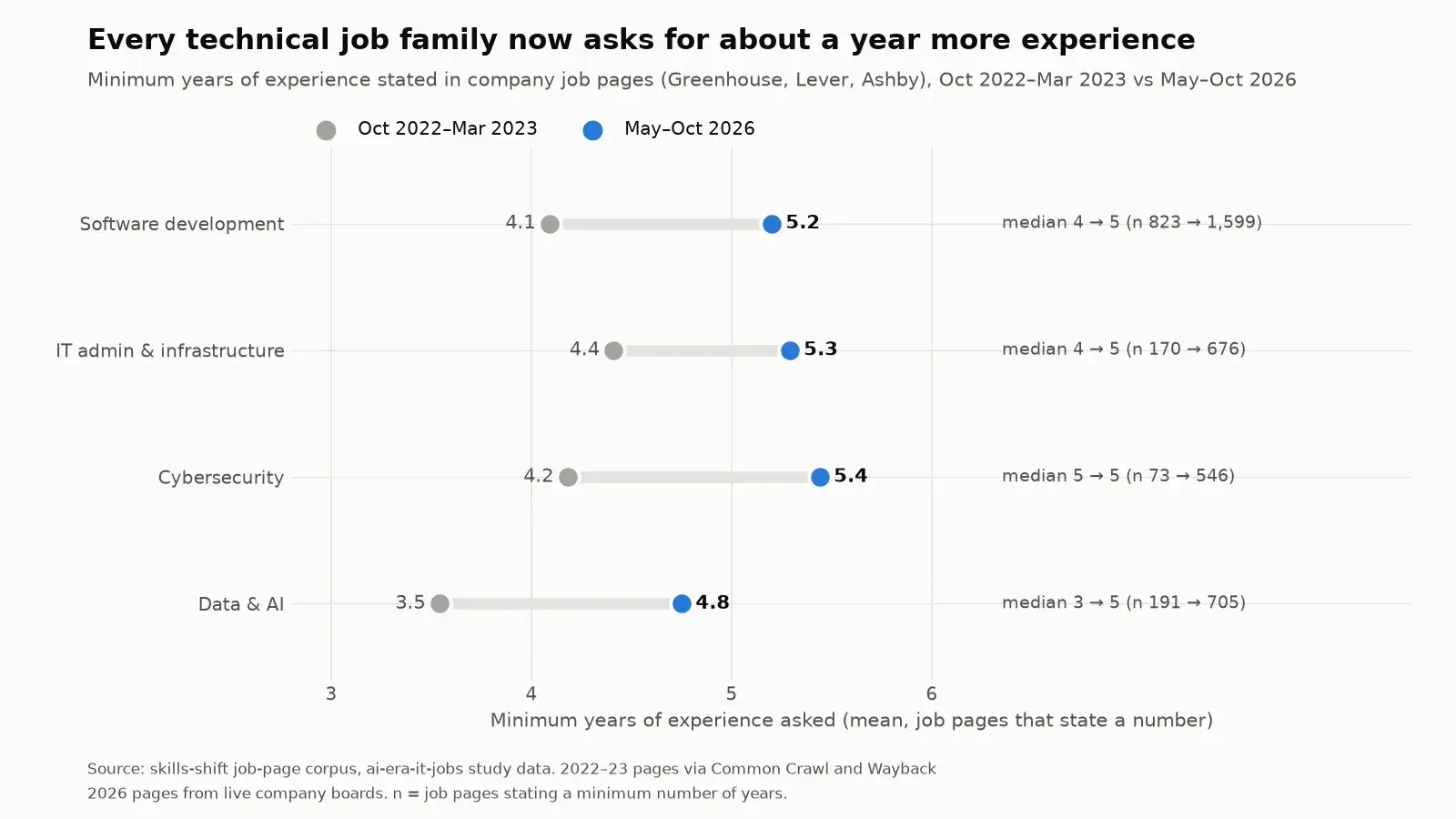 Minimum years of experience stated in company job pages, Oct 2022-Mar 2023 vs May-Oct 2026. Source: ai-era-it-jobs study.
The job descriptions themselves moved. Across technical job pages on Greenhouse, Lever and Ashby, the median minimum experience asked rose from 4 to 5 years in software and infrastructure, and from 3 to 5 in data roles [company job pages, 2022-2026]. Ads naming one to two years fell from 14.1% to 10.0% of technical pages; ads naming eight or more years rose from 6.9% to 11.9%. Indeed sees the same direction on its own data: US tech postings asking for five or more years went from 37% to 42% between mid-2022 and mid-2025 [Indeed Hiring Lab, 2025]. In Hacker News hiring posts, the share asking for senior, staff, lead or executive people rose from 18.8% to 31.3%, while explicitly junior posts stayed under 2% the whole time [Hacker News "Who is hiring", 2022-2026]. The "entry-level, three years' experience" ad has become a five-year ad, and someone with one year of experience has far fewer places to apply.
Where the first job went
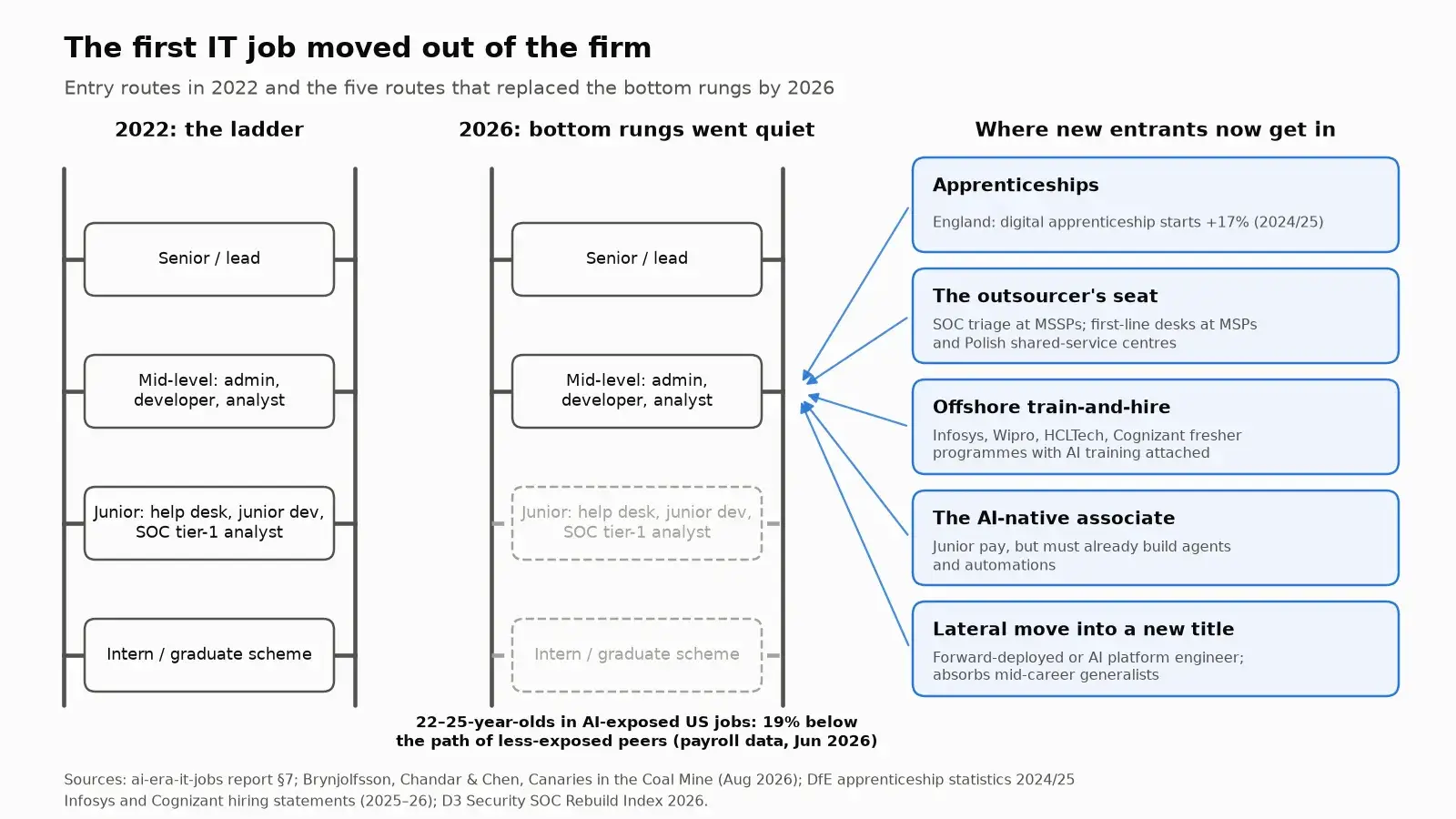 The 2022 entry ladder and the routes that replaced its bottom rungs. Source: ai-era-it-jobs report, section 7 and the sources listed below.
The bottom rungs moved outside the firm, and I count five places they went.
- Apprenticeships. Digital apprenticeship starts in England rose 17% in 2024/25 [UK Department for Education, 2025]. UK consultancies raised apprentice hiring 31% in 2025, against 10% for graduates [MCA via Consultancy.uk, 2026], while the Big Four's UK graduate and apprentice intake fell from 6,500 in 2023 to 5,400 in 2025 [Oman Observer, 2026].
- The outsourcer's seat. First-line security triage now sits at managed security and detection providers and staffing firms [D3 Security, 2026]; first-line service desks sit at MSPs and in Polish shared-service centres.
- Offshore train-and-hire. Infosys, Wipro, HCLTech and Cognizant went back to hiring freshers, with AI training attached. Cognizant describes its hiring as "decoupled from revenue growth" [HR Katha, 2026].
- The AI-native associate. Junior in pay but not in expectations: an entry-level growth associate who must already build agents and automations [Sting job posting, 2026].
- A lateral move into a new title. Forward-deployed engineer and AI platform engineer roles absorb mid-career generalists more than graduates.
What did not replace the ladder is training people inside the firm. Enterprises training non-security staff into security roles fell from 41% to 29% in a year [ISACA, 2025].
What this means if you are looking for your first IT job
- Go in through a side door, on purpose. An apprenticeship in England, alternance in France, a seat at an MSP, an MSSP or a Polish shared-service centre: these are where entry roles still exist, and they count as a first rung.
- Show that you can check and run work as well as produce it. Software job pages naming reliability rose from 11% to 30%, and code review from 18% to 25% [company job pages, 2022-2026]. Employers want people who can review and run what the tools write. A public project with tests, monitoring and a written-up incident will get you further than another to-do app.
- Pick your market by its entry route and its language. Germany has the steepest fall in entry titles, and German is required in 34% of German job pages [company job pages, 2026]. Poland hires seniors for Western clients in English. France and England have working work-study routes, so apply where the door is open.
If you hire: the payroll studies describe the junior freeze as a hiring choice, and nothing in the productivity data forces it. Someone has to train the seniors you will want in 2030.
Sources
- Stack Overflow, Developer Survey 2022-2026, public microdata (early-career share = employed or freelance respondents with 1-2 years of work experience; 0-year answers excluded). https://survey.stackoverflow.co/2022 to https://survey.stackoverflow.co/2026, extracted 2026-10-21.
- Brynjolfsson, Chandar & Chen, Stanford Digital Economy Lab, "Canaries in the Coal Mine? Six Facts about the Recent Employment Effects of Artificial Intelligence", August 2026 revision. https://digitaleconomy.stanford.edu/app/uploads/2026/08/Canaries_August2026.pdf
- Hosseini & Lichtinger (Harvard), "Generative AI as Seniority-Biased Technological Change: Evidence from U.S. Résumé and Job Posting Data", SSRN 5425555, 2025. https://papers.ssrn.com/sol3/papers.cfm?abstract_id=5425555
- SignalFire, "State of Tech Talent Report 2025", 2025-05-20. https://www.signalfire.com/blog/signalfire-state-of-talent-report-2025
- Gergely Orosz & Jessica Salmon, The Pragmatic Engineer, "Tech jobs market in 2026, part 2", 2026-06-09. https://newsletter.pragmaticengineer.com/i/201325168/3-mobile-and-frontend-demand-drops-ai-and-fde-surges
- Brynjolfsson, Li & Raymond, "Generative AI at Work", NBER w31161, April 2023. https://www.nber.org/papers/w31161
- No Fluff Jobs, "Rynek pracy IT w Polsce 2025/2026", January 2026, pp. 17-18 (2023-2025 junior shares). https://wp-insights.s3.eu-central-1.amazonaws.com/wp-content/uploads/2026/01/15073644/Rynek-pracy-IT-w-Polsce-20252026-No-Fluff-Jobs.pdf; 2022 share as summarised by xyz.pl: https://xyz.pl/?p=162319
- Just Join IT, "IT Salary Report in Poland 2026: Job offers in numbers" (2025 data). https://justjoin.it/salary-report/job-offers-in-numbers
- Eurostat, employed ICT specialists, dataset isoc_sks_itspt (Poland, 2022-2025). https://ec.europa.eu/eurostat/statistics-explained/index.php?title=ICT_specialists_in_employment
- Company job pages (Greenhouse, Lever, Ashby), Oct 2022-Mar 2023 vs May-Oct 2026; language from ai-era-it-jobs report, section 9. Mustard Seed Solutions analysis, 2026-10-21.
- UK Department for Science, Innovation and Technology, "Cyber security skills in the UK labour market 2025", updated 2026-02-02. https://www.gov.uk/government/publications/cyber-security-skills-in-the-uk-labour-market-2025/cyber-security-skills-in-the-uk-labour-market-2025
- Adzuna graduate-vacancy data, July 2026, as reported by Consultancy.uk, "AI gives with one hand and takes with the other for entry-level roles". https://www.consultancy.uk/news/44763/ai-gives-with-one-hand-and-takes-with-the-other-for-entry-level-roles
- Indeed Hiring Lab UK, "Indeed's 2026 Mid-Year UK Jobs & Hiring Trends Report", 2026-08-03. https://hiringlab.indeed.com/uk/blog/2026/08/03/mid-year-uk-jobs-hiring-trends-report/
- Indeed Hiring Lab via FRED, software development postings indexes for the US and Germany (Feb 2020 = 100), data to October 2026. https://fred.stlouisfed.org/series/IHLIDXUSTPSOFTDEVE; https://fred.stlouisfed.org/series/IHLIDXDETPSOFTDEVE
- Indeed Hiring Lab, B. Bernard, "Experience requirements have tightened amid the tech hiring freeze", 2025-07-30. https://hiringlab.indeed.com/2025/07/30/experience-requirements-have-tightened-amid-the-tech-hiring-freeze/
- Hacker News "Ask HN: Who is hiring?" threads, Oct 2022-Oct 2026, via the Algolia API; seniority shares from ai-era-it-jobs report, section 7. https://hn.algolia.com/api/v1/
- UK Department for Education, Apprenticeships 2024/25. https://explore-education-statistics.service.gov.uk/find-statistics/apprenticeships/2024-25
- Consultancy.uk (MCA / Oxford Economics), "Rising exports drove UK consulting industry growth in 2025", 2026-07-06. https://www.consultancy.uk/news/44832/rising-exports-drove-uk-consulting-industry-growth-in-2025
- Oman Observer (reprint), "Major accountancy firm plans 30% graduate hiring", 2026-06-03. https://www.omanobserver.om/article/1190636/opinion/business/major-accountancy-firm-plans-30-graduate-hiring
- D3 Security, "SOC Hiring in 2026: Three Builders for Every Analyst", 2026-09-11. https://d3security.com/blog/soc-hiring-2026/
- HR Katha, "AI increases Cognizant's productivity; fresher hiring", February 2026. https://www.hrkatha.com/recruitment/ai-increases-cognizants-productivity-fresher-hiring/
- Sting, "AI-native Growth Marketing Associate", Stockholm, job posting, 2026. https://emp.jobylon.com/jobs/354154-sting-ai-native-growth-marketing-associate/
- ISACA, "State of Cybersecurity 2025", press release 2025-09-29. https://www.isaca.org/about-us/newsroom/press-releases/2025/state-of-cybersecurity-2025-global-press-release