


We Blamed Veeam for Everything Until We Looked at Our Own Setup
When frustration boils over: "We're done with this"
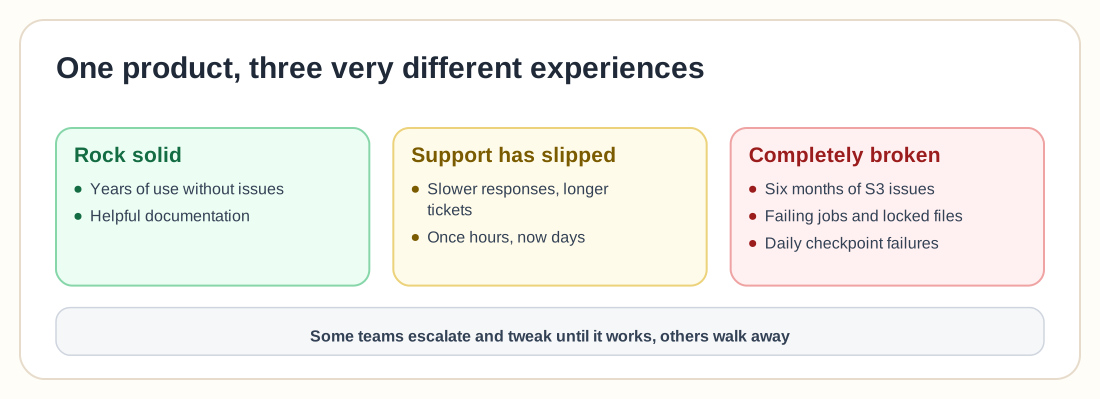
It starts the same way every time. Something breaks, then it breaks again, and suddenly patience runs out. In this case, the frustration was loud and specific: six months of unresolved S3 storage issues, backup jobs failing, files locking themselves for no clear reason, and daily checkpoint failures. Maybe the most painful part was support that felt slow, disconnected, and uninterested.
An experience like that does more than push you to look at alternatives; it makes you want out entirely. When backups stop feeling reliable, everything else in your stack starts to feel shaky too, because backups are the last line of defense. When that line starts flickering, it gets personal.
The split reality: "rock solid" vs "completely broken"
What makes this situation messy is how quickly the narrative fractures. For every voice ready to abandon Veeam, there's another saying the exact opposite. "We've been using it for years without issues," one person pushed back, almost confused by the complaints. Another doubled down: "VEEAM has been rock solid."
That contrast is hard to ignore. It's the same product with wildly different experiences. One side sees instability and silence from support, while the other sees reliability and helpful documentation. The disagreement runs so deep that the two camps seem to live in completely different realities.
Then there's the middle ground. Some admit support has slipped, with slower responses, longer ticket cycles, and less back-and-forth resolution. "It used to take hours… now it takes days," someone noted. That's not a disaster, but it's enough to erode trust over time.
The dangerous thought: "maybe it's the setup"
Here the conversation takes a turn. Some responses go beyond defending Veeam and challenge the premise entirely. One comment didn't hold back: "If you're incapable of having successful backups… look at your setup." It's blunt, maybe even unfair, but it introduces an uncomfortable possibility: what if the software is only part of the issue?
That idea gets reinforced in small ways. Someone mentions tweaking registry keys to fix S3 timeouts. Another talks about escalating tickets and finally getting real engineering support. A pattern shows up: the people who stick with it often dig deeper, tweak more, and escalate harder.
That raises another question. Should you have to?
The alternatives: hope, hype, and trade-offs
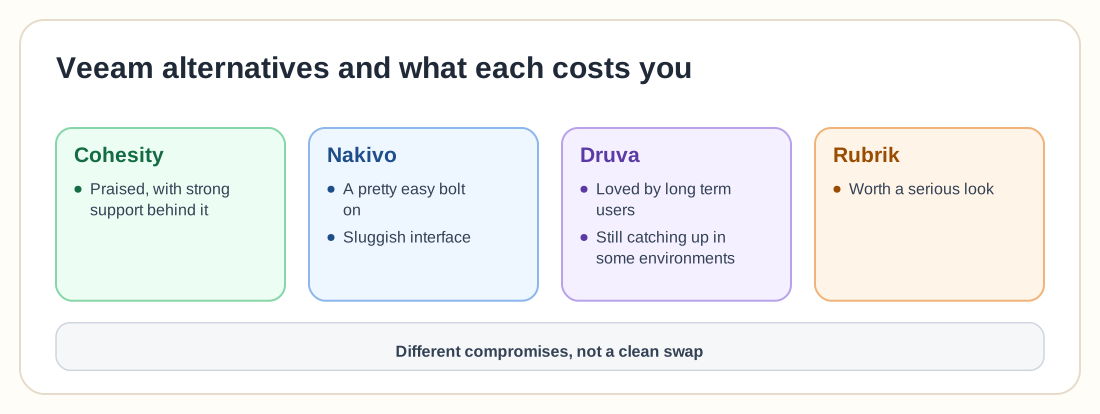
Once the door opens to alternatives, the list grows quickly. Cohesity gets praise as "one of the best decisions we've ever made," with strong support backing it up. Nakivo shows up as a "pretty easy bolt-on," though not without its own quirks like a sluggish interface. Druva gets love from long-term users, even if it's still catching up in certain environments. And heavy hitters like Rubrik get recommended, without much fanfare, as something worth a serious look.
None of these come across as perfect replacements, though. They feel more like different compromises: better support here, a weaker UI there, easier deployment with maybe less flexibility. Switching means reshuffling your priorities more than making a clean swap.
The hidden pattern: every tool breaks differently
One comment cuts through the noise with a simple, almost unsettling idea: "Backups don't need to fail 100% of the time… they only need to fail once."
That fear sits underneath every recommendation and every complaint. It doesn't matter how many successful backups you've had if the one restore you need doesn't work.
That's where the conversation shifts from features to trust. Some people trust Veeam because it's proven itself over years. Others don't trust it anymore because of recent failures. Both positions are rational, shaped by experience rather than specs.
Expectations vs reality
At some point it becomes clear that the argument reaches past Veeam, or any single tool, to expectations. People want backup systems to be invisible, effortless, and flawless. In reality, they're complex, sensitive, and sometimes unpredictable.
One person escalates tickets and tweaks settings until things work. Another hits the same wall and decides it's not worth the effort. Neither is wrong; they're drawing the line in different places.
That's the core tension. Do you invest more time into mastering a powerful but complex system, or do you switch to something simpler and accept its limits?
The takeaway nobody likes
There's no satisfying ending here, no clear winner, and no "just use this instead" answer.
Some teams will leave and feel immediate relief. Others will stay and fix what's broken without much noise. A few will try something new and eventually run into a different set of problems.
Backup platforms are trade-offs wrapped in marketing, with nothing magic about them, and when things go wrong, those trade-offs become very real, very fast. So instead of asking "what's the best alternative?", it may be more useful to ask what kind of problems you're willing to live with.