

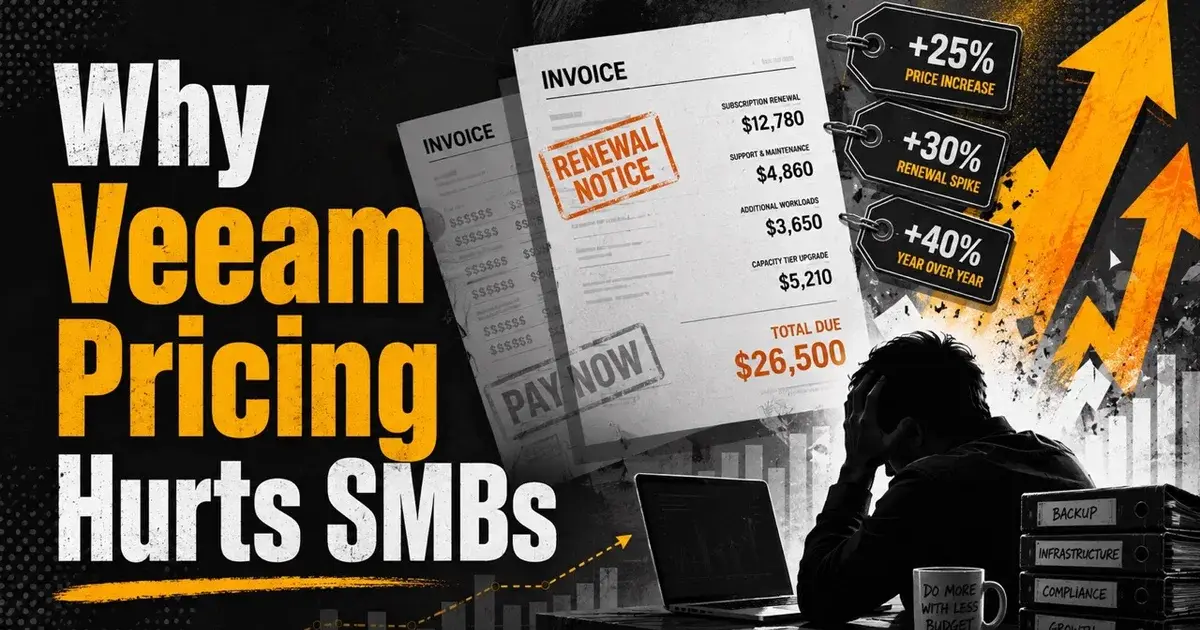
Veeam Pricing: Why SMB Renewals Can Jump So Hard
Veeam pricing can jump dramatically when an SMB moves from an older socket based purchase into a different workload or capacity model. One administrator reported paying £875.60 for three years of Backup & Replication Essentials in 2023, then receiving a quote for £1,920 for a single year covering 20 VMs. Annualized, that is roughly the 558 percent increase in the thread title.
The comments make the story more useful. Several administrators suspected the quote was not a like for like renewal and said the reseller appeared to be moving the customer to a Veeam Universal License style SKU with a different feature set. Another 2025 discussion showed the same confusion from the NAS side, where a small local government environment with about 25 TB on Synology storage received backup quotes of roughly $4,000 per year and questioned why locally hosted data capacity should affect software cost so heavily.
Was the reported 558 percent Veeam increase real?
The arithmetic in the reported case is real if the two prices are compared on an annual basis. £875.60 spread across three years is about £291.87 per year. Moving from that annualized cost to £1,920 per year is an increase of about 558 percent.
A harder question is whether the two purchases represented the same entitlement. Commenters quickly noticed that the old license was described as Backup & Replication Essentials with two sockets, while the new quote covered 20 VMs. Several suggested the reseller had quoted a different licensing model rather than simply renewing the existing socket entitlement.
That changed the administrator's next step. Instead of immediately replacing Veeam, they went back to the VAR and asked whether the existing socket based license could still be renewed. A later comment said the VAR believed that path was still possible and had not mentioned it initially.
A shocking renewal percentage should therefore trigger a SKU comparison before a platform migration. The first quote may be expensive because the vendor changed policy, or because the quote changed the product, edition, metric, support level, or term.
Why does NAS capacity make Veeam pricing feel different?
NAS backup is licensed differently from ordinary VM workload protection. Current Veeam documentation says unstructured data such as file shares and object storage is measured by protected front end capacity, with one license instance covering 500 GB after Veeam's documented rounding rules.
That makes a large file share economically different from a single virtual machine. A VM with a large attached virtual disk may be counted as one protected workload under one licensing model, while directly protecting a large NAS share can consume capacity based licensing according to the amount of unstructured data.
The local government discussion exposed exactly this mismatch. The environment had only a handful of VMs and several job specific servers, but also roughly 25 TB on a Synology system. The administrator saw the software as performing the same backup function regardless of whether the dataset was 10 GB or many terabytes. Other commenters argued that vendors see larger protected estates as a different support and risk profile, which explains why the quote changed even if you dislike the model.
Can backup architecture change the license calculation?
Yes, but changing architecture only to game licensing can create technical debt. Several commenters suggested that data stored directly on a NAS could be presented through a VM and then protected as a VM workload instead of as a file share. That may change how licensing is measured, depending on the exact product terms and design.
It also changes failure domains, storage presentation, restore workflows, and operational responsibility. Moving 25 TB of file data into a different architecture simply to reduce a license metric can be much more expensive than the license once labor, migration risk, storage growth, and recovery testing are included.
Model both approaches before buying. Ask what the platform costs when protecting VMs, physical servers, NAS shares, object storage, Microsoft 365 data, and offsite copies. Then map the licensing model onto the architecture you actually want.
Mr.PlanB's Proxmox backup comparison is useful when virtualization platform changes are already being considered because it compares Veeam with Proxmox Backup Server and other approaches. For teams using Proxmox, the PBS offline backup guide also shows how a native backup architecture can change both technology and cost assumptions.
Why did some administrators defend the higher backup cost?
The pushback was practical. One commenter argued that $4,000 per year can be small compared with the cost of an unrecoverable outage, especially in an environment that already pays for high availability, offsite storage, and air gapped media.
That argument holds up to a point, since backup software is insurance with an operational component. If it reduces recovery time, improves Linux support, gives better restore visibility, or provides vendor assistance during a serious incident, it can be worth more than a low maintenance legacy tool.
Value still has to be demonstrated, though. The local government administrator's existing product cost less than $200 per year in maintenance and still handled the current environment well except for the new Linux requirement. From that perspective, a several thousand dollar annual jump for one new capability is difficult to explain to leadership.
Everyone in that discussion already believed backup was important, so the question is whether the proposed license structure is the most economical way to achieve the required recovery capability.
What should you ask a Veeam reseller before accepting a renewal?
Ask for the exact SKU, edition, license metric, term, workload count, and protected capacity used to calculate the quote. Have the reseller show which part of the environment consumes each license unit.
Then compare the proposal with the current entitlement. If the environment still has a perpetual or socket based license, ask explicitly whether that entitlement can be renewed and what support or feature differences apply. Do not assume the new quote is the only legal or supported path merely because it was the first one offered.
For NAS, ask the reseller to model the actual file shares and explain the 500 GB capacity units. Verify whether data is being counted as a file share, object storage, or through a VM workload. A mistaken assumption about a 25 TB Synology system can dominate the entire proposal.
Finally, ask for a multi year comparison. A low first year subscription and a high renewal can look very different from a three year commitment once the total cost is visible.
What would I do after receiving a Veeam quote that jumped 558 percent?
I would not sign it and I would not migrate the backup platform that afternoon. I would first force the quote into a like for like comparison with the old license and ask a second qualified Veeam partner to validate the licensing interpretation.
If the increase remains after that review, I would price alternatives against the actual recovery requirements instead of a generic feature list. Include restore testing, application recovery, Linux support, tape or removable media, immutable storage, support quality, and the staff time required to operate the replacement.
A huge renewal increase is a legitimate reason to challenge the platform, but challenge the quote before you challenge the whole architecture.
Frequently Asked Questions
Did one SMB really report a 558 percent Veeam renewal increase?
Yes. The administrator said the old purchase was £875.60 for three years and the new quote was £1,920 for one year. Annualizing the old price puts the reported increase at roughly 558 percent, although commenters later suggested the new quote may have involved a different license SKU.
How does Veeam license NAS file share backup?
Current Veeam documentation says file share and object storage backup consume licensing based on protected unstructured data capacity. One license instance covers 500 GB once the documented rounding rules are applied.
Should an SMB switch backup products immediately after a bad Veeam quote?
Validate the quote first. Confirm the exact edition, workload count, NAS capacity, reseller assumptions, and whether an existing socket based entitlement can still be renewed before you accept the first proposal as the unavoidable price.