

The VCF Takeover: Is VMware Pricing Itself Out of the Market?
You know something's off when even long-time VMware loyalists start talking about bailing. If you've been lurking in the VMware community threads lately, the writing's on the wall: users are well past annoyed and are seriously questioning whether VMware's new VCF pricing model under Broadcom is sustainable.
So what's happening? In short, VCF is taking over, and it's not going smoothly.
VMware Cloud Foundation is now the main event
After Broadcom acquired VMware, it wasted no time streamlining the product line. Perpetual licenses are gone. Simpler SKUs, kind of. You now choose between two bundles, VVF (vSphere Foundation) and VCF (VMware Cloud Foundation). Sounds easy, right?
For many users, though, it feels less like a choice and more like a shove.
From community feedback, here's how it breaks down:
- VVF, the smaller bundle, is going for around $150 to 190 per core/year.
- VCF, the full-stack option, is hitting $300 to 400 per core/year.
- The minimum purchase is at least 72 cores per order. Some were told 96.
That's just the beginning. Multiple users said they were encouraged, or outright pushed, to adopt VCF even when they didn't need its full feature set. A few got VCF quotes as high as $6.5 million for a 3-year deal, with the same core count as their last contract and ten times the price.
Users feel blindsided and burned
The chatter around these changes paints a grim picture. VMware is offering more, sure, but customers feel they're being strong-armed into paying for features they don't need and didn't ask for.
One admin shared that VMware told them they had to go VCF "because that's the future," even though their environment was better suited to the lighter-weight VVF. Another was quoted $300 per core with a supposed 20% discount, but only if they agreed to a 3-year commitment. Oh, and they were told they could technically cancel after a year, but "it's unlikely Broadcom will allow that."
One comment nailed the mood:
"So no, there isn't really any info on transparent pricing as the VMware reps will just make up numbers depending on how much money they think they can get out of you."
That's not exactly confidence-inspiring.
Pricing, minimums, confusion, repeat
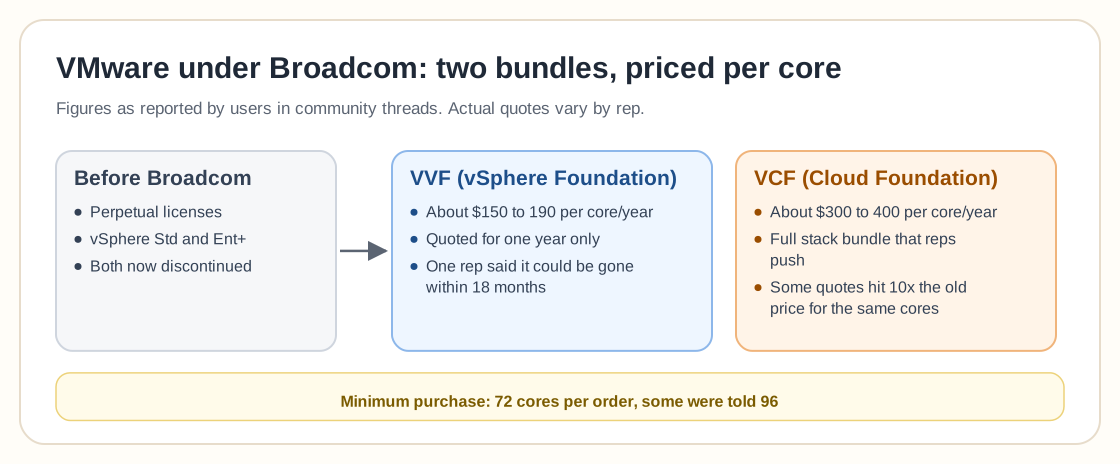
Here's what we gathered from user reports:
- VCF runs about $300 to 400/core/year.
- VVF runs about $150 to 190/core/year.
- vSphere Std and Ent+ are discontinued.
- VVF can only be quoted for one year.
- Some reps are dangling lowball quotes for "edge" VCF installs at $40/core (which many think is bogus).
- The minimum license starts at 72 cores, possibly rising to 96.
The prices frustrate people, and so does the sheer opaqueness of it all. One comment summed it up perfectly:
"We pay for VVF per core €50 and yes, only for one year with the note that this is for 2025 only and may be different in 2026."
If that sounds like pricing spaghetti, it's because it is. For a budget-focused breakdown of what this shift actually costs a small IT team, and what to do about it, see the harsh reality of VMware licensing in 2026.
Reactions range from frustration to abandonment
You'd expect some pushback, but this goes well beyond grumbling. Some users are already plotting an exit.
"We have 1.5 years to exit the VMware space."
"Why should software you host yourself be licensed based off how many cores you have? It's barbaric."
"It's clear in the long term this will destroy VMware."
Some are shifting to Oracle Cloud VMware Solution (while it still includes licensing) or considering open-source stacks. Others are bracing for Broadcom to phase out VVF altogether, since one rep reportedly said it could be gone within 18 months.
There's even a theory floating around that VMware sales reps are tossing out artificially low VCF-Edge quotes just to stop people from migrating to Hyper-V.
The bottom line: VMware is burning its goodwill
Boil it down and this is a trust issue as much as a product issue. VMware's customers have spent years, even decades, building around its stack: learning it, getting certified in it, teaching their teams, and designing their datacenters around it.
Now, with Broadcom at the helm, many feel like they're being treated as line items in a spreadsheet. In that kind of environment, customers do more than complain. They look for alternatives, whether that's open-source platforms, cloud-native stacks, KVM-based solutions, or even public cloud.
A licensing shift that turned into an identity crisis
Broadcom wants you on VCF: full-stack, tightly integrated, and tightly controlled. For many, that's not what they signed up for, and when you suddenly pay 3x or 10x more for the same core count, even the most loyal shops start exploring exits.
Right now, it feels like VMware is trying to turn every customer into an enterprise-scale VCF adopter, even if all they wanted was to run a few VMs with some decent support.
Maybe that'll work in the short term, and maybe big accounts will keep paying. But if Broadcom keeps treating customers like they have no choice, don't be surprised if more of them start making one.