

The VMware Exit Trap: Betting on a One-Year Escape From Broadcom
The anxiety behind a simple question
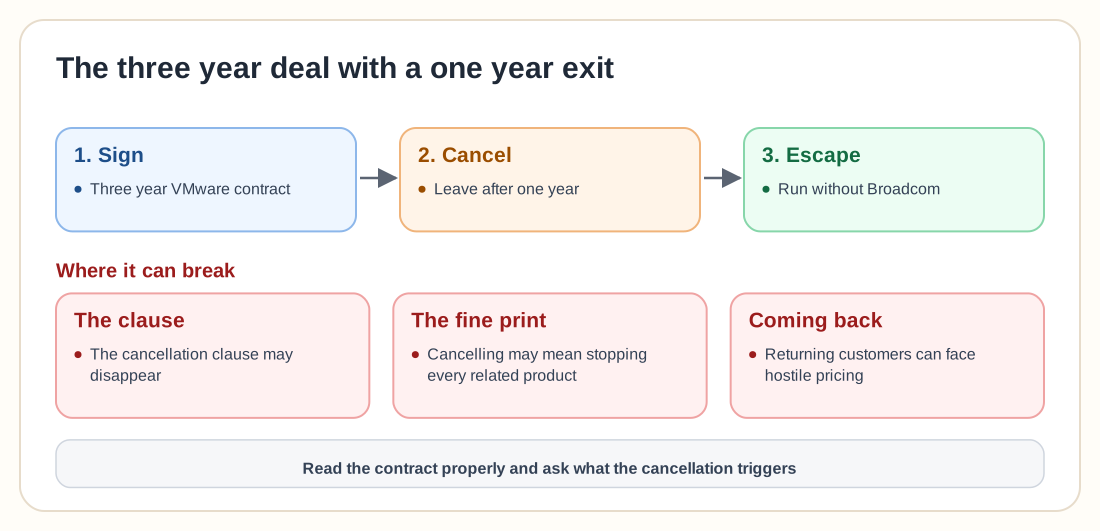
It starts disarmingly, with a simple question about canceling a subscription, but real anxiety sits underneath it. One company is being advised to sign a three-year VMware contract purely to engineer a one-year escape. That feels less like planning and more like threading a needle in a moving car.
The Great VMware Escape: Proxmox, Hyper-V, & The Future of Virtualization (2025)
What stands out is how normalized this has become. "That's the only move," one person says, almost casually. The tone is resigned rather than rebellious. Nobody is trying to outsmart the system for fun; they're trying to survive it.
The shrinking window nobody wants to talk about
Then there's timing. One commenter notes the cancellation clause itself is about to disappear: "This cancellation goes EOL this month." A clever workaround suddenly comes with a ticking clock, and if you miss the window you may be locked in for good.
Not everyone reads it as a crisis. "You should be governed by the contractual language you signed," one person counters, a reminder that contracts are commitments you signed up to honor. Fair enough, but clear rules don't make the environment around them stable.
Success stories that feel almost accidental
The success stories are short and suspiciously simple. "Yes, and we were successful. YMMV." That's the whole report, with no roadmap and no guarantees.
Another calls their exit "super easy," citing billing inconsistencies that landed in their favor. That's encouraging until you notice none of it came from a repeatable process. It came from timing, luck, or slipping through a crack before someone closed it.
The fear of burning bridges
Then comes the warning that sticks: don't come back. One voice puts it bluntly: if you leave, "be damn sure you are leaving for good."
Returning customers, another commenter suggests, face deliberately hostile pricing on top of high pricing. "It's not so much vengeful as it is 'f off' pricing," they say, framing it as strategy rather than spite. That points at a suspicion worth taking seriously: maybe the vendor has stopped trying to keep everyone and is filtering for high-value accounts while cutting the rest loose. From one angle that sounds ruthless, and from another it's just business. For the companies caught in the middle, it feels like the rules of the game are changing mid-play.
The fine print that could change everything
One piece of advice cuts through: read the contract, properly. The gotchas are real.
Some clauses can require you to stop using every related product along with the one you're canceling, which turns a tidy exit into a full-scale migration. So ask what the cancellation triggers as well as whether you can cancel at all, because the fallout can be far bigger than the line item you meant to kill.
A strategy that feels like a gamble
Step back and the plan reads as a bet. You sign the long-term deal, cancel early, and hope the clause still exists, the terms hold, and you never need to come back. That's a lot of hope for something that's supposed to be predictable.
Some call it a necessary workaround, some a move that backfires, some the new normal. Either way, the stakes go beyond one contract. The old assumptions of flexibility, long-term partnerships and predictable pricing are what's being renegotiated, and strategy, caution, and a little fear are taking their place.