

Real pay in IT 2022→2025: who lost to inflation, who beat it
Part of a 14-post series on IT jobs in the AI era. Start with the overview: IT job market 2022 to 2026: openings fell, jobs held.
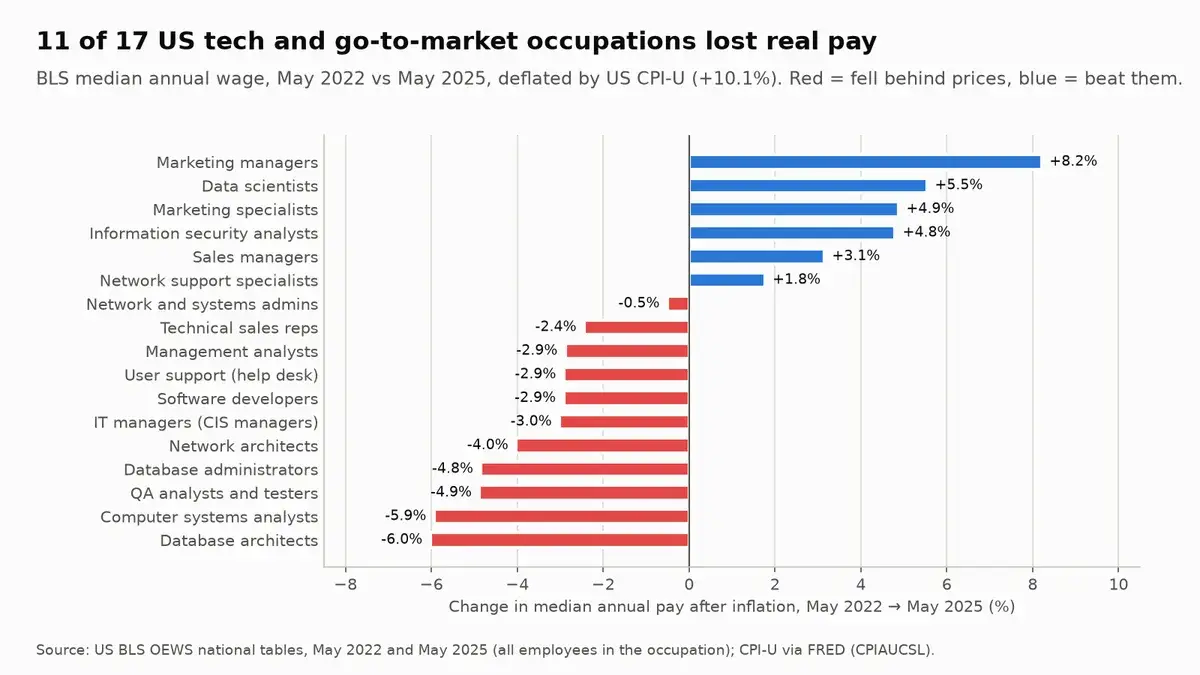
The median US software developer earned $127,260 in May 2022 and $135,980 in May 2025, a rise of 6.9 % [BLS OEWS, 2022 and 2025]. US consumer prices rose 10.1 % over the same three years [FRED CPI-U, 2025], so the median developer took a real cut of 2.9 %. Information security analysts went the other way: +15.3 % on paper, +4.8 % after inflation. Of the 17 tech and go-to-market occupations I track in the BLS data, 11 lost real pay. In Europe the picture is worse for anyone changing jobs, because offered salaries fell further behind prices than the pay of people who stayed put.
In the US, eleven of seventeen occupations fell behind
The losers are the middle of the IT org chart: database architects −6.0 %, computer systems analysts −5.9 %, QA testers −4.9 %, database administrators −4.8 %, network architects −4.0 %, IT managers −3.0 %, developers, help desk staff and management analysts −2.9 % each [BLS OEWS, 2025]. Sysadmins nearly kept pace at −0.5 %. The winners were marketing managers (+8.2 %), data scientists (+5.5 %), marketing specialists (+4.9 %), security analysts (+4.8 %), sales managers (+3.1 %) and network support specialists (+1.8 %).
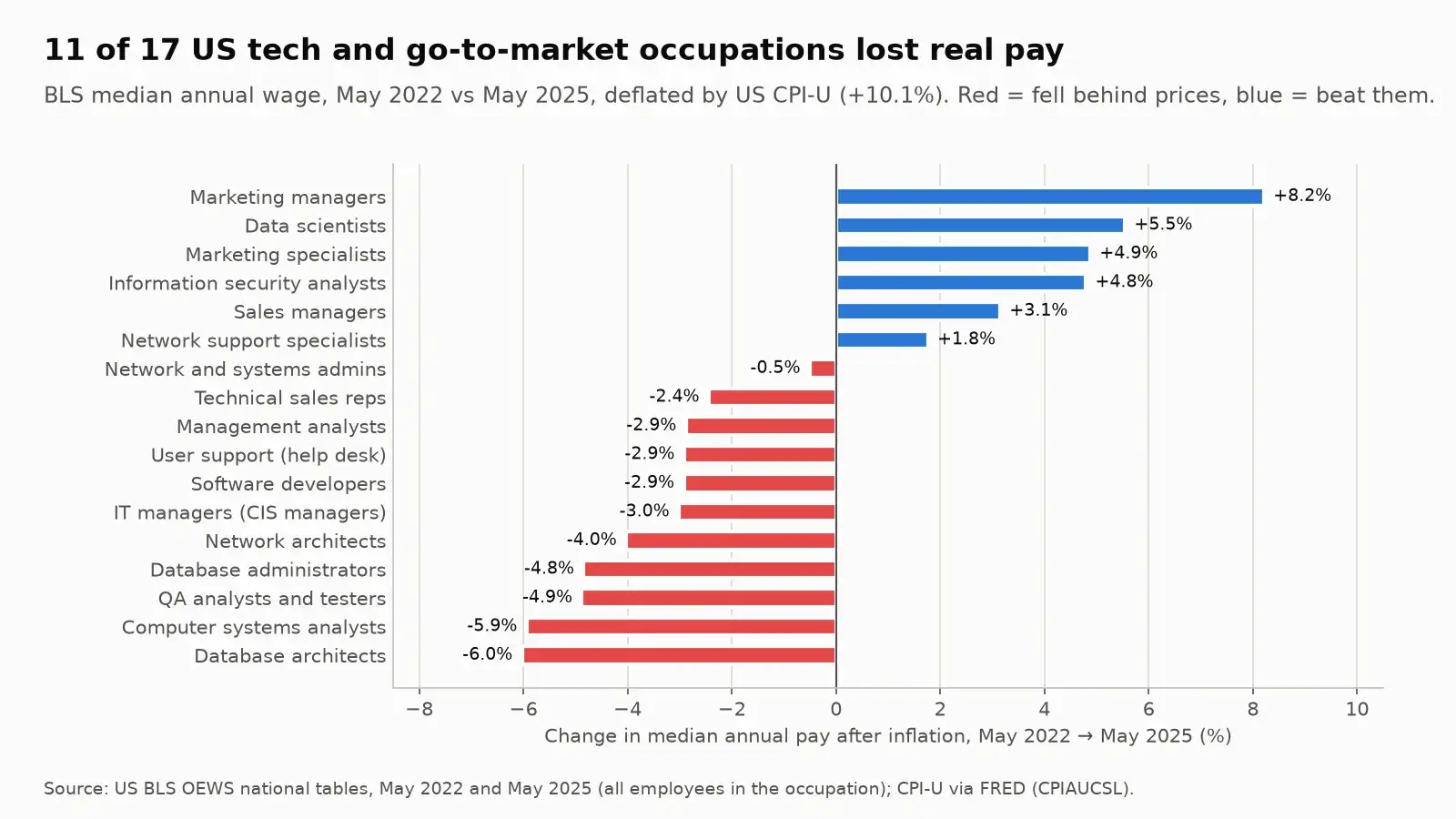 Median annual wage, May 2022 vs May 2025, deflated by CPI-U. Source: US BLS OEWS national tables; FRED CPIAUCSL.
Two of those gains need a warning. When employers stop hiring at the bottom of an occupation, the median goes up without anyone getting a raise. Network support lost 13 % of its people, mostly from the bottom, and marketing managers added 67,000 people while their job postings fell, so part of both gains comes from who is left in the job rather than from pay rises [the ai-era-it-jobs report, §8].
The Stack Overflow survey tells the same story for developers. The median US respondent reported $145,000 in 2022 and $150,000 in 2025, up 3.4 %, a third of the price rise [Stack Overflow survey, 2022 and 2025].
In Europe, people in post kept up and job offers did not
Hays publishes UK salary guides with a typical salary for each job title by region. Matching the same title in the same region between the 2023 guide (2022 data) and the 2026 guide (2025 data) gives 2,010 pairs. Their median rose 5.6 %, while UK prices rose 13.7 %, so the real change was −7.2 % [Hays UK, 2023 and 2026; the ai-era-it-jobs report, §8]. Every IT family lost. The families employers call scarce lost the most: cybersecurity −9.6 % and software development −8.9 %. IT service (−4.1 %) and infrastructure (−4.7 %) lost the least. London rose 4.7 % against 5.7 % for the rest of the UK.
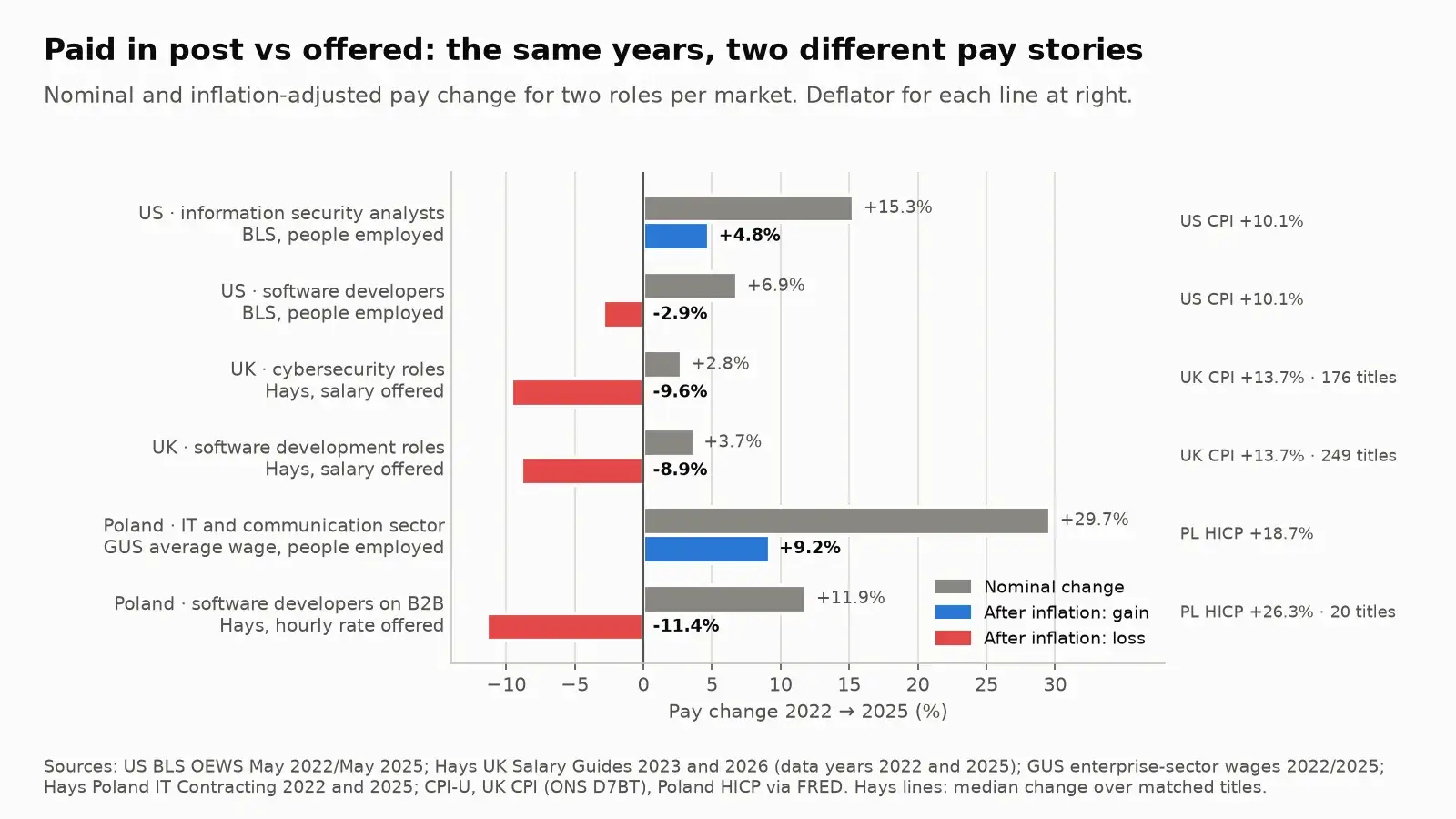 Grey: nominal change. Blue or red: after inflation. Sources: BLS OEWS; Hays UK 2023 and 2026; GUS; Hays Poland IT Contracting 2022 and 2025; CPI-U, ONS CPI, Eurostat HICP.
The official UK earnings survey (ASHE), which covers people already in jobs, shows the opposite: programmers gained about 9 % after inflation between 2022 and 2025 [ONS ASHE via the ai-era-it-jobs report, §9]. Both can be true at once: if you stayed in your job you probably kept up, but if you were looking for a new one, the offers were below what the same job paid three years earlier, after inflation.
The newest guides point the same way. Robert Half's 2027 guide raises its midpoints over the 2026 guide by 2.1 % in the US, 2.1 % in the UK and 1.6 % in Germany, against latest-year inflation of 3.7 %, 3.4 % and 3.3 % [Robert Half, 2026 and 2027]. Germany has no older guide I could collect, because Hays Germany sits behind a lead form. Payscale's German software engineer median went from €55,360 in July 2022 to €60,098 in October 2026, up 8.6 % while prices rose 15.2 % [Payscale, 2022 and 2026].
Poland: salaries beat prices, contractor rates did not
I invoice my own work as a B2B company from Warsaw, so this is the part I watch most closely. Statistics Poland's average gross wage in information and communication rose from PLN 11,334 a month in 2022 to PLN 14,696 in 2025, up 29.7 % against 18.7 % inflation, a real gain of 9.2 % [GUS, 2026; Eurostat HICP]. The enterprise average rose faster, 34.3 %, so IT's lead over the national wage shrank from 1.70 times to 1.64.
Offers lagged. Hays Poland's salaried tables rose 21.2 % for 61 matched titles between its 2022 and 2025 editions, and its B2B hourly rates for 43 IT titles rose 12.8 %, against 26.3 % inflation between January 2022 and January 2025. That is −4.0 % real for salaried offers and −10.7 % for B2B [Hays Poland, 2022 and 2025; the ai-era-it-jobs report, §8].
Bulldogjob's survey of what people actually earn shows the same split by contract type. Median take-home pay on an employment contract (umowa o pracę) rose faster than inflation in all 12 specialisations with figures for both years and both contract types. B2B rates rose less than salaried pay in 9 of the 12. Data science, ML and AI contractors went from PLN 19,500 to 20,000 a month (+3 %), architects +14 %, mobile developers +16 % [Bulldogjob, 2025]. The B2B premium is shrinking: the median programmer on B2B invoiced 2.2 times the UoP take-home in 2022 and 2.1 times in 2025.
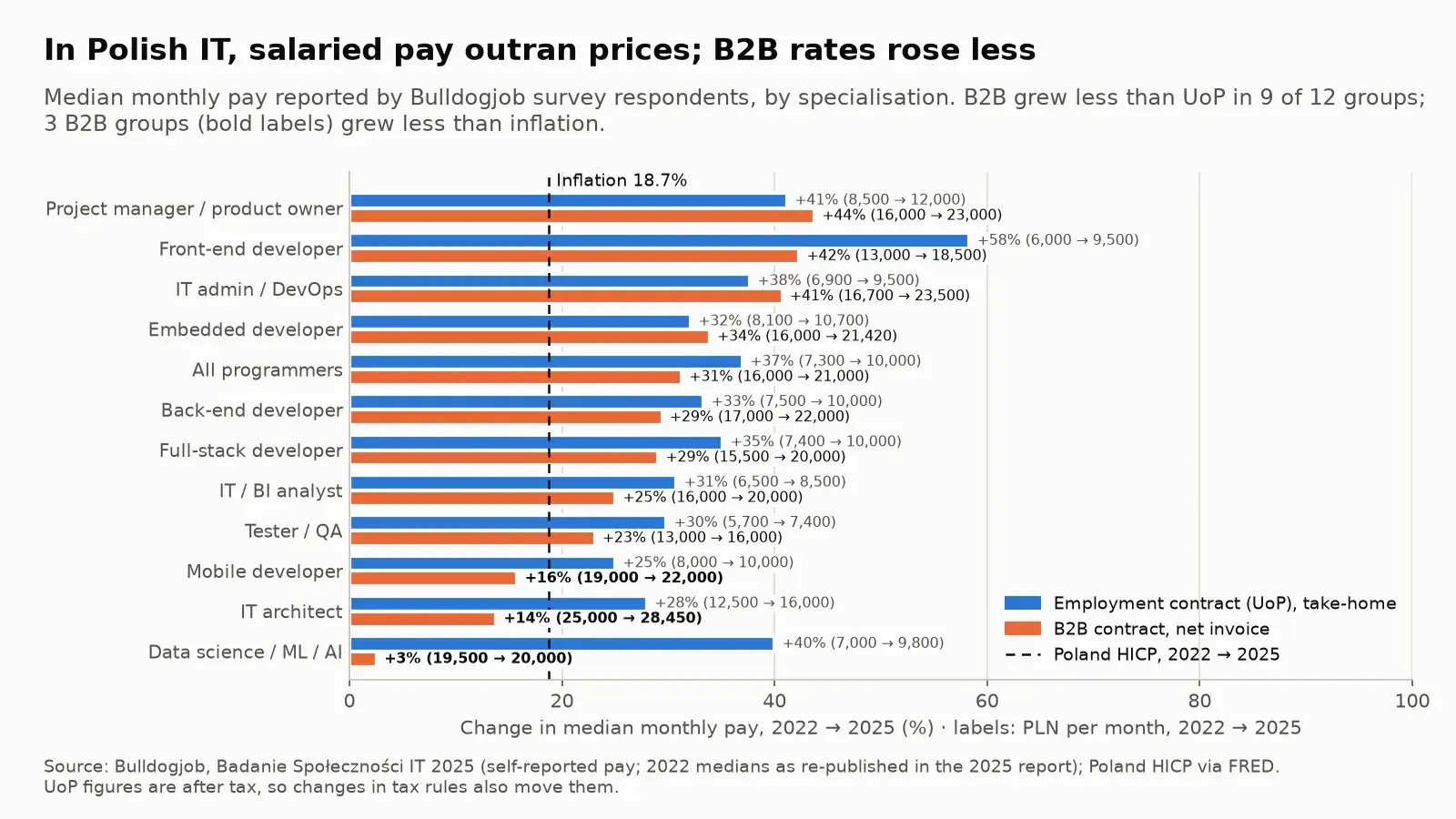 Median monthly pay reported by survey respondents; UoP after tax, B2B net invoice. Source: Bulldogjob, Badanie Społeczności IT 2025; Eurostat HICP.
The AI premium sits at the senior end
The clearest gains sit at the top of the ladder and close to AI work. Levels.fyi finds AI-specialised engineers in the US earn 6.2 % more than other engineers at entry level, 14.2 % more at senior and 18.7 % more at staff level. The staff premium rose from 15.8 % in 2024 while the entry premium fell from 10.7 % [Levels.fyi, 2025]. Its year-end report shows the gap widening: US staff engineers' median total pay rose from $425,000 to $457,000 between 2024 and 2025 (+7.5 %), entry-level engineers from $152,000 to $155,000 (+1.6 %) [Levels.fyi, 2025]. US security job ads that ask for AI skills pay 14.9 % more [AI Workforce Consortium via Help Net Security, 2026], and UK ads citing AIOps show a median of £87,500 against £70,000 for DevOps [IT Jobs Watch, 2026].
Put together, the median developer, admin, analyst and consultant lost ground to inflation while senior people who build with AI gained. I expect the premium for being junior and AI-literate to keep shrinking, because by 2026 nearly every graduate says they are.
What this means if your IT pay is up for review
- Do the inflation arithmetic before the meeting. Take your 2022 pay and add the price rise since: 10.1 % in the US (May 2022 to May 2025), 15.2 % in the UK (April to April), 18.7 % in Poland. If your pay rose less, you took a cut, and you can walk in with the exact figure.
- If you are on B2B in Poland, price yourself against the UoP alternative every year. The gap has narrowed, and offered B2B rates lost about a tenth of their value in three years. Write inflation indexation into your next contract.
- Get your AI work reflected in your level and title. The premium is paid at senior and staff level for shipped work, so ask for the scope that matches what you already deliver with AI tools, and keep a record of the systems you built and the time they saved.