

Nvidia AI Factories: Why Revenue Sharing Hit Pause
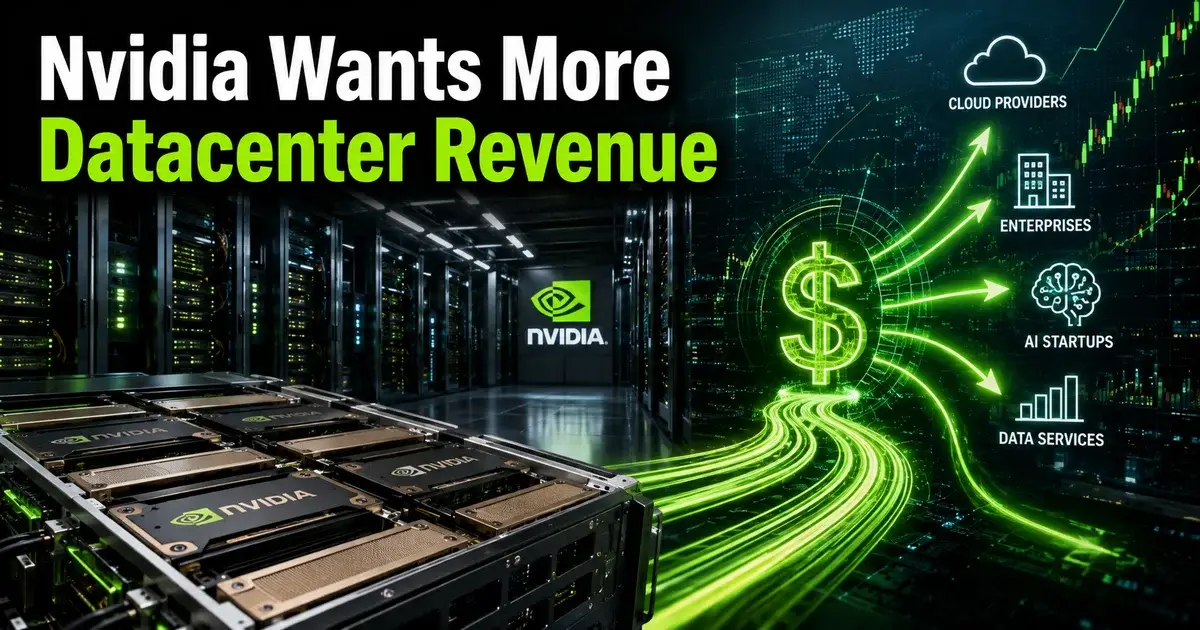
Nvidia's AI infrastructure strategy now reaches beyond selling GPUs into helping finance the data centers that contain them. In 2026 the company introduced a model that combines take-or-pay capacity commitments with revenue sharing, but reports on August 28 say at least some agreements were paused after internal concerns about competition scrutiny and how much control Nvidia could exercise over cloud partners.
This story is easy to reduce to "Nvidia backed away from data centers," which would be wrong. Nvidia's own July and August announcements show that it is still pushing DSX AI factories and third-party financing at enormous scale. The narrower issue is the specific revenue-sharing structure and the conditions attached to some partner deals.
What was Nvidia trying to do with AI cloud financing?
Nvidia was trying to solve a financing problem for AI cloud providers that have demand for compute but limited ability to fund large facilities independently. Its model paired Nvidia hardware purchases with a commitment by Nvidia to pay for some capacity if third-party customers did not take it.
In its fiscal second-quarter 2027 filing, Nvidia said selected AI cloud partners procure Nvidia data center infrastructure while Nvidia commits to cloud-service agreements. Those commitments typically run for six years and totalled $36 billion as of July 26, 2026.
Nvidia's earnings call described the commercial logic more directly. The company provides a minimum revenue guarantee through a take-or-pay commitment on part of the facility's capacity. In exchange, Nvidia shares in some revenue earned above that floor.
That gives lenders a stronger contracted revenue base, which can make an infrastructure project easier to finance. Nvidia gets the hardware sale and potentially a continuing revenue stream tied to the use of that hardware.
If you want the physical-infrastructure context behind these deals, the Mr.PlanB Data Center and AIOps section is where power, cooling, rack density, financing, and operating constraints meet.
Why would Nvidia want to earn revenue after the GPU sale?
Recurring usage-linked revenue can expand Nvidia's economics beyond a one-time equipment purchase. Nvidia said exactly that on its August earnings call, describing the model as a way to be paid on the hardware sale and again through a share of rental revenue.
That also aligns Nvidia's incentives with utilisation. If a partner fills the facility with paying customers, Nvidia benefits. If demand is weak, Nvidia's take-or-pay commitment can absorb some of the unused capacity.
The model therefore moves Nvidia closer to the business risk of running compute infrastructure without turning Nvidia into the direct owner of every data center. Independent capital still finances the projects, according to Nvidia.
This is strategically attractive because AI infrastructure is capital intensive. Nvidia can help expand the market for its own systems by making financing easier for customers that do not have hyperscaler balance sheets.
What did the reported partner terms look like?
Golem's August 28 report, citing The Wall Street Journal, says Nvidia sought a minimum GPU rental price intended to cover operator costs and depreciation, with Nvidia taking 50 percent of revenue above that level in some arrangements. The report also says Nvidia offered financing and project support plus capacity guarantees.
The same report says some proposed terms went beyond economics. Nvidia reportedly wanted influence over which customers could rent the hardware and preferred a broader base of smaller customers rather than allowing one large customer to absorb capacity in ways that might compete with Nvidia's own plans.
Those details are central to the concern. A chip supplier providing a financial backstop is one thing. A dominant supplier influencing customer selection, rental economics, and capacity distribution creates a different competition question.
Because these terms come from reporting about specific agreements, they should not be assumed to apply identically to every Nvidia financing partnership.
Why did Nvidia pause some revenue-sharing deals?
Reports say internal Nvidia concerns focused on potential competition scrutiny and the degree of involvement in customers' operations. Golem says at least some contracts were temporarily suspended while the model was reconsidered.
The timing matters because Nvidia is already central to the AI data center supply chain. Its hardware, networking, software, reference architectures, and financing relationships touch many layers of an AI factory.
When one supplier can influence the hardware, the financing floor, the rental price, and which customers receive capacity, regulators may ask whether that position restricts competition even if each individual contract is commercially rational.
A pause therefore does not mean the economics failed. It can mean the governance around those economics needs to change.
Is Nvidia still financing AI infrastructure?
Yes. Nvidia announced on August 11 that it is working with Apollo, BlackRock, Blackstone, Brookfield, Goldman Sachs, and KKR on independent financing platforms intended to mobilize more than $500 billion of third-party capital over time for AI infrastructure.
That broader capital strategy is separate from the question of how an individual neocloud revenue-sharing agreement is structured. Nvidia also continues to promote the DSX platform as a design and operating framework for AI factories.
The distinction matters. DSX is an infrastructure platform and playbook. Revenue sharing is a commercial model. Third-party financing platforms are a capital structure. They can evolve independently.
For buyers comparing infrastructure models, our comparisons section applies the same discipline: separate the technology layer from the contract layer because a good platform can still come with a bad dependency.
What is the risk for AI cloud providers?
The benefit is easier access to capital and hardware. The risk is that the provider becomes economically dependent on the same supplier that sells the core compute platform.
A take-or-pay guarantee can make a lender comfortable, but it can also shape pricing and customer strategy. If the guarantee is removed later, refinancing may become harder. If a provider builds its sales plan around terms set by Nvidia, changing GPU vendors can become more difficult than changing hardware alone.
The operator therefore needs to model two exit paths. One is technical: can workloads run on another accelerator platform? The other is financial: what happens to debt, pricing, and utilisation if the supplier guarantee changes?
These are infrastructure questions because contracts can become architecture. A six-year capacity commitment can influence which hardware is installed, how much is built, and which customers the operator needs to attract.
Does this create circular AI spending?
There is a legitimate reason to examine the circularity, but the existence of a guarantee does not prove artificial demand. Nvidia's filing says partners can sell the capacity to third parties at more advantageous rates, which reduces Nvidia's commitment as customer demand takes over.
The concern appears when supplier support becomes necessary to justify the build and the build then purchases more of the supplier's products. Investors need to understand how much end-customer demand exists independently of the guarantee.
For operators, the practical version is simpler: ask who is paying when utilisation is low. If the answer is the hardware supplier, understand the duration, cancellation rights, and what happens after that support expires.
What would I watch next?
I would watch whether Nvidia publishes revised revenue-sharing terms that reduce control over partner pricing and customer selection while preserving enough capacity support to satisfy lenders. That would show the company is adjusting the governance rather than abandoning the financing idea.
I would also compare the growth of independent financing platforms with direct Nvidia commitments. If institutional capital can underwrite AI factories based on diversified customer demand, Nvidia needs less direct commercial involvement.
Finally, I would watch utilisation rather than announced megawatts. The strongest proof of the AI factory model is not how much capital can be raised. It is whether customers keep paying to use the compute after guarantees and launch incentives fade.
If I were an AI cloud operator, I would take supplier-backed financing only if the customer, pricing, and exit restrictions left enough room to operate independently. Cheap capital is useful. A financing agreement that quietly decides your market for you is much more expensive than it looks.
Frequently Asked Questions
What was Nvidia's AI data center revenue-sharing model?
Nvidia introduced a 2026 model in which selected AI cloud partners bought Nvidia infrastructure while Nvidia provided take-or-pay capacity commitments and shared in revenue above an agreed floor. Nvidia reported $36 billion of commitments under these agreements as of July 26, 2026.
Did Nvidia cancel its AI cloud financing program?
Reports on August 28, 2026 said Nvidia paused at least some revenue-sharing agreements after internal concerns about competition scrutiny and operational control. Nvidia continues to promote AI infrastructure financing and DSX partnerships, so the broader strategy has not disappeared.
Why is Nvidia financing AI data centers?
Nvidia says some AI cloud providers have customer demand but cannot finance large infrastructure builds on their balance sheets alone. Capacity guarantees can make projects easier for independent lenders to finance while also increasing deployment of Nvidia hardware.