

Germany Data Centers: 120 Projects, 5 GW at Stake
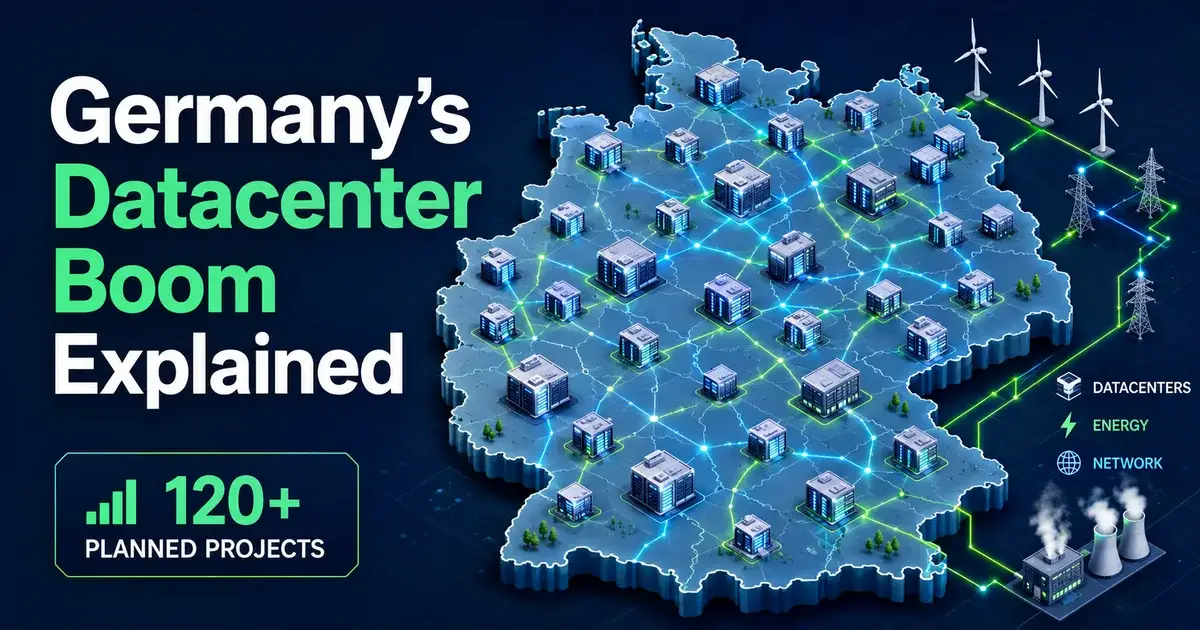
Germany's data center buildout has grown large enough to be a grid-planning issue as well as a technology story. A new 2026 mapping project has collected information on 120 planned data center projects and estimates at least 5,000 MW of planned connection capacity, while the federal government wants national data center capacity to at least double by 2030.
Keep in mind that the 120-project map is not an official government inventory. FragDenStaat, AlgorithmWatch, Leitmotiv, and the Heiße Luft collective assembled it from publicly available information and freedom-of-information requests. I compared that reporting with Germany's official 2026 data center strategy so the political criticism and the government's stated targets don't get mixed together.
What does the new German data center map show?
The map shows 120 planned projects and an estimated minimum of 5,000 MW of grid connection capacity. Where the information is available, it also collects location, project status, electricity demand, and water use.
That helps, because the real infrastructure footprint of a data center boom is scattered across planning applications, local authorities, utilities, developers, and corporate announcements. A single project may look manageable, while dozens of multi-megawatt projects in overlapping regions create a different problem.
Connection capacity deserves particular attention. It describes the electrical capacity a facility expects to be able to draw from the grid, which is not necessarily its average IT load on day one. Even so, planned connection capacity is one of the clearest signals of what utilities may need to reserve, reinforce, or build around.
If you work closer to the racks than the policy layer, our Data Center and AIOps section covers the same issue from the operator side, where power and cooling limits eventually turn into application and availability limits.
What is Germany trying to achieve by 2030?
Germany's federal data center strategy says national data center capacity should at least double by 2030 and computing capacity for HPC and AI should at least quadruple. The government presents this as part of its competitiveness and technological sovereignty agenda.
The strategy also acknowledges the bottlenecks. It says grid connection capacity is scarce in existing hotspots, connection times can be long, and energy planning is not coordinated well enough with data center location planning.
That tension runs through the whole debate. Germany wants more local compute, especially for AI, and it also needs affordable electricity, renewable energy, efficient cooling, sensible land use, and functioning local infrastructure.
These goals can coexist, though that won't happen on its own. A policy target to double capacity still has to turn into substations, transmission capacity, generation, cooling systems, fibre routes, permits, construction crews, and operating staff.
Why is 5 GW of planned capacity such a big number?
Five gigawatts is significant because data centers behave like concentrated industrial electrical loads. They need reliable power for long periods, and their business model depends on keeping expensive compute equipment utilised.
The 5,000 MW figure is the mapping project's estimate of planned connection capacity. Don't read it as 5 GW of servers already running or as a forecast of simultaneous load, since some projects may be delayed, resized, or never built.
Even with that caution, the number is large enough to make location strategy critical. If several projects target the same grid region, a theoretically attractive site can become difficult to connect. Germany's official strategy specifically names constrained grid capacity in existing hotspots as a weakness.
For infrastructure buyers, data center location can therefore affect more than latency and price. It can shape deployment schedules, expansion options, power contracts, and the provider's ability to add capacity later.
Are new data centers really about digital sovereignty?
Some are, but building a facility in Germany does not by itself create digital sovereignty. The federal strategy treats domestic compute capacity as part of technological sovereignty, while critics argue that foreign-owned providers can build German facilities and remain subject to external corporate and legal dependencies.
Both points can hold at once. Physical capacity inside Germany gives organisations more local options and reduces one kind of dependency, while ownership, software control, supply chains, and legal jurisdiction determine the others.
A useful definition of digital sovereignty is the ability to make meaningful technology choices and keep control over critical data, infrastructure, and exit paths. Location helps, but it is only one layer.
The same thinking shows up in smaller infrastructure decisions. Teams comparing Proxmox, VMware, public cloud, and private cloud are often deciding which layers they are willing to outsource and which they want to operate directly.
Why are local communities pushing back?
Local objections center on power, water, land use, heat, and whether promised local economic benefits justify the infrastructure burden. Golem's reporting on the mapping project includes strong criticism from political and civil-society actors who argue that municipalities do not always get enough transparent information early in the planning process.
Those claims are positions in an active policy debate, and they don't prove that every project is harmful. Data center designs vary widely. Cooling technology, water demand, waste-heat reuse, power sourcing, site history, and local grid conditions can make two projects with similar IT capacity look very different environmentally.
The practical fix is better project-level data. Before communities can judge the tradeoffs, they need the expected connection capacity, water design, cooling method, heat-reuse plan, construction footprint, operating jobs, and phased build schedule.
Operators should want the same transparency, because hidden infrastructure constraints eventually become operational constraints.
What should infrastructure teams watch next?
First, watch how many of the 120 projects reach permitting, financing, and grid-connection milestones. Announced capacity is easy to count, but energised capacity is what changes the market.
Second, watch where Germany adds grid capacity and whether connection queues become a competitive advantage for certain regions. A provider with secured power may be able to deploy new capacity faster than one with better real estate and no firm connection date.
Third, watch how regulation treats efficiency, renewable energy, cooling water, and waste heat. Those requirements can change site economics and can favour operators that design facilities around local energy systems instead of treating power and heat as externalities.
Our storage section makes a similar point at a smaller scale, where advertised capacity and usable, recoverable capacity are two different numbers. Datacenters face the same gap with megawatts.
Would I avoid German data centers because of the bottlenecks?
No. I would treat Germany as an important European data center market and get much more specific about location and provider capacity commitments. The federal strategy confirms political support for expansion, and it also confirms that grid constraints are real.
If I were selecting a provider, I would ask whether future capacity is already powered and permitted, how the site cools high-density racks, what happens when the local grid is constrained, and how expansion commitments are backed contractually. A glossy plan for another building is no substitute for secured megawatts.
Choosing purely on current rack price can work for workloads with no growth requirement and easy portability. For long-lived infrastructure, I would rather pay attention to the provider's power pipeline now than discover the limit when the next cluster has nowhere to go.
Frequently Asked Questions
How many new data center projects are planned in Germany?
A 2026 civil-society mapping project compiled 120 planned data center projects from public information and freedom-of-information requests. It estimates at least 5,000 MW of planned grid connection capacity across those sites.
What is Germany's official data center target for 2030?
Germany's 2026 federal data center strategy says national data center capacity should at least double by 2030. It also aims to at least quadruple computing capacity for high-performance computing and artificial intelligence.
Why are data centers a grid planning problem?
Large data centers need high-capacity electricity connections for long periods, often in places where grid capacity is already constrained. Germany's federal strategy names scarce grid connection capacity and long connection times as weaknesses in existing data center hotspots.