

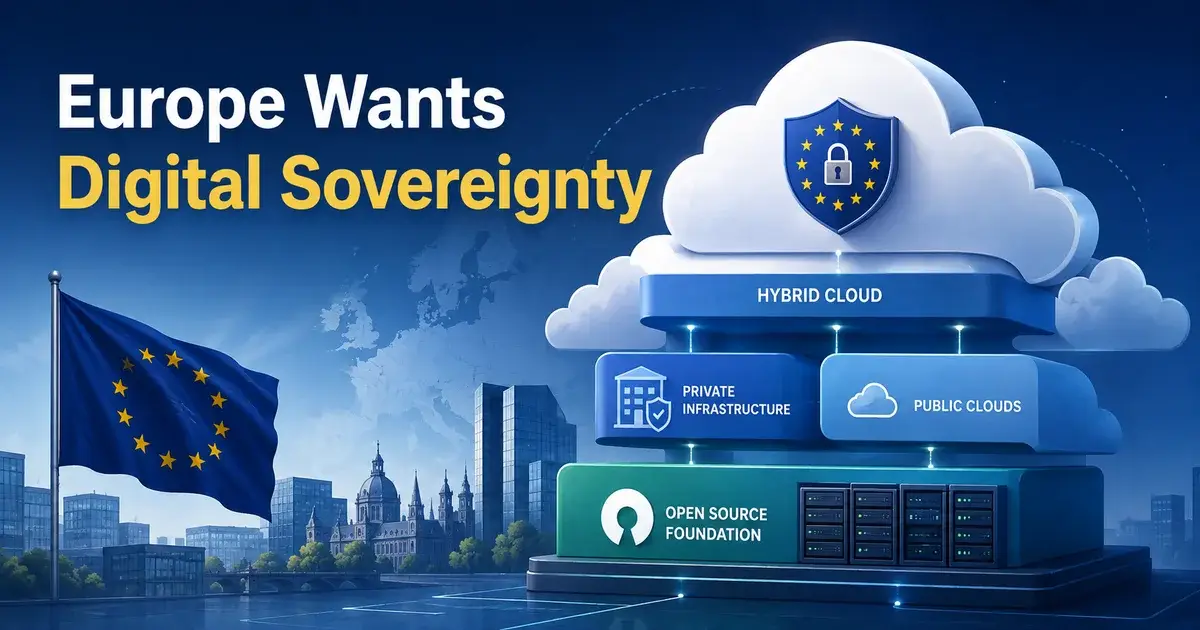
Digital Sovereignty: Why Open Source and Hybrid Cloud Matter
In Europe, digital sovereignty is turning from a policy slogan into an architecture requirement. In June 2026, the European Commission put open source, cloud and AI capacity, semiconductors and strategic autonomy into one tech sovereignty package. For infrastructure teams the practical consequence is clear: you need to know which parts of your stack you can control, move, inspect and replace.
An August 2026 article from Red Hat Italy argues that open source and hybrid cloud are central to an Italian sovereignty strategy. That is an industry viewpoint, so I checked it against the European Commission's own 2026 policy pages. The overlap is substantial: the Commission explicitly places open source at the centre of technological sovereignty and proposes a common framework for cloud and AI sovereignty.
What does digital sovereignty actually mean?
Digital sovereignty means keeping meaningful control over critical technology choices, data, infrastructure and dependencies. The European Commission describes tech sovereignty as the ability to act independently in the digital world while reducing reliance on non-EU providers.
That definition is broader than data residency. A database can sit in Frankfurt while the control plane, software ownership, support authority, cryptographic keys or parent company remains outside Europe, so the data is local while several layers of control may not be.
For an infrastructure team, sovereignty turns into a set of concrete questions. Can you export the data in a usable format? Can you operate the workload on another platform? Can you inspect or replace important software components? Who can administer the service? Which legal entity controls it? How long would an exit take?
Those questions fit naturally with the operator approach in our infrastructure comparisons, where the real cost of a platform includes migration and recovery as well as the purchase price.
Why is the EU putting open source at the centre?
The European Commission's June 2026 Open Source Strategy says open source can reduce dependence on non-EU technologies and increase control over critical digital infrastructure. It points to freedom from lock-in, inspectable code, reuse and stronger European technology ecosystems.
Open source helps because no single vendor controls the software the way it controls a closed proprietary product. An organisation can inspect code, run it on different infrastructure, contract different support providers and contribute fixes where the project's governance allows it.
Open source is still not sovereign by default. A project can depend on one small maintainer group. A company can run open software while tying identity, billing, backups and automation to proprietary services. A source available component can look open while its licence limits practical freedom.
So the useful standard is control rather than ideology: open source earns its place when it creates a credible alternative path.
Why does hybrid cloud keep appearing in sovereignty discussions?
Hybrid cloud lets organisations place different workloads in different environments instead of making one provider the default for everything. Sensitive systems can stay on infrastructure the organisation controls, while other workloads use public cloud services where the economics or managed capabilities make sense.
The Red Hat Italy article makes this argument directly, presenting open hybrid cloud as a way to decide where and how workloads run. The European Commission's 2026 Cloud and AI Development Act also treats sovereignty as a graded set of assurance requirements instead of a single yes or no label.
I find that a better mental model. Not every workload needs maximum sovereignty, and a public website has a very different risk profile from a national identity database.
A hybrid architecture works when the boundary is deliberate. If every application depends on one cloud's proprietary database, event bus, identity service and observability stack, putting a few VMs on premises does not create much freedom.
Does Proxmox fit a digital sovereignty strategy?
Proxmox can fit one because it gives organisations an open source virtualization platform they can operate on their own hardware or through service providers. It can reduce dependence at the hypervisor and private cloud layer, but it does not solve sovereignty across the whole application stack.
Our Proxmox guide helps here because it shows the difference between owning the platform layer and owning every dependency. Proxmox VE can give you control over virtual machines, containers, storage integration, networking, clustering and backup integration. Your workloads can still depend on proprietary databases, SaaS identity, external APIs or hardware from a concentrated supply chain.
The honest claim is modest: an open virtualization layer can improve optionality, and it does not make an organisation digitally independent by itself.
What should a sovereign cloud exit plan contain?
A credible exit plan should tell you how to leave before you sign the contract. If the answer is "we will work it out later," what you have is a dependency without a strategy.
Start with data format and volume. Know what can be exported, how long it takes, what transfer charges apply, and whether application metadata comes with the data. A ten terabyte test export tells you more than a portability slide.
Then map identity. If every administrator, machine account, application token and policy depends on the provider's identity system, migration becomes an identity project before it becomes a compute project.
Next, map the managed services that have no direct equivalent elsewhere. Some of them may be worth keeping; the point is to know which dependencies are intentional and which ones appeared because a team picked the easiest default.
Finally, test a small migration. You have to prove portability, because a contract clause alone will not give it to you.
Is European ownership enough for sovereignty?
No. European ownership can reduce one category of legal and corporate dependency, but technical control still matters. A European service built on a tightly coupled non-European proprietary stack can inherit important dependencies from that stack.
The reverse is also true. A non-European provider may offer strong encryption controls, contractual protections, local operations and export tools that serve a lower risk workload better than a nominally sovereign platform with weaker engineering.
That is why the Commission's proposed cloud sovereignty framework has multiple assurance levels. Different workloads need different levels of control, and provider characteristics need to be assessed instead of assumed from a flag on the website.
If you are building more of the stack yourself, our storage section is where the sovereignty discussion gets concrete. ZFS, Ceph, Proxmox Backup Server, NFS and object storage all come with different operational and portability tradeoffs.
What should European infrastructure teams do in 2026?
I would classify workloads by the consequence of external dependency and then design sovereignty around the ones that matter most. Do not start by declaring that everything must move out of public cloud. Start by identifying which systems you cannot afford to lose control over.
For those systems, favour open formats, documented APIs, replaceable components, independent backups and tested migration paths. Put identity and encryption keys under deliberate governance. Record which dependencies you accept because they provide enough value to justify the exit cost.
I would also treat open source as a tool for optionality rather than a badge. If your team cannot patch, monitor, upgrade and recover the open platform, operating it yourself can reduce reliability even while it increases theoretical control.
The opposite choice, a highly managed proprietary cloud, is sensible when speed and service depth matter more than infrastructure independence and the workload can tolerate that dependency. Sovereignty works best when it is risk based, and it turns into expensive theatre when every system gets the same answer.
Frequently Asked Questions
What is digital sovereignty in cloud computing?
The European Commission defines tech sovereignty as Europe's ability to act independently by developing and controlling key technologies, data, and infrastructure while reducing strategic dependencies. In cloud architecture, that means looking beyond data location to ownership, software control, portability, operations, and legal exposure.
Why does open source matter for digital sovereignty?
The European Commission's June 2026 Open Source Strategy places open source at the centre of its tech sovereignty policy because inspectable and reusable software can reduce lock-in and increase control over critical digital building blocks. Open source still needs competent operations, maintenance, and supply chain governance.
Is hybrid cloud automatically sovereign?
No. Hybrid cloud can improve control by letting an organisation choose where workloads and data run, but sovereignty depends on the architecture. A hybrid platform with proprietary control planes, data that is hard to export, or identity dependencies can still create strong vendor lock-in.