

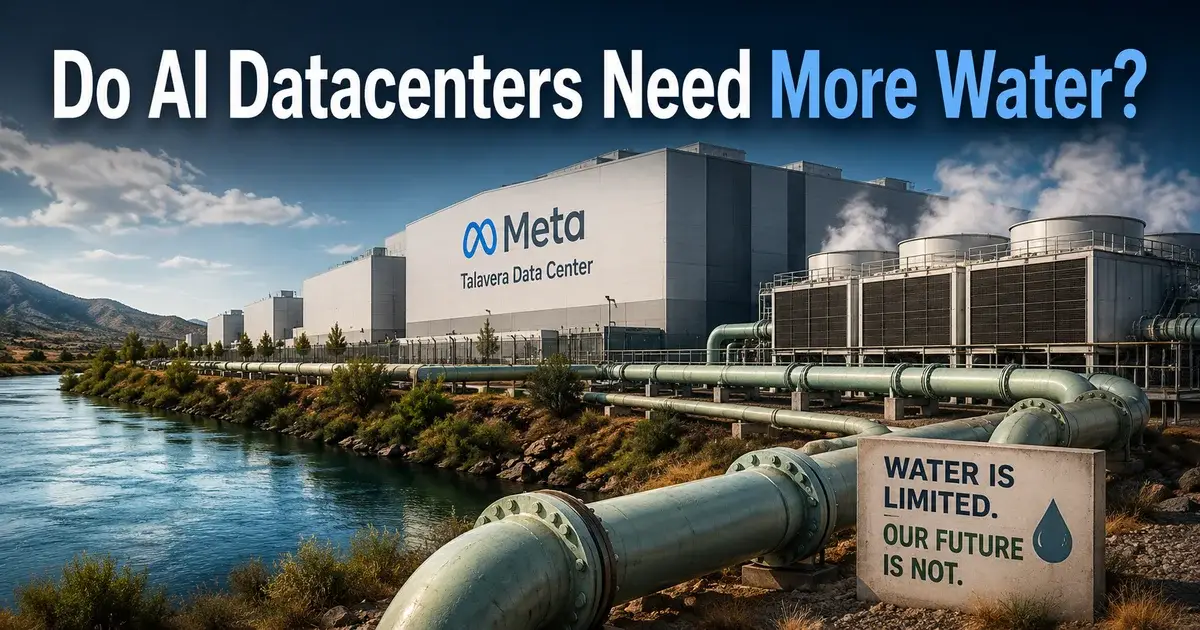
Meta Data Center Water: What Talavera Tells Us
Meta's planned data center in Talavera de la Reina shows why water claims need precise definitions. The project was redesigned to use dry-air cooling, which appears to have cut direct cooling water dramatically, but public 2026 material still contains several different numbers because some describe the data center, some the wider development area, and some government communications use another figure.
The project is moving forward after Castilla-La Mancha approved the land reparceling in August 2026, clearing a path toward construction licensing. I compared the regional government's announcements with iAgua's review of the environmental documentation because the investment and water figures differ depending on which project stage and scope is being described.
How much water will the Meta data center use?
The safest answer is that the published figures describe different scopes and should not be collapsed into one number. Castilla-La Mancha said in August 2026 that direct water consumption would be 0.2 hm³ per year, which equals about 200,000 cubic metres or 200 million litres.
However, iAgua's review of the environmental file says the environmental impact declaration attributes about 40,600 cubic metres per year of net consumption to the data center itself. Of that, roughly 40,000 cubic metres is potable water and about 600 cubic metres is industrial water associated with cooling.
The wider project area has another number: about 504,500 cubic metres per year. That figure includes uses outside the data center itself, such as the surrounding development, green areas, and river park.
This is why a headline saying "the data center uses 0.5 hm³" can be misleading if it does not explain that the figure covers the wider project area. The opposite headline, saying cooling needs only 600 cubic metres, is also incomplete if the reader assumes that is the entire site's water demand.
Why did the cooling water requirement fall so much?
The major change was a redesign from water-based cooling to dry-air cooling. Reporting on the project says the original concept had much higher cooling-water estimates, while the revised environmental design leaves only about 600 cubic metres per year assigned specifically to cooling water.
Dry-air cooling rejects heat primarily through air rather than evaporating large volumes of water. That can be attractive in regions where water availability is politically and environmentally sensitive.
The tradeoff is not free. Air cooling can require more fan energy and can become harder to operate efficiently during high ambient temperatures, especially as rack density rises. The complete design still has to balance electricity, cooling capacity, climate, and equipment temperature limits.
For a wider look at how thermal choices affect facility architecture, see the Mr.PlanB Data Center and AIOps section. Water is one resource in a system that also has hard limits around power and heat rejection.
Why are there three different 2026 water figures?
They are measuring different things, and one of them appears in government communication rather than the environmental file in the same form. That is the central reporting problem around the project.
The first figure is about 600 cubic metres per year for cooling water in the redesigned dry-air system. The second is about 40,600 cubic metres of net data center consumption in the environmental documentation. The third is about 504,500 cubic metres for the wider project area.
Castilla-La Mancha's August 25 communication uses 0.2 hm³ per year for the installation. iAgua notes that this 200,000 cubic metre figure does not appear in the environmental file in the same way and should therefore be distinguished from the documented project-scope numbers.
This does not automatically mean one side is wrong. It means readers need the denominator and scope. Is the number cooling only, building operations, the data center parcel, or the entire development area?
Infrastructure reporting would improve immediately if every water number were published with that label.
Where will the water come from?
The project is expected to use Talavera de la Reina's municipal water network rather than a direct Meta intake from the Tagus River. iAgua reports that the municipal network is supplied through the Alberche system within the Tagus basin.
That makes the project part of a shared urban water system. The relevant question is therefore not only how efficient the data center is internally, but what its additional demand means for municipal storage, treatment, drought planning, and other users.
The environmental documentation includes infrastructure work intended to support the increased demand, according to iAgua. Regional authorities have argued that the water requirement can be accommodated and that wastewater treatment capacity is sufficient.
Opponents and environmental groups have pushed for caution because the Tagus basin has experienced water stress. Those are competing assessments about regional capacity, which is why the exact scope of consumption matters.
Is the Meta project a €1 billion data center?
The project has been described with both roughly €1 billion and €750 million investment figures, and those numbers come from different points in the project's development. Meta's 2022 Spain announcement confirmed the plan to begin the process for a new data center in Castilla-La Mancha, while later project coverage associated the original plan with investment around €1 billion.
Castilla-La Mancha's August 11, 2026 announcement describes €750 million in private investment for the campus. iAgua says the environmental documentation also uses €750 million, including €685 million for construction.
The responsible way to write this is to keep both figures and dates visible rather than choosing the larger number for a headline and pretending the project never changed.
The same discipline should apply to capacity, jobs, and water. Data center projects evolve through permitting and redesign, sometimes over several years.
What does Talavera teach about data center sustainability claims?
It shows that a single efficiency metric can hide system tradeoffs. Reducing cooling water from billions of litres in an early concept to a much smaller dry-air requirement is meaningful. It does not answer every question about the wider site's total water use, electricity demand, land, or heat.
A good sustainability review separates direct cooling water from total site water, and separates both from regional water availability. It also asks whether lower water use increases electrical cooling demand and whether the power system can support that choice during hot weather.
The same system thinking appears in our storage guide. A storage platform can optimise capacity while hurting latency or recovery. Datacenter cooling can optimise water while shifting cost into energy. One metric does not describe the architecture.
Should operators prefer dry-air cooling in water-stressed regions?
I would strongly consider it where climate and rack density make it technically practical, but I would not choose a cooling method from water use alone. The facility needs a full-year thermal model that includes peak outdoor temperature, IT load, fan energy, redundancy, and the temperature limits of the equipment.
For public reporting, I would publish four separate figures: direct cooling water, total data center water, wider site water, and the source of that water. That would make projects like Talavera much easier to evaluate without arguments caused by incompatible numbers.
The opposite choice, using evaporative or water-assisted cooling, can still make sense where water availability is adequate and the energy efficiency benefit is material. The right answer is local. What Talavera demonstrates is that cooling architecture can change the water story by orders of magnitude, so the design choice deserves the same scrutiny as the headline investment number.
Frequently Asked Questions
How much water will Meta's Talavera data center use?
There is no single 2026 figure that describes every part of the project. Castilla-La Mancha has publicly cited 0.2 hm³ per year for the installation, while environmental documentation reported by iAgua attributes about 40,600 m³ per year of net use to the data center itself and about 504,500 m³ to the wider project area.
Why did Meta reduce water use at the Talavera data center?
The project was redesigned from water-based cooling to dry-air cooling. Reporting based on the environmental file says water used strictly for cooling fell to about 600 m³ per year, far below earlier estimates for the original cooling design.
How much is Meta investing in Talavera de la Reina?
Meta's earlier project announcement was associated with investment around €1 billion, while Castilla-La Mancha's 2026 approval announcement describes €750 million of private investment. The figures come from different project documents and dates, so they should be kept separate.