

MinIO in Maintenance Mode: Best Self-Hosted S3 Alternatives
If you're into self-hosting, chances are you've crossed paths with MinIO at some point, and now that its open-source version is in maintenance mode, you may be looking for MinIO alternatives. MinIO has been one of the go-to solutions for S3-compatible object storage, a sleek, powerful, enterprise-ready option that played nice in both hobbyist labs and serious production environments. That's why, when MinIO dropped the bomb in their GitHub README with little fanfare, stating that the open-source version was entering "maintenance mode," the reaction was instant and loud: frustration, confusion, and a lot of scrambling.
For the self-hosting crowd, this felt like a betrayal more than a technical shift. A project built on the strength and enthusiasm of its open-source community had effectively ghosted the very people who helped it grow.
So what now?
What did MinIO actually do?
In their latest README update, MinIO announced they would no longer accept new changes or review issues in the open-source repo. Critical security fixes might get evaluated, if you're lucky. For anyone relying on MinIO in a serious capacity, especially for internet-facing workloads, that kind of "maybe we'll patch it" approach raises massive red flags.
It also became clear this wasn't a spontaneous move. According to some longtime users, the signs had been there for a while, from pulling the web GUI out of the open-source version to steering more resources toward AIStor, their commercial, closed-source fork. And that fork, according to users, is subtly incompatible with MinIO in certain failure cases, which makes migration messy and trust even messier.
In short, if you were using MinIO because it was open, transparent, and community-driven, that ship has sailed.
Update: the situation escalated. On February 13, 2026, the MinIO open-source repository was archived outright, with no more issues and no more pull requests at all. See our follow-up on testing K8s-ready S3 alternatives after the archival for how that changed the calculus for Kubernetes users specifically.
The community reacts with anger, sadness, and migrations
The response online was immediate and, frankly, kind of heartbreaking. "We paid for support to encourage a great open source project and this is what comes of it," one user shared, pointing to their company's failed attempt to rely on MinIO's open-source roots for troubleshooting.
Another user compared the move to Broadcom's strategy of wringing profit out of beloved tools after an acquisition: milk the community for goodwill and free labor, then close it up behind a paywall when it's convenient.
The silver lining is that the community isn't sitting still. In true self-hosting fashion, people are already testing, migrating to, and recommending viable alternatives. Here's a closer look at what's rising from MinIO's ashes.
1. Garage, the surprise darling of the migration wave
Garage, built by the folks at Deuxfleurs, has suddenly found itself in the spotlight. It's a distributed object storage solution written in Rust (for the Rust fans out there), and it's getting a ton of love from former MinIO users. It supports S3 APIs, it's light on resources, it's straightforward to deploy with Docker and Traefik, and, perhaps most importantly, it's still very much community-driven.
Users migrating from MinIO say the performance is solid, setup is well-documented, and there's even a clean Web UI, although admittedly it's more basic than MinIO's slick dashboard. The downsides are that some people are still figuring out how access control works, and Garage's user base, while growing fast, is still relatively niche.
For a hands-on look at setting Garage up as a MinIO replacement, see our detailed guide to migrating to Garage.
2. SeaweedFS: lightweight, battle-tested and written in Go
SeaweedFS is another name that's popping up more and more. Written in Go and known for its scalability, SeaweedFS puts a more traditional filesystem approach underneath a solid S3-compatible interface. It's not quite "drop-in replacement" easy, but it gets close, and unlike MinIO, the team seems committed to the open-source model.
It does chunking well, handles large files by splitting them across volumes, and even offers a special "large disk" build for massive use cases (think up to 8TB per volume). That makes it especially appealing if you handle media files, backups, or machine learning datasets.
The documentation can be sparse in places, though, and it might take a bit more tuning than Garage. Still, it's proving to be a solid choice for anyone who wants more control and flexibility.
3. RustFS is promising but not quite production-ready
Some adventurous users are playing with RustFS, another S3-compatible storage solution written in Rust. Early impressions are good: the architecture makes sense, performance looks solid, and it has the kind of minimalist elegance Rust fans appreciate.
The caveat is that even the developers admit it's not quite production-ready. If you're running mission-critical workloads or large-scale backups, you might want to wait until things stabilize.
Still, it's a name to watch, especially if you're the kind of self-hoster who likes living on the edge and contributing to early-stage projects.
4. Ceph with RadosGW, for the hardcore storage nerds
If you don't flinch at complexity and want something bulletproof, Ceph with its S3-compatible Rados Gateway (RadosGW) remains a powerful option. It's not for the faint of heart, since setting up Ceph can be daunting, but if you've got the chops (or a team that does), it offers rock-solid clustered storage with excellent scalability and redundancy.
Users who've deployed it in production speak highly of its flexibility and resilience. It has been the backend of choice for companies and platforms that need enterprise-grade object storage without vendor lock-in. Again, though, this isn't plug-and-play territory.
Why does this keep happening?
What happened with MinIO isn't new. We've seen it with Redis, Terraform, MongoDB, and other open-source darlings. A project builds up community goodwill, gets widespread adoption, and then, once it's enterprise-ready, pivots hard to protect the commercial revenue stream.
The code going closed source is only part of the frustration. Users contributed time, code, and trust to something they believed was part of the open web, and when that gets shut off, it feels like being used, which stings far more than a repo change.
And yet we keep going, because the alternative of full lock-in, zero transparency, and no control is even worse.
What should you do now?
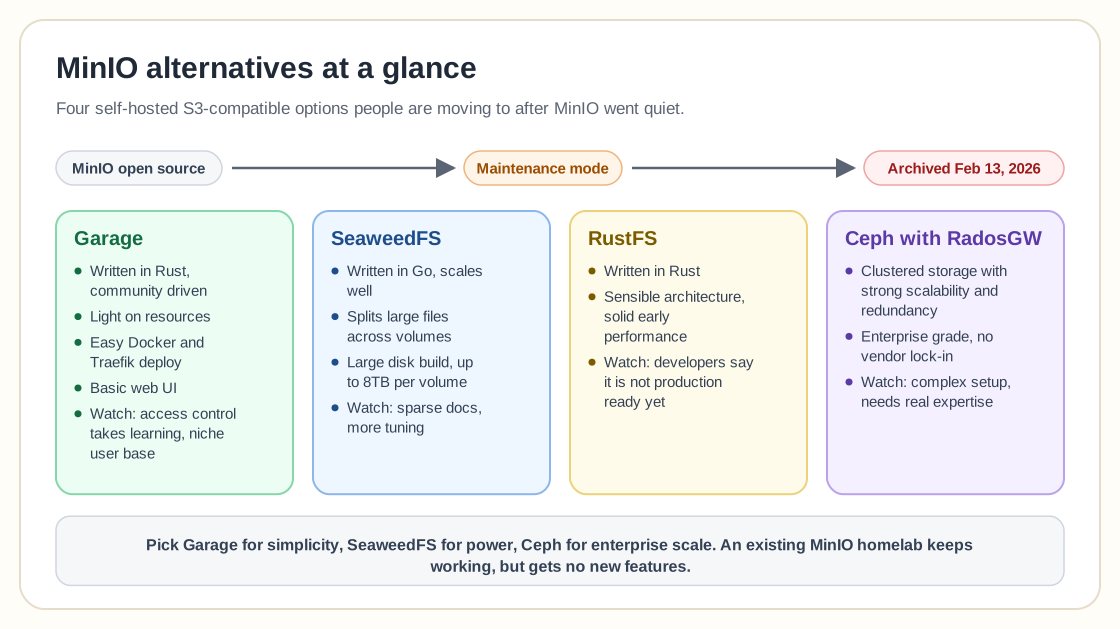
If you're still running MinIO in your homelab and it does what you need, there's no need to panic. It hasn't suddenly stopped working. Understand, though, that it's now a dead end for the open-source community, with no new features, questionable security fixes, and a future locked behind a commercial paywall.
For new deployments, or if you're planning for the long term, it's time to move on. Whether you pick Garage for its simplicity, SeaweedFS for its power, or Ceph for its enterprise scale, the takeaway is the same: own your stack, keep your options open, and remember that the best part of self-hosting is the freedom more than the tech.
MinIO's story is still unfolding, but its community has already started writing the next chapter, and from what we're seeing, it might be a better one: lighter, faster, and more open. People have stopped asking "what happened to MinIO?" and started asking what we're building next.