

Which risks are acceptable to share?
Several business teams may share the Kubernetes API, control-plane availability, worker nodes, cluster administrators, admission controllers, CRDs, container networking, storage systems, Ingress/Gateway infrastructure, monitoring and backup platforms. Namespaces, RBAC, quotas, NetworkPolicies, Pod Security controls and workload identity can reduce unwanted access, but they do not automatically make one cluster equivalent to several separate environments.
Plan around which risks these teams can accept sharing, rather than how many teams fit in one cluster.
Soft multi-tenancy versus hard multi-tenancy
Namespaces alone are rarely sufficient for hostile-tenant isolation.
Namespace-based tenancy, and what it doesn't isolate
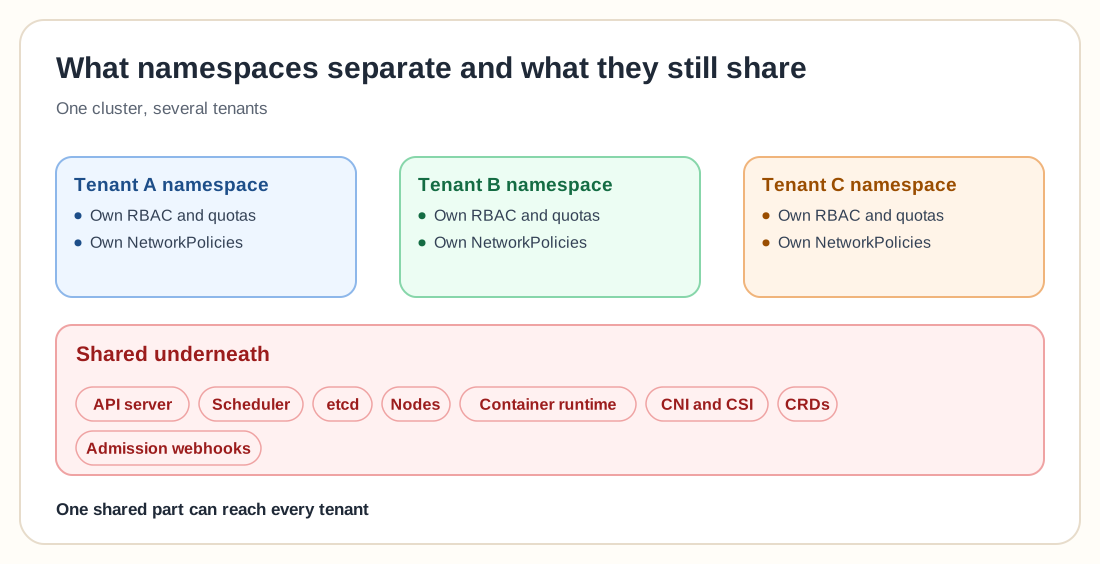
Namespaces divide cluster resources between multiple users and provide a scope for RBAC Roles, NetworkPolicies, ResourceQuotas, LimitRanges and Pod Security Admission labels. Kubernetes namespaces cannot be nested.
A namespace is an organizational and policy boundary and does not have a separate control plane. Tenants in different namespaces may still share the API server, scheduler, etcd, nodes, the container runtime, CNI/CSI, cluster-scoped resources, ClusterRoles, CRDs and admission webhooks. A failure or privileged change in one shared component may affect every namespace.
Identity, RBAC and network isolation
Every tenant should have named identities and groups rather than access granted directly to individuals. Kubernetes RBAC regulates API access using Roles, ClusterRoles, RoleBindings and ClusterRoleBindings. Least privilege matters because some namespaced permissions still lead to broad access: creating Pods, reading Secrets, or mounting arbitrary PVCs can expose more than the resource name suggests.
Network isolation
NetworkPolicy controls how selected Pods may communicate when the CNI implementation enforces it. A common tenant baseline is default-deny ingress and egress with explicit rules for DNS, database and monitoring access.
Compute isolation: quotas, priority and node pools
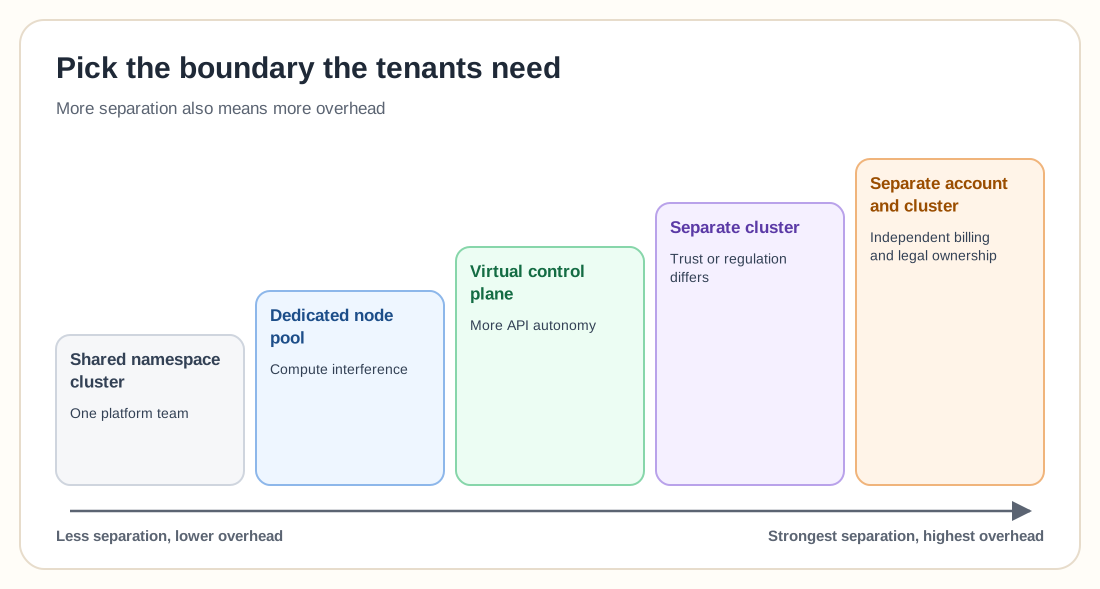
A ResourceQuota limits aggregate consumption or object counts within a namespace, but it does not reserve capacity. It sets a maximum and does not guarantee the cluster has enough free capacity for the tenant to use the full amount. For guaranteed capacity, evaluate dedicated node pools, minimum node counts, or a separate cluster.
Storage and Secret tenancy
A PVC is namespaced, but that boundary can't correct an insecure external storage configuration. Broad Pod-creation permissions in another namespace, shared storage credentials, or reused encryption keys can all bypass it. Use tenant-specific StorageClasses, buckets or prefixes, service identities and encryption keys for object storage.
Secrets are namespaced too, but tenant access still depends on RBAC and workload permissions. Protect Secret read access, Pod creation, debug containers and backup exports together as a single privilege surface.
Backup, monitoring and cost tenancy
A shared backup platform must define who creates policy, who can restore across namespaces, and who can restore Secrets. A tenant restore must never overwrite or expose another tenant's resources. Test same-namespace restore, alternate-namespace restore and replacement-cluster restore with tenant-specific credentials.
A shared monitoring system may expose logs, traces and infrastructure data across tenant boundaries, so define query isolation, retention and sensitive-data filtering. For cost, chargeback should include CPU/memory usage, storage, network transfer, load balancers and backup. Usage-only chargeback can undervalue capacity reserved for one tenant but left idle for availability.
Choosing the isolation boundary
Disaster recovery for shared clusters
A shared-cluster recovery must consider all tenants, because they do not all return at once. Classify platform services, critical customer applications, important business workloads and disposable environments into recovery tiers, then plan minimum node count and critical-tenant quota for the recovery environment, since it may not initially match production capacity.
Common multi-tenant Kubernetes mistakes
Tenants still share the control plane, nodes, kernel, CRDs and platform services. Use layered isolation or separate clusters.
One tenant can affect every workload. Use namespaced RBAC.
A quota does not reserve compute. Maintain enough cluster capacity to back it.
The selected CNI may not enforce every expected behavior. Test the implementation.
Unrelated applications inherit the same permissions. Use workload-specific identities.
One namespace may access another tenant's data. Use tenant-specific identities and buckets or prefixes.
The recovery cluster may run out of capacity. Use recovery priorities.
Shared services, reservations, storage and backup remain unaccounted. Use a complete cost model.
Multi-tenant Kubernetes checklist
0 / 24Frequently asked questions
It is a Kubernetes operating model where several teams, applications, customers, or environments share some combination of the control plane, worker nodes, and platform services.
Namespaces provide useful policy and organizational scope, but they are not complete hard-security boundaries because tenants may still share nodes, the control plane, CRDs, and cluster-wide services.
No. Kubernetes namespaces cannot be nested.
Normally no. Cluster-admin can affect the entire cluster and every tenant.
It limits aggregate resource consumption or object counts within a namespace.
No. It defines a maximum but does not guarantee that the cluster has free capacity available.
It defines allowed network communication for selected Pods when the CNI implementation supports and enforces NetworkPolicy.
No. Enforcement depends on the CNI and the exact traffic path. Test the selected networking implementation.
No. They improve compute and kernel separation, but tenants may still share the Kubernetes control plane and cluster-wide services.
Use controlled, platform-approved classes. Unrestricted priority can allow one tenant to disrupt another.
Use separate clusters when administrator trust, compliance, upgrade timing, security policy, blast radius, cluster-scoped customization, or recovery ownership must differ.
Test RBAC, cross-namespace access, network isolation, quotas, noisy-neighbor behavior, node separation, backup restoration, incident quarantine, and replacement-cluster recovery.
Share only the risks the business accepts
Multi-tenant Kubernetes can provide an efficient platform for several business teams. Namespaces, RBAC, NetworkPolicies, quotas, LimitRanges, Pod Security controls, workload identities and dedicated node pools create useful separation, but they don't erase the shared control plane, cluster administrators, nodes, storage or upgrade lifecycle.
Classify tenant trust, identify every shared failure domain, restrict namespaced and cluster-scoped permissions, control networking and cloud identity, separate sensitive storage and backup access, and allocate shared costs transparently. Use dedicated nodes where compute separation is sufficient, and separate clusters where administrative, regulatory or blast-radius separation is required. Share the platform only where the shared risk stays acceptable, measurable and recoverable.