

Veeam Immutable Backups: How Much Should You Trust Them?
Veeam immutable backups deserve substantial trust as one layer of ransomware recovery, though treating them as an invincible final copy goes too far. A hardened repository can make backup files resistant to deletion or modification for as long as the configured retention lasts, yet the repository host, management plane, encryption information, and operational recovery process still need protection.
That tension was at the center of a thoughtful administrator discussion. The environment used a Veeam hardened repository with single use credentials and SSH disabled after setup. The administrator had followed the hardening guidance and still kept one last defensive layer on tape. The administrator wanted to know how much confidence an operator should really place in online immutability after doing the hardening correctly.
What does a Veeam hardened repository actually protect?
A Veeam hardened repository is designed to prevent backup files from being moved, modified, or deleted while a configured immutability period is in effect. Veeam's current documentation also describes single use credentials that are used during deployment and are not stored in the Veeam Backup & Replication configuration database.
Those controls matter. If an attacker compromises the normal Veeam management server, the design is intended to prevent that attacker from simply retrieving the original Linux onboarding credentials and logging into the repository as though it were an ordinary managed server.
The repository also has dedicated Veeam services that manage immutability. Current documentation describes an immutability service with root permissions running as a controlled child process and includes timeshift detection, which matters because manipulating system time is an obvious way an attacker might try to shorten a retention boundary.
This is a much stronger design than placing backups on a general purpose file server with the same administrative credentials used everywhere else, although a stronger design is still not magic.
Mr.PlanB's PBS offline backup guide reaches a similar conclusion from another platform. Immutability helps, but disconnected or independently controlled copies still matter when the threat model includes compromise of the management plane itself.
Why were some administrators still skeptical?
The skeptical side focused on a basic systems principle: if software and hardware remain online, there is still some management path controlling them. One participant argued that Veeam ultimately has services that set and remove immutability attributes as retention expires, so a vulnerability in that control path could theoretically matter.
Another commenter made the point more carefully. The Veeam Backup & Replication server is a management plane. It has to communicate with data mover services, distribute software updates, and tell infrastructure components what to do. That does not prove an existing exploit can bypass hardened repository immutability. It does explain why an administrator should not convert a security feature into a guarantee that no future management plane vulnerability could ever affect it.
The discussion also included speculation about hypothetical attack techniques, and those ideas should not be repeated as known vulnerabilities. What I take from it is architectural: reduce unnecessary management paths, patch the components that remain, and assume every online control plane deserves scrutiny.
Veeam's own security guidance makes a related point. It warns that an immutable filesystem is not sufficient if an attacker can wipe or reconfigure the system at a lower level. Hardware management interfaces, storage administration layers, remote consoles, and privileged accounts still belong in the threat model.
Does disabling SSH and iDRAC solve the problem?
Removing unnecessary access paths improves the design, although the repository still depends on other systems. The administrator who started the discussion had deliberately disabled SSH and other management interfaces, which is a sensible hardening move when those interfaces are not needed for daily operation.
The harder question is what remains. The repository still needs power, networking, Veeam service communication, software maintenance, timekeeping, storage hardware, and a method for authorized recovery administration. Each dependency should be understood and restricted.
For physical servers, out of band management can be both a recovery tool and a security risk. Completely disabling it may increase isolation, but it can also make hardware recovery slower. Keeping it on a separate management network with strong authentication may be a better operational tradeoff in some environments.
There is no universal configuration that makes every compromise path disappear. The goal is to make destructive access require crossing several independent boundaries.
Why did tape keep coming up in the discussion?
Tape changes the trust model because an ejected cartridge is no longer reachable through the production network. Several participants therefore described offline tape rotation as the copy they trusted most.
That position also received pushback. One commenter argued that humans can lose, damage, mishandle, or fail to rotate tapes, while a properly designed immutable service may be more reliable in practice. That is a fair criticism. Offline media is only useful if the organization actually writes it, ejects it, stores it safely, tracks retention, and tests restores.
A fair comparison weighs how tape and online storage are each actually operated, flaws included.
For environments without tape, removable storage, a second secured site, or object storage with independent retention controls may provide another layer. The Proxmox backup strategy guide covers several of these architectural choices. The specific technology matters less than the independence between copies.
Why can immutable backup data still be unusable during recovery?
Backup files alone are not always enough to produce a clean recovery. One incident responder in the discussion described a ransomware case where immutable cloud backups survived, but the Veeam data and configuration needed around them had not been protected independently. The recovery became far more difficult, and the team was fortunate to find surviving storage snapshots.
That story is more useful than any abstract argument about whether immutability is absolute. A backup can remain intact while the organization loses the information, keys, configuration, or procedures needed to use it efficiently.
Protect the Veeam configuration backup separately. Record encryption passwords in an approved secure system. Document repository locations and import procedures. Keep enough infrastructure documentation to rebuild the backup server if the existing control plane cannot be trusted.
Then test that process, because a recovery design that has never been exercised is still partly theoretical.
How should Veeam immutability fit into a layered backup design?
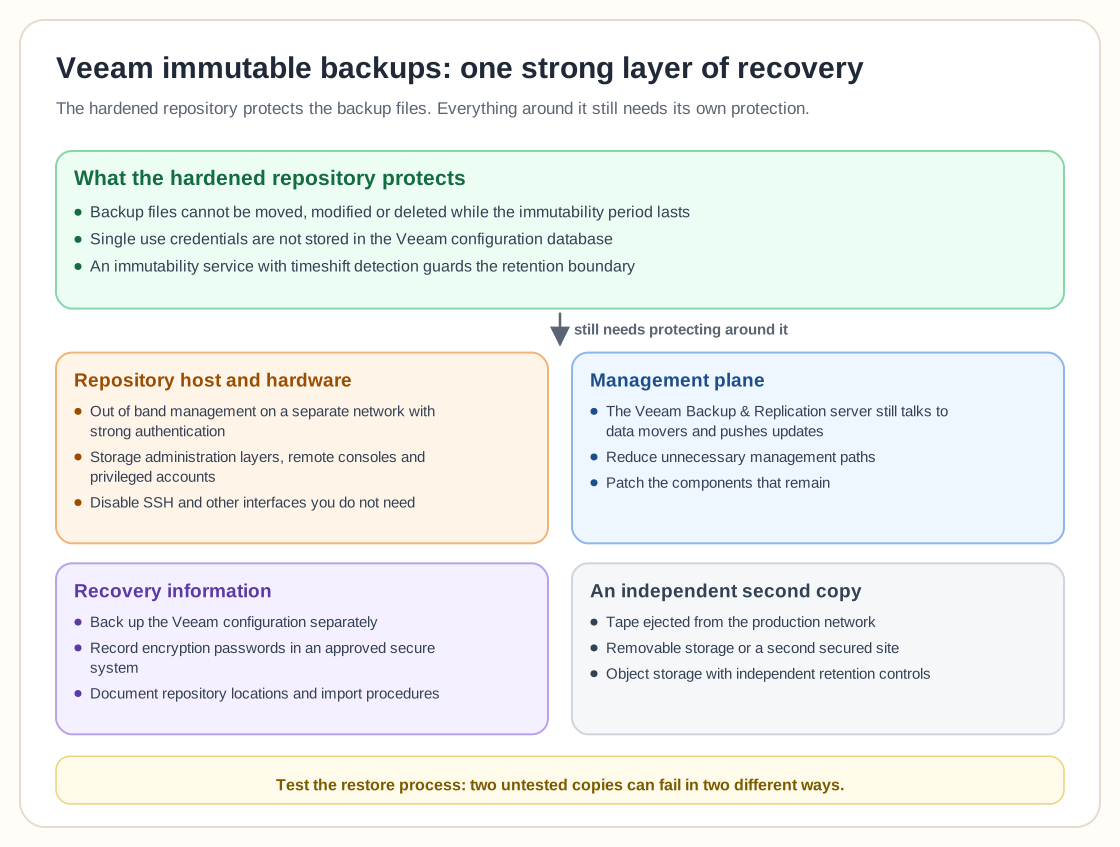
Use the hardened repository as one strong layer, then create separation around it. Keep production administration separate from backup administration. Restrict low level storage and hardware management. Maintain an independent configuration backup. Add a second copy whose control plane or physical state is independent from the primary Veeam environment.
The exact combination depends on risk and budget. A small business may use a local hardened repository plus rotated removable media. A larger organization may combine a hardened repository, immutable object storage, a second site, and tape. The same separation principle applies to both.
Do not use redundancy as an excuse to skip restore testing, since two untested copies can fail in two different ways.
What would I trust after reading the administrator debate?
I would trust Veeam hardened repository immutability as a serious security control. I would not trust it as the only thing standing between a ransomware incident and permanent data loss.
The most credible position in the discussion sits between the extremes. Calling every online immutable system worthless ignores the protections it actually provides. Calling any immutable system impossible to defeat ignores the rest of the management and hardware stack.
Build so that one mistake, one compromised credential, one future vulnerability, or one failed storage system cannot remove every recovery path. Immutability earns trust as part of that design and loses it when it is asked to replace the design.
Frequently Asked Questions
Are Veeam hardened repository backups really immutable?
Veeam documents that backup files on a hardened repository cannot be moved, modified, or deleted during the configured immutability period. The design is a strong control, but administrators still need to protect the repository host, management plane, credentials, and recovery configuration.
Does a Veeam hardened repository eliminate the need for offline backups?
No single repository should be the only recovery path for critical data. The administrator discussion strongly favored keeping an independent copy such as tape, especially for organizations worried about ransomware reaching online management layers.
What else must be backed up besides Veeam backup files?
Protect the Veeam configuration and the information required to decrypt and import backups. One incident responder described a case where immutable backup data existed but recovery became difficult because the surrounding Veeam configuration was not independently protected.