

VDI Alternatives After Citrix and VMware Price Changes
VDI customers frustrated by Citrix or VMware related pricing should pilot at least one VDI alternative before their next renewal, but they should not assume every alternative is cheaper once infrastructure and operations are counted. In 2026 the practical shortlist starts with Azure Virtual Desktop for Microsoft heavy environments, Omnissa Horizon for teams that still value the Horizon operating model, and smaller app delivery platforms when simplicity matters more than feature parity.
I reviewed the current community discussion that triggered this question, Microsoft licensing documentation, and Omnissa's 2026 Horizon direction. The public evidence shows real migrations and active evaluation, but it does not justify claiming that most Citrix or Horizon customers have already left.
Are companies actually switching VDI platforms in 2026?
Yes, some organizations are clearly switching, but public reports are a signal rather than a statistically reliable market share study. That difference matters because migration stories tend to come from customers with a strong reason to speak up.
The current Spiceworks discussion is worth reading because the question is operational: has anyone actually moved after pricing changes, and where did they go? Similar community reports describe environments removing Citrix after renewal economics stopped making sense, while software review sites contain individual examples of customers moving away from Horizon because they wanted less platform uncertainty.
What I take from it is that VDI teams no longer treat the incumbent as permanent infrastructure and are putting the delivery layer back into competition.
The mistake would be turning that into "everyone is leaving." Large VDI estates have application packaging, profile management, identity, graphics, printing, endpoint, security, and support dependencies that make a platform change expensive. A renewal increase can justify a pilot without automatically justifying a migration.
If you are also reevaluating the hypervisor below VDI, the questions overlap with the broader virtualization comparisons. The desktop broker and the hypervisor can be separate decisions, and 2026 finally gives more teams enough options to treat them that way.
Is VMware Horizon still a Broadcom product?
No, Horizon is now an Omnissa product. Broadcom acquired VMware, but the End User Computing business that included Horizon later became Omnissa under separate ownership.
The distinction matters because people still use "VMware Horizon" as shorthand. Your Horizon renewal, roadmap, and support relationship are now tied to Omnissa. Your underlying vSphere licensing can still be tied to Broadcom if Horizon runs on VMware infrastructure.
Omnissa has been actively widening that separation. Horizon 8 support for Nutanix AHV reached general availability, giving organizations a way to keep Horizon while changing the virtualization layer underneath it. Omnissa also says its current Horizon packaging can be purchased without VMware vSphere Foundation for VDI in some offerings, which directly addresses the complaint that a VDI decision should not force one hypervisor choice.
This creates a middle path that did not look as clean a few years ago. You can ask whether Horizon is still the right broker without assuming vSphere must stay, and you can ask whether vSphere should stay without forcing a desktop migration at the same time.
For teams already studying VMware replacement skills, this is similar to the learning curve discussed in the move from VMware to Proxmox. The hardest part is often translating operating habits, which takes longer than matching one logo to another.
Which VDI alternatives are realistic now?
The realistic VDI alternatives in 2026 fall into different operating models, so I would shortlist by architecture before comparing feature checkboxes. A product that is excellent for cloud hosted Windows desktops can be the wrong answer for an on premises application publishing estate.
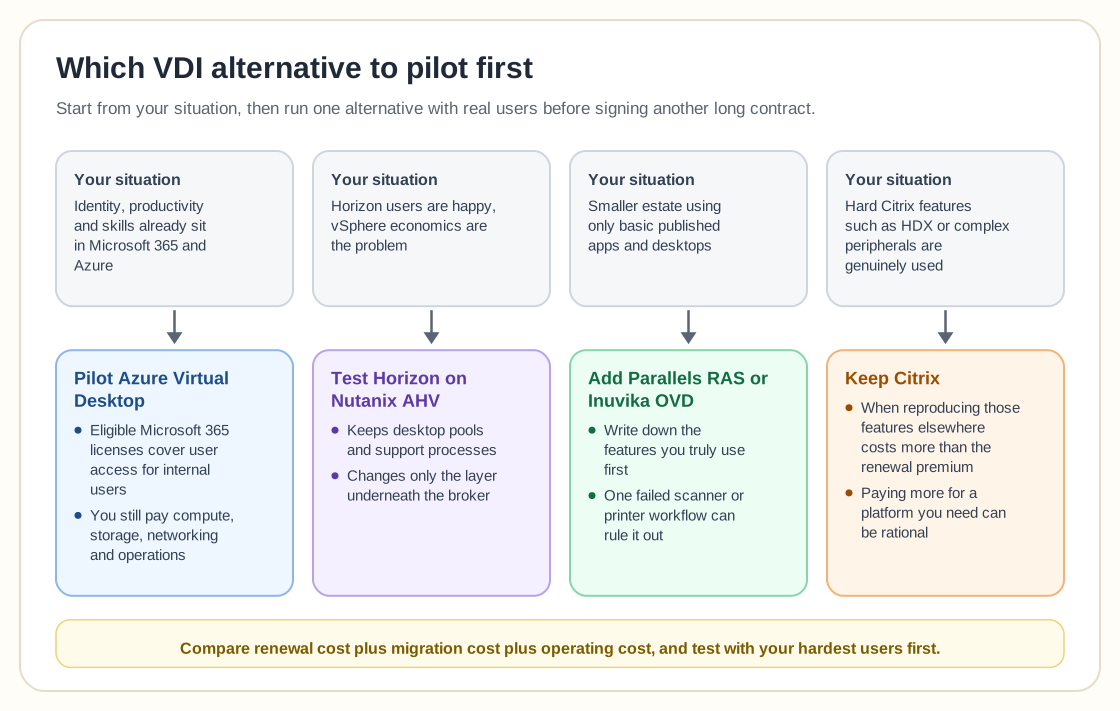
Azure Virtual Desktop is the obvious first test for organizations already deep in Microsoft 365 and Azure. Microsoft documents that licenses including Microsoft 365 E3, E5, F3, Business Premium, and several Windows Enterprise plans provide Azure Virtual Desktop access rights for internal commercial use. That does not make AVD free. You still pay for Azure compute, storage, networking, supporting services, and the people who operate the environment.
Omnissa Horizon remains a strong option when your team already knows Horizon, depends on Blast, App Volumes, or established desktop workflows, and wants to change infrastructure without changing the user delivery model. The ability to run Horizon on Nutanix AHV is especially relevant to organizations trying to reduce vSphere dependency.
Citrix remains a valid answer too. A customer angry about one Citrix renewal can still discover that Citrix is the best technical fit for complex application delivery, especially where HDX behavior, mature policy control, or difficult peripheral requirements matter. The comparison that counts is renewal cost plus migration cost plus operating cost. Holding the renewal up against a competitor's list price tells you very little.
Smaller platforms such as Parallels RAS and Inuvika OVD can be attractive when you do not need every enterprise feature in Citrix or Horizon. I would put them into a pilot only after writing down the features you truly use today. Smaller licensing bills do not help if the replacement fails one essential healthcare scanner, CAD workload, smart card workflow, or branch printing requirement.
When is Azure Virtual Desktop the best first pilot?
Azure Virtual Desktop is the best first pilot when your identity, productivity stack, and operational skills already sit in Microsoft 365 and Azure. In that environment you are testing a platform adjacent to systems your team already manages rather than introducing a completely new vendor stack.
The licensing position is also easy to explain to finance. Eligible Microsoft 365 and Windows licenses can cover the user access right for internal users, while Azure infrastructure remains consumption based. That separates the user entitlement from the actual cost of running session hosts.
Where AVD gets less simple is operations. You still need profile design, image lifecycle, application packaging, host pool scaling, monitoring, storage performance, identity controls, disaster recovery, and cost governance. Moving from Citrix to AVD can reduce one vendor bill while increasing the amount of engineering you own.
I would test AVD with your hardest users first. Do not start with ten office workers who only open a browser and Outlook. Start with the user who has six monitors, the finance application with an old printer driver, the call center headset, the developer who needs local USB behavior, and the remote site with poor latency. Easy users rarely expose VDI architecture mistakes.
When does keeping Horizon make more sense than replacing it?
Keeping Horizon makes sense when the broker and user experience are working and the problem is the cost or direction of the underlying VMware infrastructure. Horizon on Nutanix AHV gives that customer a meaningful alternative because it separates desktop delivery from vSphere.
That can be cheaper operationally than changing two layers at once. Your team keeps familiar desktop pools, application delivery concepts, and support processes while learning a new infrastructure platform underneath.
It also gives procurement a better negotiating position. If your Horizon architecture no longer requires one hypervisor, the renewal discussion changes from "what will this stack cost?" to "which capacity platform earns the workload?"
I would still test the AHV path with production shaped workloads. VDI is sensitive to storage latency, boot storms, profile behavior, graphics, and image operations. A supported architecture only means the evaluation can start.
How should I compare VDI platforms without getting fooled by license price?
Compare VDI platforms using cost per delivered user experience rather than cost per license. A cheap broker on expensive cloud capacity can lose to an expensive broker on infrastructure you already own.
For a pilot, I would capture at least these numbers:
- Login time from credential entry to usable desktop.
- Profile load and write behavior during morning concurrency.
- Session host density for your real application mix.
- CPU and memory headroom during Teams or Zoom calls.
- Storage latency during boot and application launch bursts.
- GPU allocation and performance for graphics users.
- Help desk incidents caused by printing, USB, audio, smart cards, or profile issues.
- Monthly infrastructure cost at normal load and peak load.
- Administrator hours spent on image maintenance, failures, and user support.
Then add migration cost. Application packaging, user profile migration, parallel operation, consulting, retraining, and project risk belong in the model. A platform that saves 25 percent per year but takes four years to repay the migration is not automatically a good move.
What would I choose after a bad Citrix or VMware renewal?
I would not sign another long contract until I had one alternative running with real users. A renewal deadline is negotiating leverage only if you have a technically credible exit.
For a Microsoft centered company, I would pilot Azure Virtual Desktop first. For a Horizon environment where users are happy but vSphere economics are the problem, I would test Horizon on Nutanix AHV before replacing the broker. For a smaller estate that uses only basic published applications and desktops, I would include Parallels RAS or Inuvika OVD to see whether the enterprise platforms are simply more machinery than the business needs.
I would keep Citrix when its hard features are genuinely being used and the cost to reproduce them elsewhere exceeds the renewal premium. Paying more for a platform you need can be rational, while paying more because nobody tested an alternative is hard to justify.
Frequently Asked Questions
Are companies actually leaving Citrix and VMware Horizon in 2026?
Yes, there are public examples of organizations and reviewers reporting migrations, but the evidence is still anecdotal and does not prove a market wide exodus. The useful signal is that more teams are running replacement pilots before renewal dates.
Is VMware Horizon still owned by Broadcom?
No. The former VMware End User Computing business became Omnissa in 2024, so Horizon licensing and product strategy now sit with Omnissa. A Horizon deployment can still depend on Broadcom vSphere, but Omnissa also supports other capacity options, including Nutanix AHV.
Which VDI alternative is easiest for Microsoft 365 customers?
Azure Virtual Desktop is often the first platform to test because Microsoft 365 E3, E5, Business Premium and several other licenses include Azure Virtual Desktop access rights for internal users. You still pay compute, storage, networking, and operational costs.