

The VMware Exit Door Is Getting Crowded as Companies Eye Proxmox
A small event that says something bigger
Sometimes the biggest industry shifts show up in small, almost casual announcements.
A system administrator recently shared that they had migrated their company's infrastructure from VMware running on a SAN to a new stack built on Proxmox and Ceph. Now they're speaking at a small event in Belgium about how the migration actually worked in practice. The gathering is scheduled for April 23, 2026 at the Thomas More Campus in Geel, organized with support from Linux Belgium and the Mind community to help companies exploring VMware alternatives.
The Proxmox SAN Trap: Why Your VMware Migration Might Fail
On the surface, it's just another community meetup: three hours, some technical presentations, a Q&A, and snacks afterward. Look closer, though, and it points to something happening across the virtualization world. A growing number of organizations have moved past curiosity about VMware alternatives and are actively leaving, and the conversations around those migrations are getting more open.
The agenda that VMware admins actually want
The topic is only part of what makes this event interesting; the structure of the talk matters too. Instead of the usual marketing-heavy sessions about "digital transformation" or cloud strategies, the focus is deliberately practical. The presenters plan to walk through three things: why organizations are reassessing their virtualization stacks, how Proxmox actually works compared to vSphere, and a real migration case moving from VMware with SAN storage to Proxmox with Ceph.
That last part is where most of the value sits. Anyone who has ever migrated infrastructure knows that official documentation rarely covers the messy parts: the things that break, the architectural surprises, and the moments when a design that looked perfect on paper behaves differently in production.
One organizer described the presentation simply as architecture and lessons learned, with practical details instead of marketing slides and buzzwords. For many VMware administrators currently evaluating their options, that's exactly the information they want.
The catalyst: Broadcom's VMware shake-up
The background to all this interest is the Broadcom acquisition of VMware.
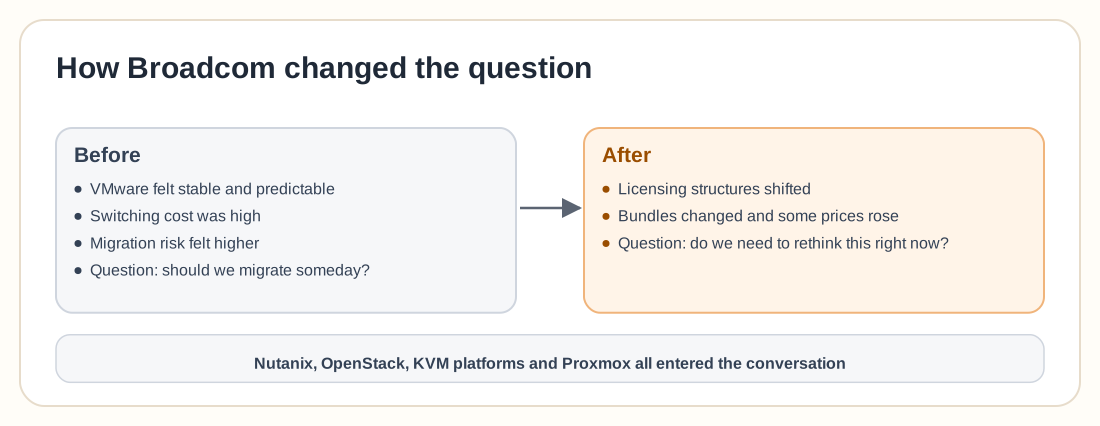
For years, VMware dominated enterprise virtualization with an ecosystem that felt stable, predictable, and deeply embedded in corporate infrastructure. Even companies that explored alternatives often stayed with VMware because the switching cost was high and the risk of migration felt even higher.
Broadcom's strategy changed that calculation almost overnight. Licensing structures shifted and bundles changed. Some organizations saw major price increases, and others discovered that products they relied on were being consolidated or repositioned. Suddenly the question went from "Should we migrate someday?" to "Do we need to rethink this right now?"
The result has been a surge of experimentation across the industry. Hyper-V, Nutanix, OpenStack, KVM-based platforms, and especially Proxmox have all entered the conversation in ways that rarely happened before, and in many companies that conversation is happening at the board level rather than inside the server room.
Why Proxmox is showing up in these conversations
Proxmox has existed for years, but historically it lived more in homelabs, smaller deployments, and open-source-friendly organizations than in traditional enterprise environments. That perception is starting to shift.
The platform combines several pieces that enterprises typically deploy separately: a virtualization layer built on KVM, container support with LXC, integrated clustering, built-in backup tools, and tight integration with Ceph for distributed storage. For organizations currently running VMware plus external SAN infrastructure, the idea of collapsing multiple layers into one platform is appealing.
In the migration story being presented at the Belgian event, that's exactly what happened: the environment moved from VMware backed by a SAN to Proxmox with Ceph providing distributed storage. A shift like that changes more than the hypervisor. It reshapes how storage, redundancy, and scaling work across the entire cluster, and for some companies that redesign is the hardest part of leaving VMware.
The migration question everyone is asking
One of the biggest fears around leaving VMware is downtime, more than the technology itself. Migration projects often involve dozens or hundreds of virtual machines, storage systems holding terabytes of data, and applications that business units depend on daily. Moving those workloads safely requires careful planning.
The upcoming presentation specifically promises to cover downtime planning, storage tradeoffs, and operational differences between the platforms, which is where real-world migrations get complicated.
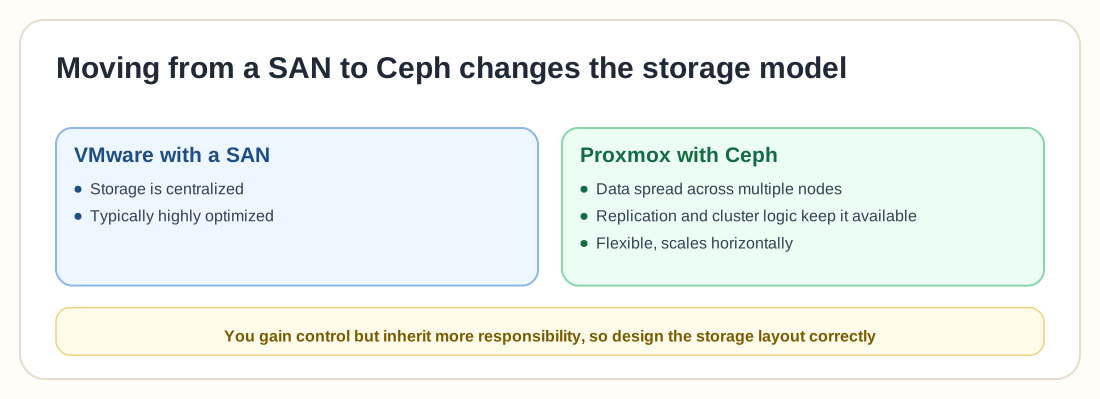
SAN-based architectures behave very differently from distributed storage systems like Ceph. In a SAN setup, storage is centralized and typically highly optimized. Ceph spreads data across multiple nodes, relying on replication and cluster logic to maintain availability. The benefit is flexibility and horizontal scaling, and the downside is that designing the storage layout correctly becomes critical.
Administrators who have already made the transition often describe the experience as both empowering and slightly terrifying. You gain enormous control, but you also inherit more responsibility for designing the underlying infrastructure.
Not everyone is convinced
Despite the growing interest in alternatives, plenty of engineers remain skeptical about large-scale VMware migrations.
One group argues that VMware still offers the most mature ecosystem in enterprise virtualization. Features like vMotion, distributed switching, advanced lifecycle management, and third-party integrations have been refined over many years. From this perspective, replacing VMware with a newer or less enterprise-focused platform introduces risk that organizations might underestimate.
Another group takes a more pragmatic view. They believe migrations make sense primarily for organizations with strong in-house infrastructure expertise. If a company lacks engineers comfortable managing distributed storage, networking design, and open-source tooling, switching platforms could create operational challenges.
A third perspective is becoming more common: hybrid strategies. Some companies are migrating only part of their workloads away from VMware while leaving critical or legacy systems on the platform. This approach reduces licensing exposure while avoiding a full infrastructure overhaul. So the industry is branching instead of moving in one direction.
The community side of infrastructure
Beyond the technical content, events like this Belgian meetup are interesting for their community element. Virtualization used to be dominated by vendor conferences and corporate training sessions. Today, much of the most practical knowledge spreads through community events, forums, and engineers sharing real experiences.
Attendees at this particular event will hear about architecture choices, operational differences, and cost changes after the Broadcom acquisition, then move into an open Q&A session. There's something refreshing about that format. Instead of polished vendor messaging, you get engineers asking the questions that actually matter: what broke during migration, how long downtime lasted, and what design decisions they would change if they started again. Sometimes those answers matter more than official documentation.
The global curiosity around VMware alternatives
Interest in the event reaches beyond Belgium. Some people asked whether the presentations could be streamed or recorded so they could watch remotely. Others said they had already registered because the topic is becoming increasingly relevant across Europe. The organizers hinted they might try recording the session for later sharing, though nothing was guaranteed.
That level of curiosity says a lot about where the industry is right now. For years, VMware migrations were rare. Most companies simply upgraded their clusters, renewed licenses, and carried on. Now engineers everywhere seem to be asking what it would actually look like to move somewhere else, and suddenly there are people who can answer.
A shift that's still in motion
It's too early to declare a mass exodus from VMware. The platform remains deeply embedded in thousands of organizations, and its technology stack is still among the most advanced in enterprise virtualization. Many companies will stay simply because the cost and risk of migration outweigh potential benefits.
Something has clearly changed, though. More administrators are experimenting with alternatives, more companies are running pilot clusters, and more infrastructure teams are asking questions they never needed to ask before. Events like the one in Belgium may seem small, but they are part of the early stages of a wider conversation across the industry, and those conversations often start small before turning into full-scale migrations.