

Oracle Linux vs VMware: What Enterprises Find When They Test OLVM
The first sign something was wrong was an invoice. No cluster had broken and no host had failed.
Somewhere inside a sprawling U.S. enterprise, 20,000 VMs deep, stretched across 1,500 hosts and stitched together by years of operational muscle memory, a price increase landed with a thud big enough to rattle the executive floor. This was no modest bump or inflation adjustment. It was a 300 percent increase, closer to a tectonic shift, triggered by Broadcom's now-infamous licensing overhaul of VMware's portfolio.
Teams who had spent their careers building around ESXi, vCenter, vSAN, NSX, and all the connective tissue that made VMware feel almost invisible suddenly found themselves running the math on a future they hadn't planned for. The directive from above was predictable: look for alternatives.
That's how Oracle Linux Virtualization Manager (OLVM) ended up in the lab. Nobody was particularly excited about it, but the company needed a contender that could slot into an environment this large without torching budgets or rewriting every operational playbook. And Oracle, for all the noise the company draws, knows how to position itself as the cheaper option when the market starts shaking.
Testing has a way of exposing things quickly, though. By the time the team got a realistic feel for OLVM, the mood had changed from hopeful to resigned. They saw cliffs where they had expected gaps, and they weren't alone.
Across the industry, IT teams that dipped a toe into Oracle's ecosystem kept saying the same thing: if you're leaving VMware purely to save money, Oracle is not the escape hatch you think it is.
What follows is what enterprises actually discover when they test Oracle Linux as a VMware replacement, and why the road away from VMware is anything but simple.
1. The price mirage
Whenever Oracle appears on the menu, the same warning shot gets fired from veterans in the field:
"That's cute you think you'll save money by switching to anything Oracle."
The line is sarcastic, but it comes from survival instinct. Oracle has a long history of offering attractive entry points only to layer in aggressive licensing, audits, and renewals that balloon the total cost of ownership. Many engineers have scars from RDBMS audits or have watched budgets implode when running Oracle workloads on non-Oracle platforms.
A few points came up repeatedly:
"Oracle won't be cheaper in the long run."
"If you want to talk about their licensing, make sure your house is in order first."
"Read the licensing stories before you even think about it."
Even Oracle employees, current and former, acknowledge the reputation exists for a reason.
So before enterprises even get to technical features, there's already suspicion that the numbers won't end in their favor. And at VMware scale, 20,000 VMs' worth, every unexpected line item hits like a headline.
2. Missing features hit hardest
For teams testing OLVM, the biggest shock comes from trying to map VMware features onto it, more than from the interface or the learning curve.
One engineer doing hands-on testing summed it up cleanly:
"Definitely not ideal… a TON of missing features compared to what we're already using."
Others echoed that OLVM feels familiar, "old-school vSphere-ish", but the similarity is only skin-deep. Once teams start comparing the actual tooling VMware has built over two decades, the cracks widen.
Issues people raised include:
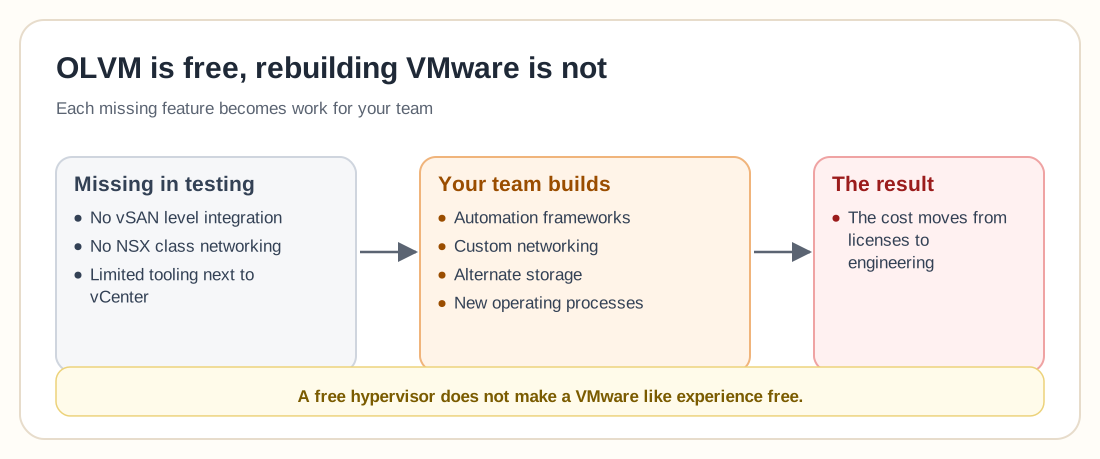
- No real equivalent to VMware's most mature stack
- No vSAN-level integration
- No NSX-class network virtualization
- No polished enterprise cloud management ecosystem
- Limited operational tooling compared to vCenter's ecosystem
The DIY tax
Every missing VMware feature has a cost: automation frameworks to rebuild, custom networking to design, alternate storage solutions to engineer, and operational processes to reinvent. OLVM is technically free, but building a VMware-like experience on top of it absolutely is not.
An engineer in the conversation captured it perfectly:
"They are either cheaper and less feature rich, which means you have to engineer those solutions yourself, or cheaper the first year to get you migrated and then tighten the cord."
That "tighten the cord" line comes up often when people talk about Oracle. And nobody wants to rebuild their entire virtualization strategy on a platform that may not stay stable, or affordable, over time.
3. Xen roots, mixed feelings
Oracle's hypervisor stack is built around KVM today, though some engineers still remember when its virtualization offering leaned on Xen. The memories aren't flattering.
One user put it bluntly:
"I played with Xen once and hated it. That was many years ago, so it's probably different now…"
Even if the underlying tech has modernized, impressions matter. Most engineers evaluating OLVM today grew up on VMware's hypervisor polish, and anything that feels like a regression can trigger doubts immediately, even if it's technically fine.
4. Oracle Linux: familiar but not the full story
A few more charitable voices in the field point out that Oracle Linux itself isn't the problem. In fact, it's often described as:
- "Red Hat compatible"
- "Easy to support"
- "Free support"
That's not the part enterprises are evaluating when escaping VMware, though. They're looking at OLVM as a hypervisor replacement, and once you step into the virtualization layer, the conversation changes entirely.
One engineer captured the disconnect clearly:
"When someone says Oracle Linux, I don't connect that with a hypervisor."
For many teams, the Oracle brand still maps to databases and enterprise applications. It doesn't map to a modern, feature-complete virtualization layer that can shoulder mission-critical workloads at massive scale.
5. Compatibility landmines start piling up
When you yank VMware out of a datacenter, you replace every tool that talks to ESXi along with ESXi itself: backup platforms, monitoring agents, automation scripts, network virtualization, storage policies, disaster recovery, capacity planning, cloud pipelines, and pretty much everything else.
One engineer put this reminder front and center:
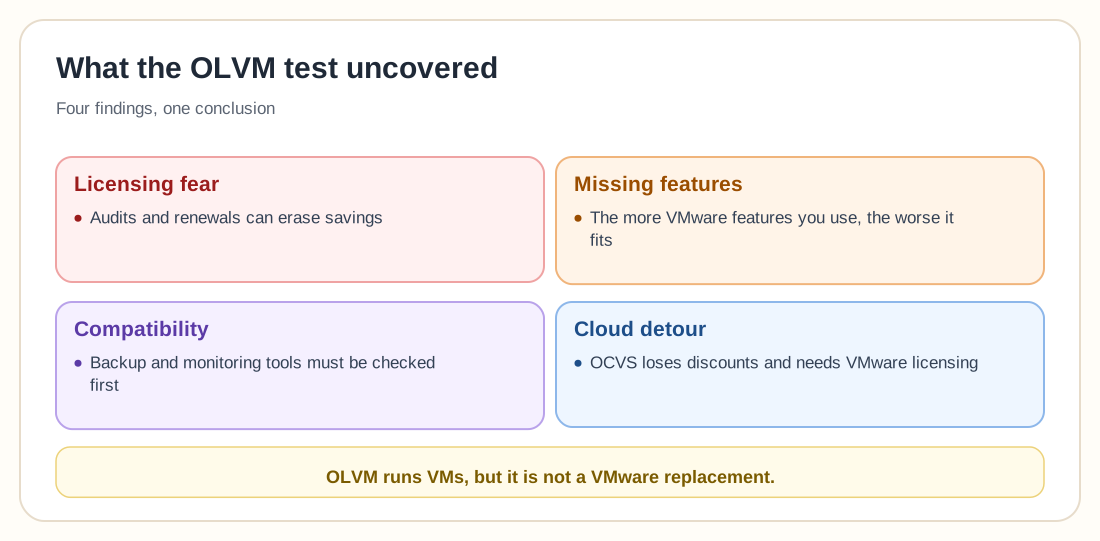
"Make sure anything else you use is compatible with your solution… your backup solution especially, or that could be additionally expensive."
For a 20,000-VM environment, "additionally expensive" becomes "astronomical" real fast.
OLVM struggles most here. VMware's ecosystem is massive, and it's been the default for so long that vendors build for it first and everything else second. Oracle's stack doesn't have anywhere close to that footprint.
6. The cloud detour doesn't help either
Some people testing Oracle's platform end up looking at Oracle Cloud VMware Solution (OCVS). It doesn't solve the feature gaps, but it's a familiar landing zone: VMware running on Oracle cloud hardware.
Even that path is shaky. Multiple engineers warned that OCVS is about to lose discounts and will soon require direct VMware licensing instead of bundled pricing. Combine that with slower storage performance, "dog slow and throttles like crazy", and OCVS stops looking like a strategic move and starts looking like a temporary escape pod with a leaky hull.
And none of it helps the team evaluating OLVM as an on-prem replacement anyway.
7. The culture shock
Then there's the human side. Some teams evaluating alternatives are also weighing Kubernetes-based platforms like OpenShift or KubeVirt as part of a broader modernization push. For the people who've been living in VMware land for a decade or more, the operational shift is often overwhelming.
One engineer described their trial bluntly:
"The k8s learning curve was pretty much the nail in the coffin."
Kubernetes is powerful, but it's a different universe. VMware admins who are used to clusters, hosts, and vCenters don't automatically map to pods, nodes, controllers, operators, and CRDs. For many of them the move amounts to learning a new profession.
OLVM doesn't fill that gap either. It feels familiar enough to lure teams in but isn't capable enough to replace what they already have.
8. The bottom line: OLVM is not VMware
When you zoom out across everything enterprises discover during testing, the pattern is consistent:
- OLVM can run VMs, but it's not a VMware replacement.
- It's familiar enough to give the illusion of similarity, but the feature set isn't there.
- Licensing fears remain a constant red flag.
- At scale, the operational debt outweighs any savings.
- The ecosystem simply isn't large enough.
- The more VMware features you use, the worse OLVM fits.
The most honest summary came from someone who's been through these evaluations before:
"If you're using a lot of VMware features, you'll be hard pressed finding an alternative at a considerably lower price."
And for those who tried OLVM specifically:
"Not ideal… definitely a lot missing."
9. So why does OLVM keep coming up?
Because the industry is desperate. Broadcom's licensing changes pushed thousands of organizations into panic mode. Budgets are getting rewritten, multi-year projections are being shredded, and VMware alternatives, no matter how incomplete, are suddenly getting trialed in labs they would've never stepped foot in before.
Oracle knows this, and so does every other vendor. Meanwhile every IT leader is being asked the same question by their CFO:
"What else can we use?"
For OLVM, the answer is becoming clearer. It's an option, but not a true replacement, at least for enterprises operating at VMware scale or anyone expecting parity.
What teams discover in testing is that VMware built two decades of deeply integrated infrastructure technology, and you can't replace that with something that only solves the hypervisor layer. That doesn't make OLVM bad. The features, the ecosystem, and the operations muscle memory all matter, and cost covers everything around licensing as well as the licenses themselves.
10. The outcome enterprises would rather not admit
Many enterprises aren't going to find a perfect alternative, at least not this year and maybe not next. VMware won the virtualization market so thoroughly that it became the market.
Switching is possible, but it requires trade-offs, compromises, retraining, new tooling, and a willingness to shed years of built-up VMware dependency. OLVM doesn't eliminate any of that. If anything, it amplifies it.
So when teams test Oracle Linux as a VMware replacement, they discover missing features and, along with them, just how much VMware has shaped the way they work. For many, the decision becomes less about fleeing VMware and more about choosing which kind of pain they'd prefer: paying Broadcom's new prices or rebuilding their virtualization universe from scratch.
For now, most teams evaluating Oracle Linux are coming to the same conclusion, which is that OLVM isn't the way out.