

Evaluating HPE Morpheus for VMware Exit Strategies
Why this question is coming up now
Many teams are now evaluating HPE Morpheus as a VMware alternative, and there's a lot of exhaustion behind that search. You can feel it in every late-night migration plan and every spreadsheet trying to make sense of rising virtualization costs. Teams that spent a decade building stable, predictable environments on VMware are suddenly staring at licensing changes, budget pressures, and a future that feels far less certain than it did a year ago.
So when Hewlett Packard Enterprise stepped in and positioned Morpheus as its KVM-based answer to the chaos, people paid attention, though attention is a long way from trust.
The original question floating around was simple. HPE bought Morpheus and is pitching it as their KVM solution. Lab testing looks okay, and support during setup has been solid. But does anyone have real production experience?
One of the most grounded responses cut straight to the point: before you even think about jumping, build a brutally granular checklist of what you actually need out of your virtualization stack, with real questions instead of vague "enterprise-grade" talk. Do you need vMotion-level mobility? High availability that just works when hardware fails at 3AM? Replication with change block tracking? Archival workflows that won't implode under compliance audits? Monitoring integrations that match your current stack? Vendor support for the virtual appliances you're already running?
That advice doesn't sound flashy. It sounds like someone who's been burned before.
Then came the line that stuck: if this were a non-critical function, "say running a car wash", sure, it might be worth trying. In serious production IT, not yet. That's where the dividing line sits right now, with curiosity on one side and conscience on the other.
Trust gap: HPE history and operator skepticism
There's also the elephant in the room, which is HPE's track record. More than one person didn't hold back. One blunt take described HPE as "great at transforming everything it touches into something worse." That goes well past mild skepticism into institutional scar tissue.
The Aruba story keeps coming up in conversations. People once assumed HPE wouldn't dismantle Aruba's identity or direction and believed it was safe. Then product lines and messaging shifted, and some users felt they'd lost something that once felt stable and distinct. That memory lingers, and memory matters in IT.
When you're choosing a hypervisor or virtualization management platform, you're making a bet that lasts years. You're committing to retraining staff, rewriting automation, redoing backup strategies, and changing how disaster recovery works. Swapping out a monitoring tool is minor by comparison; this is open-heart surgery on your infrastructure.
Product maturity vs production readiness
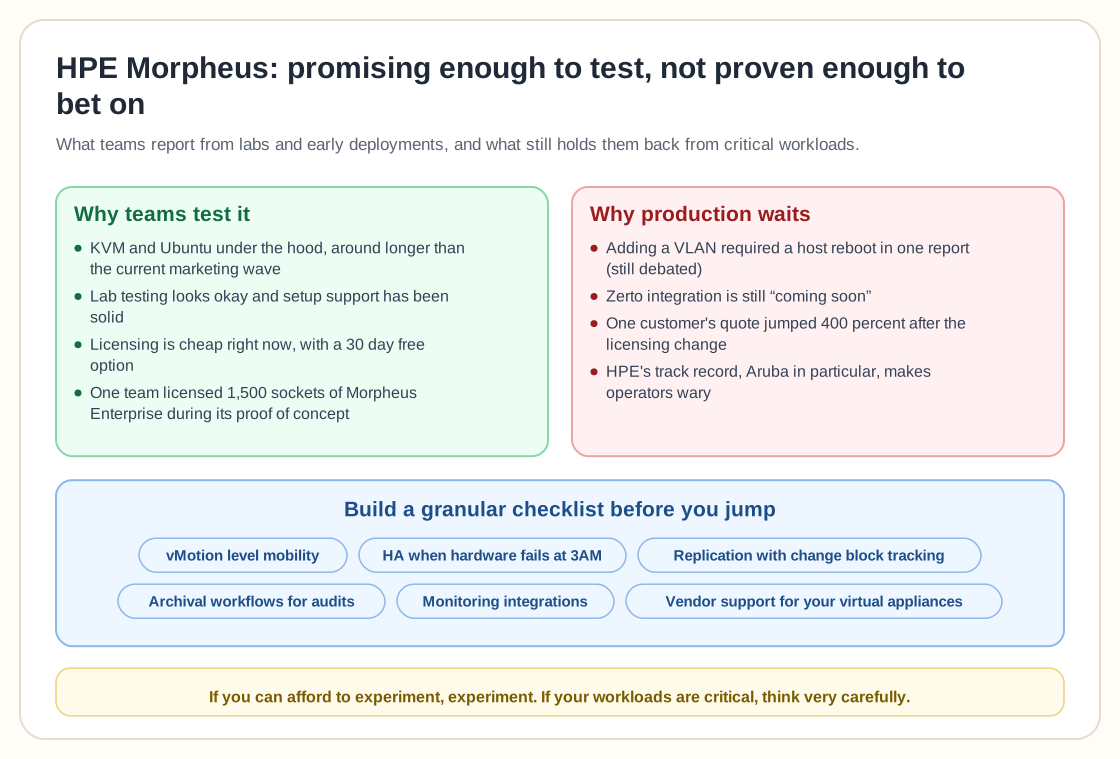
On the technical side, Morpheus isn't some overnight project. Under the hood, it's KVM and Ubuntu, and it's been around longer than this latest marketing wave suggests. But what HPE is selling now, VM Essentials and Morpheus Enterprise, feels new in the ways that matter: new positioning, new licensing, new expectations. And "new" is risky.
Some early deployments in non-critical environments are cautiously optimistic: a few Windows Server VMs here, a test cluster there. Licensing is cheap right now, and there's even a 30-day free option. In a world where VMware invoices can induce mild cardiac events, "insanely cheap" gets attention. Cheap only feels good until something breaks, though.
One complaint stood out: adding a VLAN required a host reboot. Even the suggestion of that happening in production made people wince. Whether that's a configuration misunderstanding or an actual limitation, the fear is telling, because nobody wants to discover an architectural gotcha after go-live.
There's back-and-forth about that specific issue. Some argue it's confusion around management bonds versus Open vSwitch VLAN handling. Others flatly say if you had to reboot, you were doing something wrong. That debate alone says a lot about how the platform's nuances aren't yet second nature. VMware's quirks are known, documented, blogged about and dissected for years, while Morpheus still feels like it's in that early "figure it out together" phase, and that phase can be rough.
Zerto and the "coming soon" factor
Another thread in this conversation is Zerto. HPE owns it, and Zerto has a reputation for slick continuous data protection. If HPE integrates Zerto deeply into Morpheus, the story changes. Suddenly you're talking about cross-platform replication, maybe even hybrid setups where production stays on VMware but DR shifts to KVM to cut costs. That would be compelling and would open real options.
Right now, though, it's still "coming soon." Some users have been waiting for promised integrations since last year. Development priorities appear to have shifted toward VM Essentials, which leaves long-time Zerto watchers wondering whether timelines are sliding.
There's also licensing. One longtime Morpheus customer shared a sharp detail: after HPE acquired the company and changed the licensing model, their quote jumped by 400 percent. Four hundred is no rounding error; a number like that changes the relationship, and they're dropping the product entirely.
That's the risk of acquisitions. The technology might be fine, and the business model might be the problem.
Licensing shock and decision psychology
At the emotional core of all this, people are evaluating trust along with features.
VMware, for all its pricing drama, built years of muscle memory. Admins know how HA behaves under pressure and what happens during a host failure. They've tested upgrades, rolled back patches, and debugged edge cases, and there's comfort in that familiarity. Morpheus doesn't have that yet for most of these teams.
Even the ones running proof-of-concepts talk in cautious tones. "Great potential." "Long way to go." "Not ready for critical workloads." I'd read that as guarded optimism, and optimism in infrastructure only goes so far.
What's fascinating is how split the reactions are, with deep cynicism about HPE on one side and pragmatic hope on the other. Some point out that HPE absolutely has the resources to build something strong, and they've done it before in other areas. What people doubt is execution, and execution is everything.
Virtualization isn't glamorous or a consumer product, and nobody gets applause for picking a hypervisor. If you pick wrong, though, you will absolutely hear about it, loudly and at inconvenient times.
There's also the timing factor. VM Essentials was released relatively recently, and migrating an entire infrastructure to something that fresh feels reckless to some teams. The cautious approach is clear: test in labs, deploy in non-critical environments, watch a few release cycles go by, and see if 8.1 actually smooths out the rough edges people are talking about.
One team mentioned already licensing 1,500 sockets of Morpheus Enterprise during their proof-of-concept, which is serious evaluation and well beyond dabbling. They believe updates are addressing pain points, which suggests HPE is iterating quickly. Still, iteration under enterprise load is different from iteration in a lab.
The psychological layer matters here too. A lot of teams are running away from something else more than they're running toward Morpheus. When migration decisions are driven by frustration, especially pricing frustration, it's easy to underestimate the gravity of the leap.
Escaping VMware's new cost structure might feel urgent. But trading a mature ecosystem for a platform still proving itself could create a different kind of stress, one that doesn't show up on a budget spreadsheet but absolutely shows up in uptime metrics.
One comment in this whole debate sums it up best without trying to be dramatic: if you can afford to experiment, experiment. If your workloads are critical, think very carefully. That's the mood right now, with little hype or blind loyalty and a lot of careful calculation.
Bottom line
Morpheus might evolve into a real contender. KVM is powerful, Ubuntu is stable, and Zerto integration could change the picture if it's done right. HPE has the scale and engineering talent to pull this off.
Marketing decks won't build the trust, though. That comes when an admin adds a VLAN and doesn't hold their breath, when a replication job works flawlessly during a real outage, and when licensing doesn't spike overnight after an acquisition.
Right now, Morpheus sits in an uncomfortable middle ground: promising enough to test, not proven enough to bet the farm on. That tension is what drives this whole conversation.
IT teams shopping for a new hypervisor are really trying to avoid regret. They've already seen what happens when pricing shifts, when product directions change, and when acquisitions rewrite roadmaps. So they're asking a better question than "does it work in the lab?" They want to know "will it hold up when everything's on fire?", which is a much harder test.
Until Morpheus passes that test in the wild, loudly, repeatedly, and without caveats, the hesitation comes from experience.